

Maestro del Billar presents ▶ Backward Counter-Spin System, for playing LLK caroms with backward counter-spin in three-cushion billiards.
This time we present the technique and the system for backward counter-spin, which is little known but key to playing this type of carom.
We will see how to use the classic system reference, how to calculate the hit thickness, and the execution technique.
Backward Counter-Spin System – Video
Join The Billiards Master
Access the PREMIUM content of Billiards Master, exclusive for MEMBERS:
✅Key #6: Exit Tangent
✅Key #5: Shot Line
✅Banana Shot: Complete System
✅Key #4: Parallels
✅Chat with Billiards Psychologist
✅Hair Ball Hit Technique
✅Key #3: Mirror Technique
✅Key #2: English
✅Key #1: Halves System
✅Ball Hit for Pass Ball
✅1 Cushion Method
✅Vertical Pass Ball System
✅Cross Table System
✅Master Halves System
✅Vertical Counter Effect System
✅Master Rotation: Systems & Technique
✅X-Ray Plus System
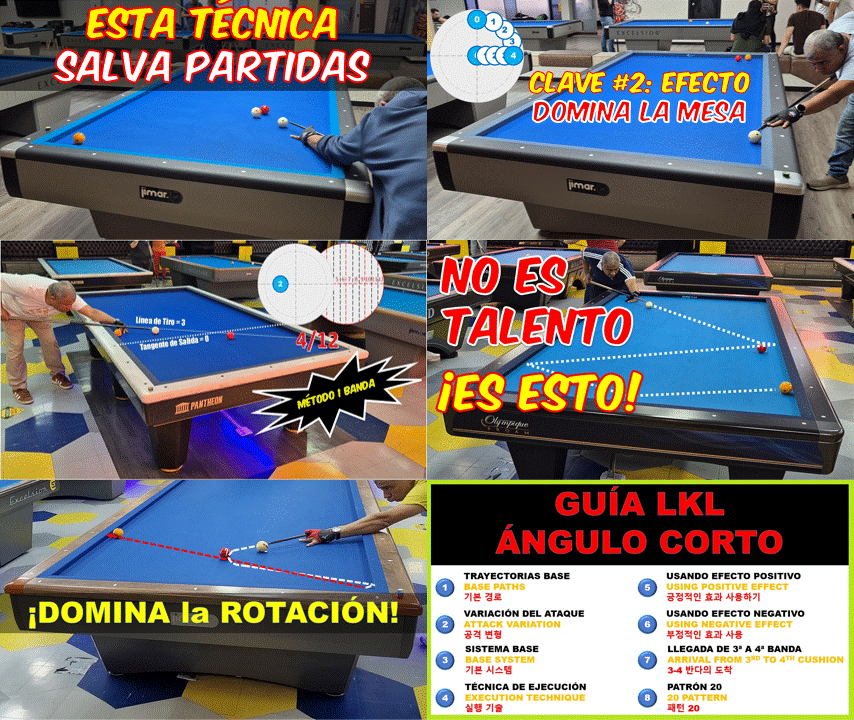
✅LKL Short Angle Guide
Backward Counter-Spin System – Classic System Reference
We will start by showing how to use the reference of the classic system.

The previous diagram shows part of the numbering for the departure, aim, and arrival rails of the very well-known classic system.
This time we will use the classic system reference to determine the arrival point on the second rail, which, according to the previous diagram, corresponds to the aim rail.
This concept will become clearer later. The important thing right now is that, starting from the classic system, we can determine the arrival point on the second rail so that our ball follows the path shown in the image.
Backward Counter-Spin System
Next, we present the backward counter-spin system, which will allow us to calculate the value of the hit thickness, measured in eighths of a ball, so that our ball goes to the arrival point on the second rail.
The spin is almost always the same; we will use maximum spin below the center of the ball, as shown in the following image.

The hit thickness, in eighths of a ball, is obtained by adding the angle value and the arrival value on the second rail.

The angle value corresponds to the inclination measured in diamonds between balls one and two.
Note that the zero value for arrival on the second rail corresponds to the position of ball two; in this case, it corresponds to the position of the red ball, as shown in the diagram.
In this example, we have an angle value of three diamonds and an arrival value on the second rail of one. Adding these values, three and one, we get a total value of four. So our hit thickness will be four eighths, which corresponds to half a ball.
Korean Systems for Three Cushion Billiards

Fernando Díaz presents a selection of Korean systems applied to 3-cushion billiards, the result of years of research, training and direct validation on the table.
Fernando Díaz is a multiple champion, coach of the main leagues in Colombia and recognized as one of the greatest billiards experts in Latin America.
Execution Technique
To complete the backward counter-spin system, we need to describe the execution technique.
The three main aspects of the execution technique for the backward counter-spin system are:

First: Use a tilted cue, raising the butt of the cue by approximately 10 centimeters. If we increase the tilt of the cue, our arrival value on the second rail will increase!
Second: It is suggested to move the grip forward, the hand holding the cue, the right hand for most players.
Third: Use a semi-penetrating stroke, almost a dry hit; this will favor the generation of maximum rotation.
UNIBILLAR: The Billiards University
Access a wide variety of digital billiards content.
Study at UNIBILLAR, the Billiards University, with the best instructors in Latin America.
José “Pepe” Hernandez, Pedro Gonzalez, Marco Vallejo, Fernando Diaz, Mauricio Gutierrez, Carlos Vallejo, Fernando Castillo “El Flaco Billarista”, Rafael Galeano.
