

Maestro del Billar presents ▶ How to play box shots and rolls of follow or semi-follow in three-cushion billiards.
In this post, we will look at the execution technique, and include a secret that can help you improve your execution.
We will also cover a very important concept called effect gain.
Finally, we will present 2 systems for playing follow or semi-follow caroms.
Box Shots and Follow Rolls
Join The Billiards Master
Access the PREMIUM content of Billiards Master, exclusive for MEMBERS:
✅Key #6: Exit Tangent
✅Key #5: Shot Line
✅Banana Shot: Complete System
✅Key #4: Parallels
✅Chat with Billiards Psychologist
✅Hair Ball Hit Technique
✅Key #3: Mirror Technique
✅Key #2: English
✅Key #1: Halves System
✅Ball Hit for Pass Ball
✅1 Cushion Method
✅Vertical Pass Ball System
✅Cross Table System
✅Master Halves System
✅Vertical Counter Effect System
✅Master Rotation: Systems & Technique
✅X-Ray Plus System
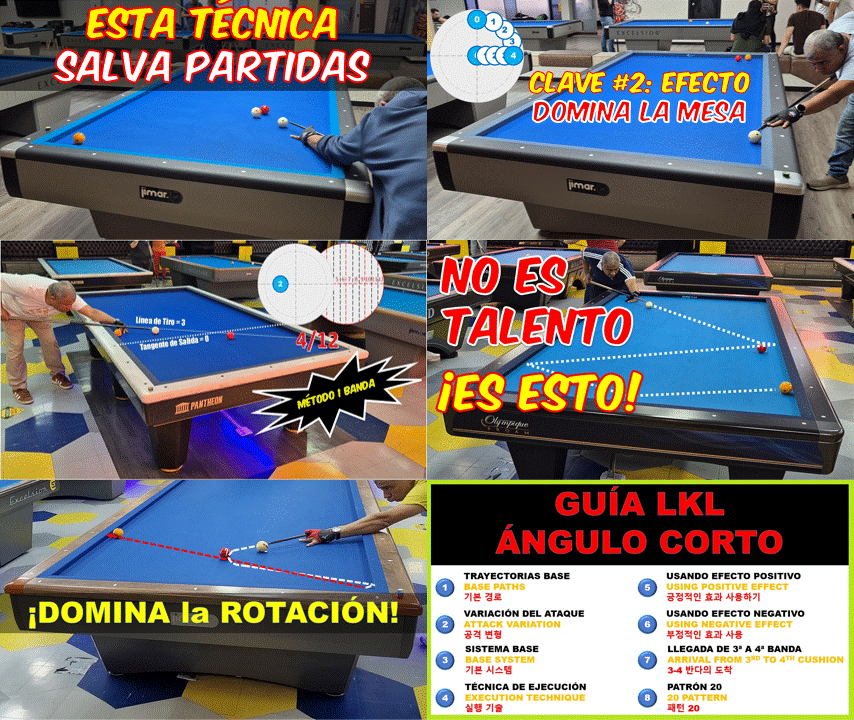
✅LKL Short Angle Guide
Execution Technique for Follows
Let’s start with the execution technique for playing box shots and rolls of follow or semi-follow.
It is always said that to execute follows, we must play with a high, flat cue, a penetrating and advanced stroke.
And without a doubt, that is correct.
But if you also add the following two tips (secrets), it will make executing follows easier for you:
First: Hold the cue well back, this will cause the cue tip to point upward at the end of the execution.
Second: Loosen your hand, thereby increasing the gap between your palm and the cue. This extra space will help delay the natural braking process that occurs toward the end of the stroke. When you try it, you won’t believe the magic that happens!

Spin Gain
The gain of spin is a concept that is rarely explained but is important in three-cushion billiards, and it is key when we want to predict the cue ball’s path while executing box shots or follow and semi-follow caroms.
To try to explain this concept, let’s first look at the normal path of the cue ball when playing with 4 spin.
We know that if we apply 4 spin, we will achieve an opening of 2 diamonds, playing from long rail to long rail.

But when we apply 4 spin and take a full ball hit on ball 2, we see an additional opening of 2 diamonds.
This happens because when taking a full ball hit on ball 2, ball 1 experiences a phenomenon known as spin gain.
Taking a full ball hit on ball 2 will cause the spin applied to ball 1 to double.

In the table shown on screen, we present how the spin gain varies as the hit thickness decreases.

Let’s look at other examples:

In the graph above, when making a hit thickness of ten, we will have a gain of 3 spin, which added to the 4 spin initially applied to ball 1 gives us a total of 7 spin, producing an opening of 3.5 diamonds, measured from long rail to long rail.

In the previous example, when making a hit thickness of eight, we will have a gain of 2 spin, which added to the 4 spin initially applied to ball 1 gives us a total of 6 spin, producing an opening of 3 diamonds, measured from long rail to long rail.
Box Shots and Follow Rolls System
As shown below, this system has the basic numbering of the classic system; however, we have made 3 modifications to incorporate the spin gain.
First: For aim values up to 50, we must add an adjustment value, equivalent to 10, to the departure value.
Second: For aim values greater than 50, we must add 10 additional points to the adjustment value, obtaining a total adjustment of 20 points.
Third: Due to the high rotation acquired by ball 1, we divide the formula value by two to obtain the value of the arrival on the third rail.

Korean Systems for Three Cushion Billiards

Fernando Díaz presents a selection of Korean systems applied to 3-cushion billiards, the result of years of research, training and direct validation on the table.
Fernando Díaz is a multiple champion, coach of the main leagues in Colombia and recognized as one of the greatest billiards experts in Latin America.
Box Shots and Semi-Follow Rolls System
Next, we present a system for semi-follow shots, that is, when we make a hit thickness less than a full ball hit.
Before looking at the semi-follow system, let’s see how hit thickness works in this type of shot.

The formula shown in the graph above tells us that if we subtract the value of the inclination angle we want ball 1 to follow from the value 12, we will obtain the hit thickness value.
In this case, the inclination angle value is one, so if we make a hit thickness of value 11, ball 1 will follow the path shown in the diagram.

In this case, the inclination angle value is two, so if we make a hit thickness of value 10, ball 1 will follow the path shown in the diagram.

Applying the same concept, in this case the value of the inclination angle is 4, so if we make a hit thickness of value 8, ball one will leave parallel to the short rail and follow the path shown on screen.
Before presenting the semi-follow system, it is important to keep in mind the adjustment value chart shown in the following table.

Remember that for aim values greater than 50, we must add 10 additional points to the adjustment value. This is because the scale of the long rail aim numbering varies starting from value 50.

In the previous diagram, we presented the semi-follow system for a hit thickness value of 10, which has an adjustment value of 7.5.
The system is the same one previously presented for full-ball follow shots; the only thing that changes is the adjustment value.
When balls one and two are facing each other, it is suggested to perform the calculation with a hit thickness value of 10 and then increase or decrease the hit thickness as appropriate.
When balls one and two are angled, it is suggested to perform the calculation with a hit thickness value that makes ball one leave parallel to the short rail, as seen in the hit thickness calculation, and then increase or decrease the hit thickness as appropriate.
UNIBILLAR: The Billiards University
Access a wide variety of digital billiards content.
Study at UNIBILLAR, the Billiards University, with the best instructors in Latin America.
José “Pepe” Hernandez, Pedro Gonzalez, Marco Vallejo, Fernando Diaz, Mauricio Gutierrez, Carlos Vallejo, Fernando Castillo “El Flaco Billarista”, Rafael Galeano.
