

Maestro del Billar presents ▶ Half-Ball System, easy and powerful for avoiding certain types of TAS TAS or collisions, and in many cases preparing the next shot.
In this type of positions, we frequently use the classic system to determine the trajectory that ball 1, the cue ball, takes toward ball 3, the yellow ball.
However, in many cases, ball 2, the red ball, is often a stone in the path that stops ball 1 or changes its direction. We will see several cases that exemplify this unfortunate situation, and then we will see the most important part: The system to avoid this type of TAS TAS or collision and facilitate the next carom.
Half-Ball System – Video
Ball Hit Master System

Even when you can read the path of a carom, one decision shapes the shot: how much of the object ball to hit to send the cue ball along that path. This guide shows how to read the key reference points, judge the thickness of the hit, aim with your cue, play feather-thin contacts, and use the reflections and shadows on the balls and cloth.
Half-Ball System
The half-ball system is easy and very powerful, as by simply taking half a ball and varying the spin, you obtain the following advantages:
First: The half-ball hit thickness is very flexible, because you can take a little more or less of the ball and the trajectory of ball 1 is not affected as much. In addition, it is a hit thickness that is comfortable to execute.
Second: In the type of positions we saw previously, the half-ball hit thickness allows avoiding the TAS TAS or collision; and in many cases facilitates the next carom.
Third: In most of the proposed spins, the cue tip can be used as a aiming point; to perform the half-ball hit thickness with greater precision.

The procedure to use the half-ball system is as follows:
First: Calculate the value of the inclination angle between balls 1 and 2. If balls 1 and 2 are facing each other, the value of the angle is 12. Later we will see how to calculate this value.
Second: The value of ball 2 corresponds to the location of ball 2, with respect to the first rail; in this case the value of ball 2 is 4.
Third: Determine the arrival value on the fourth rail, by subtracting the value of ball 2 from the value of the angle. In this case the arrival value on the fourth rail is 8, since 12 minus 4 is equal to 8.
Fourth: The arrival value on the fourth rail can be modified, by increasing or decreasing the value of the spin, as we will see later.
Fifth: Use a penetrating and advanced stroke and speed to place ball 2 in the ideal zone, later we will see what that zone is.
How to calculate the value of the angle
Next, we will see how to calculate the value of the inclination angle between balls 1 and 2.
To begin, we will see why when the balls are facing each other, the angle value is 12.
Keep in mind that the first long rail has no numbering; this helps to easily locate the numbers, especially when we are just starting to use this type of system.

The angle value is obtained by adding the two values connected by the black dashed line.
In the previous image, we can see that these values always add up to 12.

In the previous diagram, the inclination angle value between balls 1 and 2 is 13. We move from having the balls facing each other to having an inclination diamond; that is why the value changes from 12 to 13.

If the line connecting balls 1 and 2 passes through both long rails; the inclination angle between balls 1 and 2 corresponds to the length in diamonds of the white double arrow, as shown in the previous figure.
In this case, the angle value is 6.

When we do not have the two numbers to add, we propose using a parallel to obtain them.
With practice and time, calculating the angle value becomes something very easy and intuitive to do.
Join Maestro del Billar
Get access to premium Maestro del Billar content, exclusive to members:
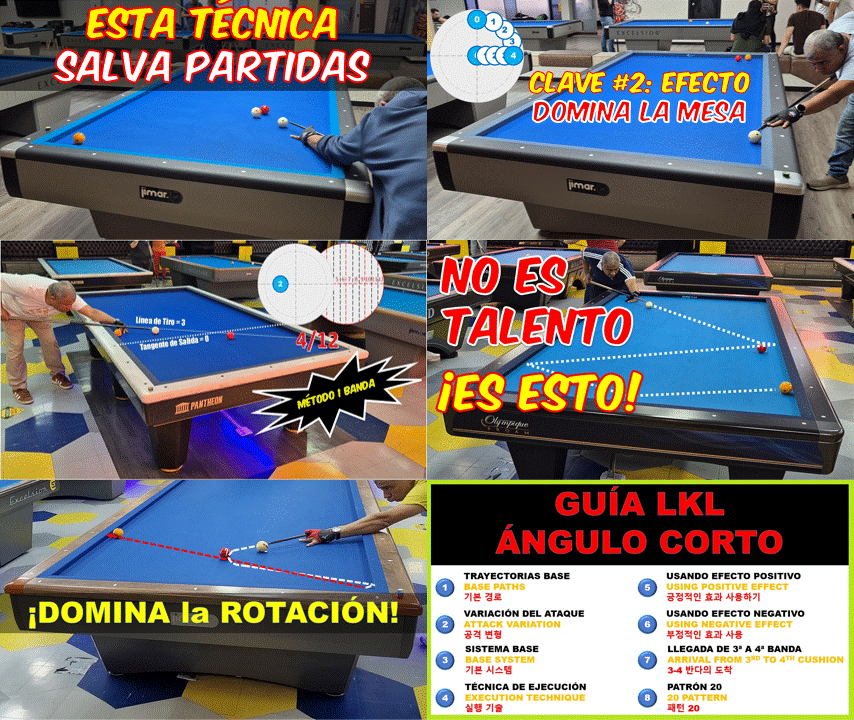
✅Key #7: Ball Hit
✅Speed Plus System
✅Key #6: Exit Tangent
✅Key #5: Shot Line
✅Banana Shot: Complete System
✅Key #4: Parallels
✅Talk with a Sports Psychologist
✅Feather-Thin Hits
✅Key #3: Mirror
✅Key #2: Spin
✅Key #1: Halves
✅Ball Hit for Pass-Ball Shots
✅One-Cushion Method
✅Vertical Pass-Ball System
✅Cross-Table System
✅Master Halves System
✅Vertical Reverse Spin System
✅Rotation Systems and Techniques
✅X-Ray Plus System
✅Short-Angle LKL Guide
Half-Ball System – Ball 2 Zone
Now let’s see what is the ideal positioning zone for ball 2 in the half-ball system.

Ball 2 should ideally be within the white rectangle; this zone is ideal for playing without TAS TAS or contact and preparing the next shot.
Half-Ball System – Use of Spin
In the half-ball system, spin is used to modify the arrival value on the fourth rail.

The previous graphic shows how to mark the different spins and the value corresponding to each one.
It is important that when using zero or positive spin, the cue is parallel to the playing surface.
UniBillar: The Billiards University
Explore a wide range of digital billiards resources.
Study at UniBillar, the Billiards University, with leading instructors from Latin America.
José “Pepe” Hernandez, Pedro Gonzalez, Marco Vallejo, Fernando Diaz, Mauricio Gutierrez, Julián Torres, Jaime Carrasco, Carlos Vallejo, Fernando Castillo “El Flaco Billarista”, Rafael Galeano.
