

Maestro del Billar, reveals ▶ The hidden power of the box shot, it is a trick and a very powerful tool, that will help us improve our technique in three-cushion billiards!
This technique is part of the families of long-rail systems and short-rail systems at the same time!
In this post we will discover the hidden power of the box shot, and see several examples to learn how to use it in three-cushion billiards:
- Chapter 1: Brief definition of what we call a box shot
- Chapter 2: What is the hidden power of the box shot
- Chapter 3: Examples
- Chapter 4: System of projections
Explanatory video
Join The Billiards Master
Access the PREMIUM content of Billiards Master, exclusive for MEMBERS:
✅Key #6: Exit Tangent
✅Key #5: Shot Line
✅Banana Shot: Complete System
✅Key #4: Parallels
✅Chat with Billiards Psychologist
✅Hair Ball Hit Technique
✅Key #3: Mirror Technique
✅Key #2: English
✅Key #1: Halves System
✅Ball Hit for Pass Ball
✅1 Cushion Method
✅Vertical Pass Ball System
✅Cross Table System
✅Master Halves System
✅Vertical Counter Effect System
✅Master Rotation: Systems & Technique
✅X-Ray Plus System
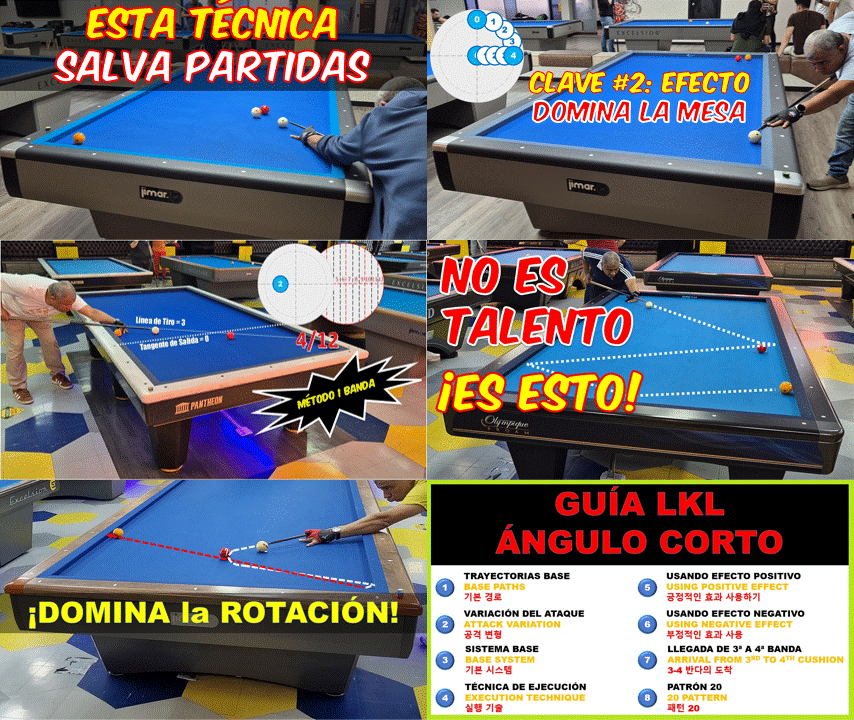
✅LKL Short Angle Guide
Brief definition of a box shot
A box shot is a small house, in billiards it is called a box shot for certain zones of the table, which in themselves are small tables or scaled-down tables.
The most used scales are a quarter and a half.


What is the power
The hidden power of the box shot is that it allows us to see the short rail as if it were a long rail, and thus we can use long-rail systems even when playing off the short rail!
To explain it better, let’s look at an example:

The image shows a carom known as an eight or double return. From the classic or L K L system, we know that if ball one manages to enter the diagonal shown by the double white arrow, we will achieve the carom.
In the graph on the right, we show a long-rail system for playing corners or box shots that we previously published and which we use as a reference to play this position as if it were a corner or box shot carom!
A major advantage of this technique is that we have a close reference point on the second rail, which allows us to visualize the shot better and have better “feeling” when playing!. This simple trick is a very powerful tool that will help us improve our three-cushion billiards technique!
Korean Systems for Three Cushion Billiards

Fernando Díaz presents a selection of Korean systems applied to 3-cushion billiards, the result of years of research, training and direct validation on the table.
Fernando Díaz is a multiple champion, coach of the main leagues in Colombia and recognized as one of the greatest billiards experts in Latin America.
Examples

In the position shown on screen, we know that if our cue ball enters the diagonal of the double white arrow, and according to the classic system or LKL, we will achieve the carom.
This is NOT a simple carom, but if we use the hidden power of the box shot, we can play it as if it were a ball pass on the long rail, as shown in the figure on the right.
Here there is an additional variable, which is that the starting point is off the table. In the next chapter, we will see a simple projection system to clear this variable.

In the previous representation, we see an example of how to use the quarter-table box shot.
In this case, we can use the “tube previous two rails” system or TIKI, shown in the image on the right.
The possibilities offered by the hidden power of the box shot technique are infinite, and these will only depend on our imagination and creativity!

In the portrait we see on the screen, we show another example of how to use the quarter-size table.
In this case, we can use the “tube previous one rail” system or tickie, shown in the graph on the right.
Projection system
We explain the projection system in the video on the ball and spin system; however, let’s see how it is used in the box shot technique.

At the beginning of this post, we presented the position shown on screen. But we did not explain how to calculate the 6.5 starting point, and that in the ball pass on the long rail system, this starting point corresponds to spin 1.5 to achieve turning in the corner.
The diagram on the right shows the system formula for projections and how we use it to calculate the value 6.5.
With experience and repetition, this technique ends up being something simple and mechanical.

In the carom shown in the image, we see another case where we must use the projection system before proceeding to apply the box shot system shown in the figure on the right.
It must be taken into account that since we play to 4 rails, we must use a higher speed than that used in a normal box or box shot, and this in some cases implies making small adjustments.
As always, the best thing is to verify it on the game table.
UNIBILLAR: The Billiards University
Access a wide variety of digital billiards content.
Study at UNIBILLAR, the Billiards University, with the best instructors in Latin America.
José “Pepe” Hernandez, Pedro Gonzalez, Marco Vallejo, Fernando Diaz, Mauricio Gutierrez, Carlos Vallejo, Fernando Castillo “El Flaco Billarista”, Rafael Galeano.
