

We present ▶ key techniques and systems for playing ball-pass (ball and rail) caroms in three-cushion billiards, explaining how to calculate the spin and ball hit to use when playing ball-pass via long rail
How to calculate the spin?

This system allows us to calculate the spin to use in order to reach the third rail.
Calculation Procedure
First: Determine the starting position and aim; the image shows a zero start (0) and a zero aim (0). The aim corresponds to the position of ball 2 on the long rail, according to the numbering shown in the diagram.
Second: Determine the arrival point on the third (3) rail; according to the image, we must reach the corner, which has a value of zero (0)
Third: The spin to be used is calculated by adding the values of the start, aim, and arrival. 0 = 0 + 0 + 0.
Ball Hits

Join The Billiards Master
Access the PREMIUM content of Billiards Master, exclusive for MEMBERS:
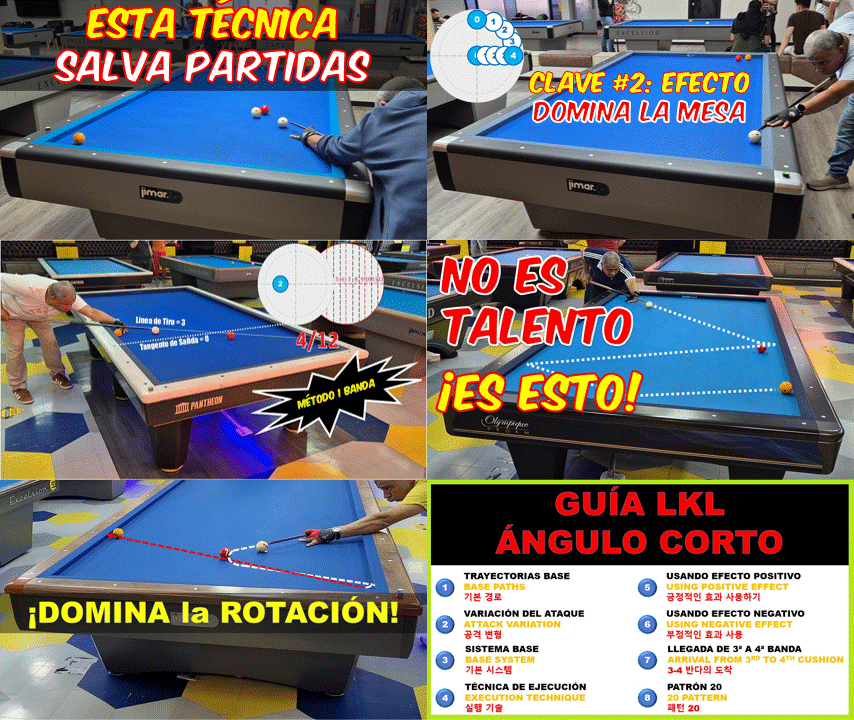
✅Key #6: Exit Tangent
✅Key #5: Shot Line
✅Banana Shot: Complete System
✅Key #4: Parallels
✅Chat with Billiards Psychologist
✅Hair Ball Hit Technique
✅Key #3: Mirror Technique
✅Key #2: English
✅Key #1: Halves System
✅Ball Hit for Pass Ball
✅1 Cushion Method
✅Vertical Pass Ball System
✅Cross Table System
✅Master Halves System
✅Vertical Counter Effect System
✅Master Rotation: Systems & Technique
✅X-Ray Plus System
✅LKL Short Angle Guide
For ball hits, the 12-part technique is recommended, which consists of dividing ball 2 into 12 equal parts. Let’s look at some of the most common ball hits:
- 1/4 = 3/12
- 1/3 = 4/12
- 2/5 = 5/12
- 1/2 = 6/12
- 2/3 = 8/12
- 3/4 = 9/12
How to calculate the ball hit?
To calculate the ball hit to be used, we must determine the angle of incidence between balls 1 and 2. Let’s look at 2 examples:
In the following image, we have an angle of incidence of six (6) diamonds, measured from long rail to long rail, and we must take 6/12 of the ball (half ball).

In the following image, we have an angle of incidence of three (3) diamonds, measured from long rail to long rail, and we must take 3/12 of the ball (quarter ball).

Ball 2 Separated from the Rail
When ball 2 is separated from the long rail, we must subtract one (1) spin for each diamond of separation.
In the following image, to reach the corner, we must use zero spin (0). 0 = 1 + 0 + 0 – 1.
Note that in this case the angle of incidence between balls 1 and 2 is seven (7) diamonds, and therefore the ball hit to be used is 7/12.

Arrivals to 4th Rail
Arrivals on the fourth (4) rail are calculated as openings from the aim point and depend on the arrival on the third rail:
Korean Systems for Three Cushion Billiards

Fernando Díaz presents a selection of Korean systems applied to 3-cushion billiards, the result of years of research, training and direct validation on the table.
Fernando Díaz is a multiple champion, coach of the main leagues in Colombia and recognized as one of the greatest billiards experts in Latin America.
- Arrival at 0 opens 2 diamonds
- Arrival at 1 opens 3 diamonds
- Arrival at 2 opens 3.7 diamonds
- Arrival at 3 opens 4.3 diamonds
- Arrival at 4 opens 5 diamonds
Let’s look at some examples:


Demonstrative Video
In the “Long Rail Systems” section, you will find the “System Pase Bola” video, where we show some of the techniques seen previously.
Lutfi CENET and the Pase Bola System
Pase Bola System Base 40
This system allows us to calculate the arrival on the third (3) rail, using the numbering of the classic system but with base 40. It is played with maximum follow (4).

UNIBILLAR: The Billiards University
Access a wide variety of digital billiards content.
Study at UNIBILLAR, the Billiards University, with the best instructors in Latin America.
José “Pepe” Hernandez, Pedro Gonzalez, Marco Vallejo, Fernando Diaz, Mauricio Gutierrez, Carlos Vallejo, Fernando Castillo “El Flaco Billarista”, Rafael Galeano.

Support us
Support Maestro del Billar by searching for or buying whatever you want on AMAZON through our online store
Share, comment, or ask…