

Would you like to master a shot that even professionals prefer to keep hidden?
I am the Maestro del Billar and today I am going to reveal a technique that will expand your possibilities in three-cushion billiards: The “TIKI with Curve” System.
How many times have you faced positions that seem impossible, especially when the object ball is very close to the rail? Most players ignore a simple but surprising solution: using the proximity of that ball to the rail to generate a double cushion, known as TIKI. But here is what is truly impressive: by combining this basic technique with a small curve, you can solve positions that previously seemed impossible.
This method, which very few know and is barely documented, will allow you to turn complicated situations into clear opportunities to shine on the table.
Do you want to discover how to do it and start surprising everyone with this secret shot?
Stay with me, because what you are about to see can give you a decisive advantage in a match.
Join The Billiards Master
Access the PREMIUM content of Billiards Master, exclusive for MEMBERS:
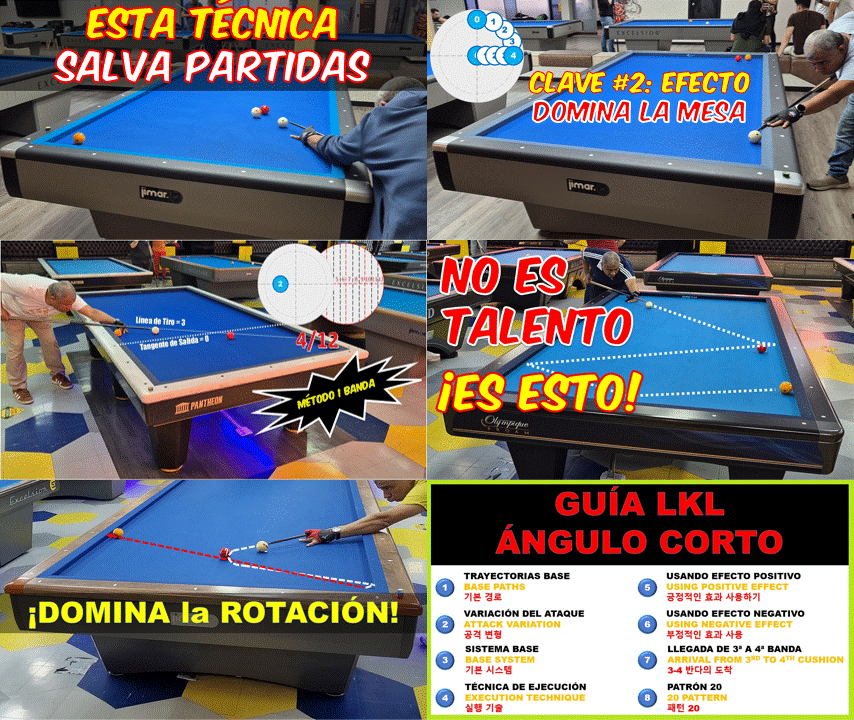
✅Key #6: Exit Tangent
✅Key #5: Shot Line
✅Banana Shot: Complete System
✅Key #4: Parallels
✅Chat with Billiards Psychologist
✅Hair Ball Hit Technique
✅Key #3: Mirror Technique
✅Key #2: English
✅Key #1: Halves System
✅Ball Hit for Pass Ball
✅1 Cushion Method
✅Vertical Pass Ball System
✅Cross Table System
✅Master Halves System
✅Vertical Counter Effect System
✅Master Rotation: Systems & Technique
✅X-Ray Plus System
✅LKL Short Angle Guide
Base Position of the TIKI System with Curve
When we talk about the TIKI System with Curve, it is fundamental to master what we call the base position.


The first step is to identify a position where balls 2 and 3 form an angle of approximately 45 degrees, where they are at the same distance from the corner. But be careful, because here is the detail that makes the difference: ball number 2 must be located approximately one ball length from the rail.


And what is the exact point where we must strike? You must direct your cue ball just in front of ball 2, aiming at the inner edge of the rail. Here is the interesting part: to achieve that trajectory, we apply spin 2, below the equator of the ball.

But pay attention, this stroke is not common: it must be fast, penetrating, and advanced.

Do you know what happens when you do it correctly? Your cue ball will describe a subtle curve, expanding your possibilities and leaving you ready to master shots that others would not even imagine.
Now tell me, would you like to see how to adjust this technique as the position of ball 3 changes?

Korean Systems for Three Cushion Billiards

Fernando Díaz presents a selection of Korean systems applied to 3-cushion billiards, the result of years of research, training and direct validation on the table.
Fernando Díaz is a multiple champion, coach of the main leagues in Colombia and recognized as one of the greatest billiards experts in Latin America.
How to Adjust the Arrival on the Third Rail
Now you will discover how small adjustments can generate big changes in the final trajectory of your cue ball.

Starting from spin 2 that we used in the base position, gradually passing to negative spin 2, you will learn to close progressively the angle after executing your TIKI, achieving an arrival on the third rail that allows you to solve seemingly impossible positions.
Additionally, you will understand how slight variations in the aiming point allow us to increase the hit thickness and further amplify the effect of these adjustments, giving you the power to direct your cue ball exactly where you need it.
Do you want to know exactly what spin to apply and where to aim in each specific situation? Stay until the end, because this is key to taking advantage of this type of positions in a game.
Learn to Measure Angles in the Diamond System

Take a close look at the image on screen. This version “Billiards Draw” of our table, enlarged, clearly shows that the angle of our base position corresponds exactly to 8 diamonds.

But here is the secret that will make all the difference: learning to quickly measure any angle using the cut points generated in a 1×1 diamond square.
Observe well: between each of these cut points there is exactly a distance of 1/8 of a diamond. Yes, that simple! Once you understand this, you will be able to easily identify how much you need to close the angle to achieve that carom that seemed impossible.
Key #1: How to Close the Angle by Modifying the Spin in the TIKI System with Curve
The base position is played with spin 2, aiming at the exact point that leads us to take 4/8 of the ball. From here, there is a simple and powerful rule:
Every time you reduce one point of spin, you will close your arrival angle exactly 2 diamonds.

To understand it clearly, let’s see a practical example on the table. Observe closely, because mastering this detail can make the difference between an average carom and a masterful shot.

We know that our base position generates an angle of 8 diamonds. But what happens when ball 3 moves and ends up exactly on diamond 4 of the long rail, creating an angle of only 4 diamonds?
The logic here is clear: we must close the 4-diamond angle to reach our target.
And remember our golden rule: for every unit of spin you reduce, you close exactly 2 diamonds.
So, how much spin do we need to reduce to close those 4 diamonds? Exactly: 2 units less.

Instead of using our initial spin, spin 2, we will play with spin 0.
With a simple spin adjustment, we turn an apparently complicated position into a feasible shot with a wide arrival.
Key #2: The Secret to Mastering Hit Thickness in the TIKI
Here is one of those keys you cannot forget if you want to master the TIKI:

If you aim at the inner edge of the cushion… you will take a 4/8 hit.

If you aim at the center of the cushion rubber, you take a full ball: 8/8 hit.

And if you aim right at the midpoint between those two… you take a 6/8 hit.
That simple. And now that you know… let’s see an example!
Key #3: How to Close the Angle by Modifying Hit Thickness in the TIKI System with Curve
Rule number 2: Close angles by increasing hit thickness.
We play the base position with spin 2 and aiming at the point that leads to a 4/8 hit. From there, every time we increase the hit thickness by 1/8, we manage to close the angle by 2 diamonds.
Does that sound complicated? Don’t worry, it is actually very simple when you see it in action. Let’s look at an example to understand it clearly.

In this example, ball 3 has moved from its base position to the 8th diamond of the long rail, forming an angle of only 2 diamonds. This means we must close the angle by 6 diamonds.

And how do we achieve that?

We play with spin 0, which allows us to close 4 diamonds…
And if we also increase the hit thickness from 4/8 to 5/8 —that is, 1/8 more—, we will close an additional 2 diamonds.
In total: 4 from the spin, plus 2 from the hit thickness… we close exactly the 6 diamonds we need.
Did you notice how small changes make a big difference?
See you in the next video system… and remember: in billiards, every detail counts.
UNIBILLAR: The Billiards University
Access a wide variety of digital billiards content.
Study at UNIBILLAR, the Billiards University, with the best instructors in Latin America.
José “Pepe” Hernandez, Pedro Gonzalez, Marco Vallejo, Fernando Diaz, Mauricio Gutierrez, Carlos Vallejo, Fernando Castillo “El Flaco Billarista”, Rafael Galeano.
