
Maestro del Billar presents ▶ A very simple system to solve some complicated caroms in three-cushion billiards, allowing us to play these types of positions without exaggerating the speed and controlling the position of ball 2.
This system allows us to determine the spin and ball hit to use to reach the short rail, whether it is the third or fourth cushion in the path of ball one.
This system is part of the families of long-rail systems and ball and spin systems. As with most systems, it is important to verify the conditions of the playing material: cloth, cushions, and balls.
Demonstrative Video
Join The Billiards Master
Access the PREMIUM content of Billiards Master, exclusive for MEMBERS:
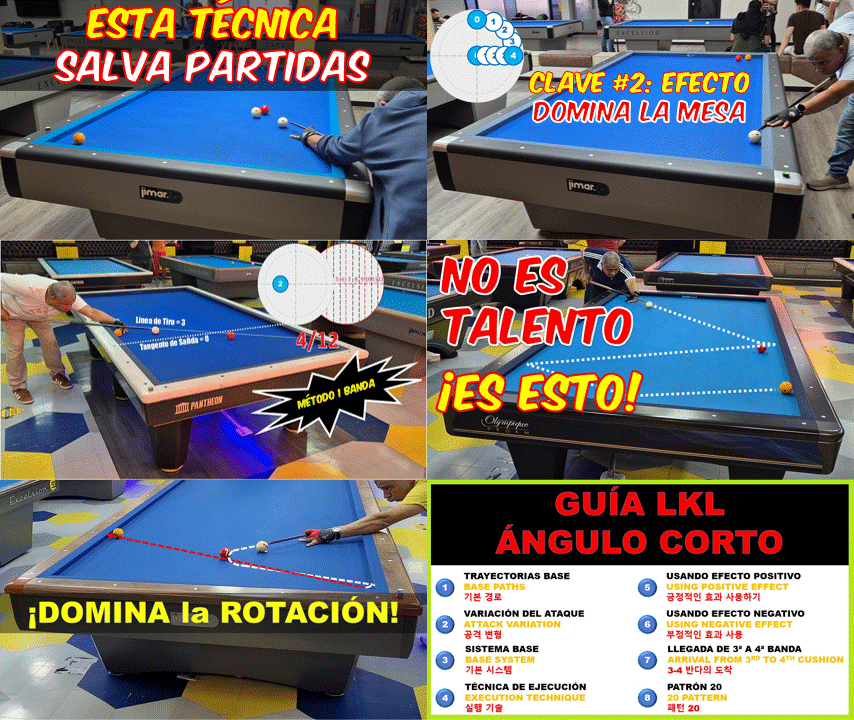
✅Key #6: Exit Tangent
✅Key #5: Shot Line
✅Banana Shot: Complete System
✅Key #4: Parallels
✅Chat with Billiards Psychologist
✅Hair Ball Hit Technique
✅Key #3: Mirror Technique
✅Key #2: English
✅Key #1: Halves System
✅Ball Hit for Pass Ball
✅1 Cushion Method
✅Vertical Pass Ball System
✅Cross Table System
✅Master Halves System
✅Vertical Counter Effect System
✅Master Rotation: Systems & Technique
✅X-Ray Plus System
✅LKL Short Angle Guide
Ball Hits and Spins
The 12-part technique is used to measure the ball hit. Each part is equivalent to one point.

Three different spins are used; the following image shows how to mark each of them and their corresponding values.

Korean Systems for Three Cushion Billiards

Fernando Díaz presents a selection of Korean systems applied to 3-cushion billiards, the result of years of research, training and direct validation on the table.
Fernando Díaz is a multiple champion, coach of the main leagues in Colombia and recognized as one of the greatest billiards experts in Latin America.
Arrivals at the Fourth Cushion
Let’s look at the numbering and formula of the system when the short rail is the fourth cushion in the path of ball one.

System 9 11 gets its name because the numbering of the arrival cushion starts with the values 9 and 11.
The angle corresponds to the inclination, measured in diamonds on the long rail, between balls 1 and 2.
In the previous image, the angle corresponds to the black line on the long rail. Each half-diamond is equivalent to one point.
This system allows us to select the spin and ball hit to use, provided that their sum equals the value corresponding to the difference between the arrival value and the angle value.
In the image, we have an arrival value of 11 and an angle value of 2. The difference between these two values is 9.
We must find a combination of ball hit and spin values that sum to 9.
One option is to use the ball hit value of 6, that is, a half-ball, and the spin with a value of 3.
Use a straight cue, a penetrating and advanced stroke, and speed upon arrival.
Arrivals at the Third Cushion
Let’s look at the numbering and formula of the system when the short rail is the third cushion in the path of ball one.

When the short rail is the third cushion in the path of ball one, the only thing that changes in the system is the arrival numbering.
And it is a continuation of the previous numbering, which started at value 9 and ended at value 13.
Value 14 is 3 tenths of a diamond from the corner, and from there, each half-diamond adds one point to the arrival value.
In the previous image, we have an arrival value of 15 and an angle value of 4. The difference between these two values is 11.
We must find a combination of ball hit and spin values that sum to 11.
One option is to use the ball hit value of 8, and spin with a value of 3.
You must use a flat cue, a penetrating and advanced stroke, and arrival speed.
UNIBILLAR: The Billiards University
Access a wide variety of digital billiards content.
Study at UNIBILLAR, the Billiards University, with the best instructors in Latin America.
José “Pepe” Hernandez, Pedro Gonzalez, Marco Vallejo, Fernando Diaz, Mauricio Gutierrez, Carlos Vallejo, Fernando Castillo “El Flaco Billarista”, Rafael Galeano.
