
Maestro del Billar, we present ▶ an ultra-secret technique for calculating ball hit thickness in billiards:
- Chapter 0: When are balls 1 and 2 facing each other?
- Chapter 1: Balls 1 and 2 facing each other.
- Chapter 2: Balls 1 and 2 angled.
- Chapter 3: Does it only work for playing to the corner?
Demonstration video
Join The Billiards Master
Access the PREMIUM content of Billiards Master, exclusive for MEMBERS:
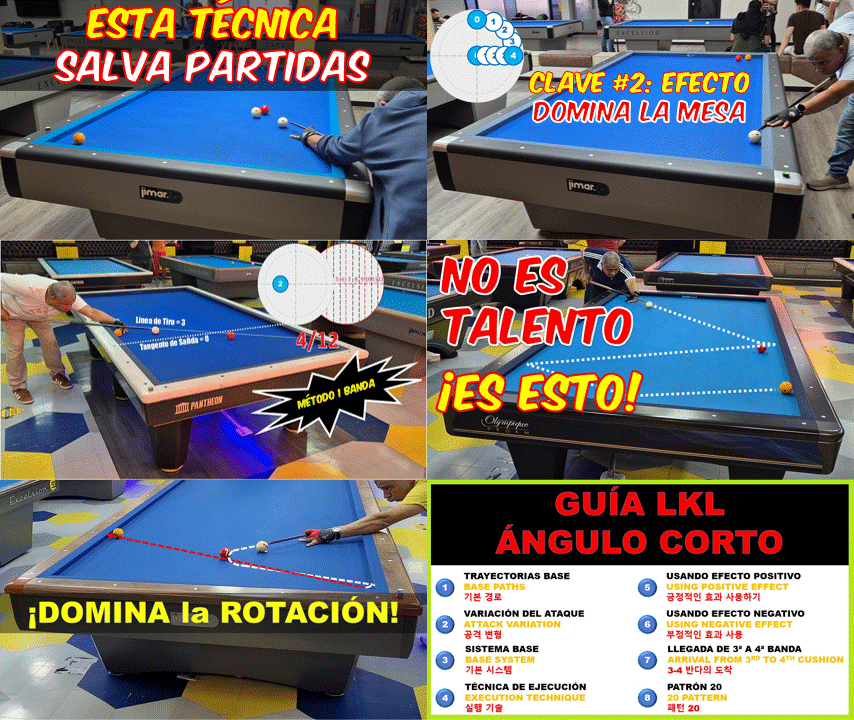
✅Key #6: Exit Tangent
✅Key #5: Shot Line
✅Banana Shot: Complete System
✅Key #4: Parallels
✅Chat with Billiards Psychologist
✅Hair Ball Hit Technique
✅Key #3: Mirror Technique
✅Key #2: English
✅Key #1: Halves System
✅Ball Hit for Pass Ball
✅1 Cushion Method
✅Vertical Pass Ball System
✅Cross Table System
✅Master Halves System
✅Vertical Counter Effect System
✅Master Rotation: Systems & Technique
✅X-Ray Plus System
✅LKL Short Angle Guide
When are balls 1 and 2 facing each other?

A very important aspect of this technique is defining when balls one and two are facing each other?
There are 3 cases:
First case: The distance between balls one and two is less than one diamond. In this case, the line of inclination connects the inner edges of the two balls.
Second case: The distance between balls one and two is between one and two diamonds. In this case, the line of inclination connects the center of ball one with the inner edge of ball two.
Third case: The distance between balls one and two is greater than two diamonds. In this case, the line of inclination connects the centers of the two balls.
Balls 1 and 2 Facing Each Other

What ball hit thickness would you use to perform the carom shown in the previous image?
The formula is very simple, as the ball hit thickness is equal to the angle between ball two and the aiming point.
The image shows, in black, the values of the angles relative to the corner.
For the ball hit thickness, we will use the 12-part technique, which consists of dividing ball two into 12 parts.
Ball one must arrive at the contact with ball two without vertical spin (follow or draw), as this allows closing or opening the angle.
In this example, we have an angle value of two, therefore, we must take 2/12 of the ball.
Let’s look at another example:

In the following diagram, the base angle values are shown when playing from the short side of the table.

Although in these cases, that is, when the aiming point is close, we usually rely on our intuition to define the ball hit. However, it is important to know these values.
Note the coincidence of the value 6, that is, half ball, compared to the previous diagrams!
Korean Systems for Three Cushion Billiards
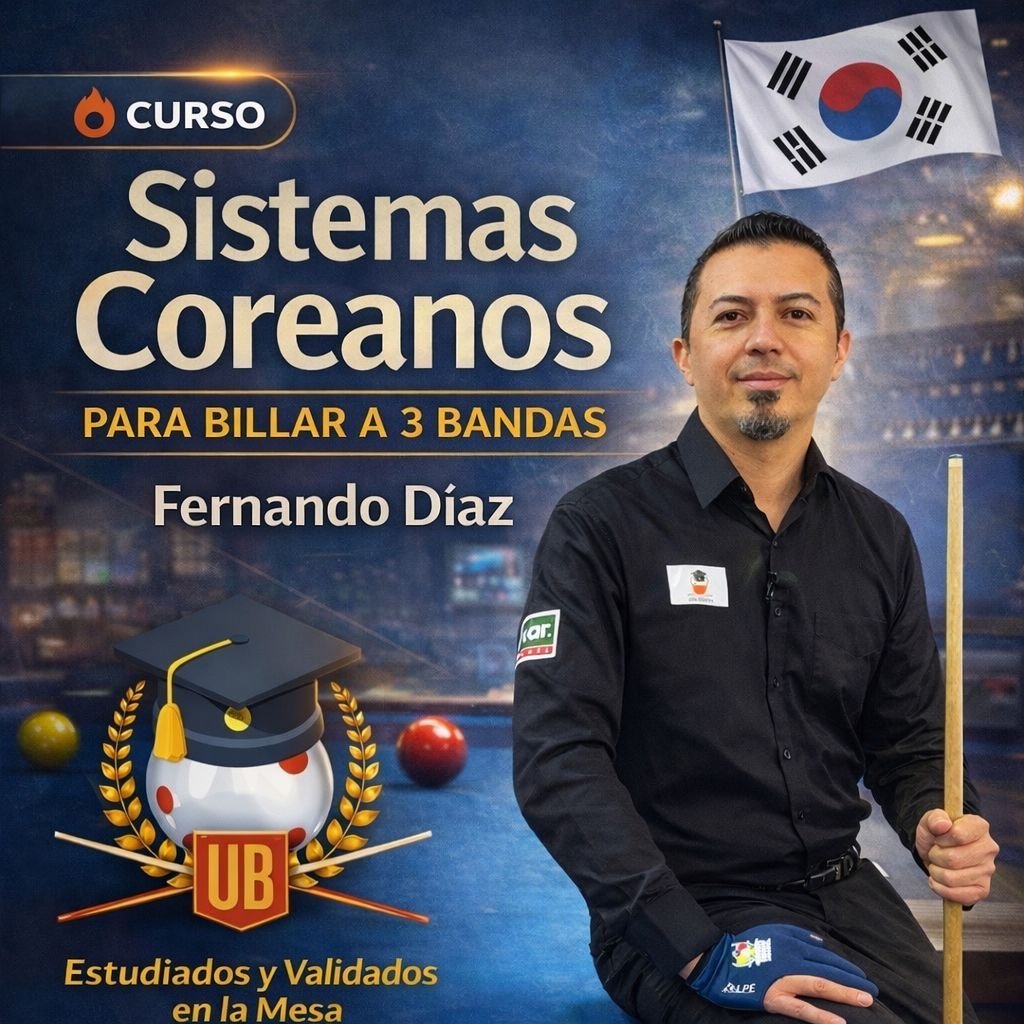
Fernando Díaz presents a selection of Korean systems applied to 3-cushion billiards, the result of years of research, training and direct validation on the table.
Fernando Díaz is a multiple champion, coach of the main leagues in Colombia and recognized as one of the greatest billiards experts in Latin America.
Balls 1 and 2 inclined

When balls one and two are inclined, we simply add the value of the aiming angle, which we have called angle one here, to the value of the inclination angle, which we call angle two here.
In this example, we have a value of 0.5 for the aiming angle, and a value of 1.5 for the inclination angle.
The sum of these two values gives us a total angle value of two.
Does it only work for playing to the corner?

But, does this technique only work for playing to the corner?
And it is here that the player’s imagination gives power to the technique!!!
Although the base angle values are measured relative to the corner, we can use parallel lines when aiming at other points on the rail.
When the aiming point does not correspond to the corner, the fastest and most comfortable way is to move the aiming line in parallel until bringing it to the corner!
In this case, the angle value is equal to 3.
A more precise but more complex technique, called PROJECTIONS, was explained in the video: “Ball and Spin System”.
UNIBILLAR: The Billiards University
Access a wide variety of digital billiards content.
Study at UNIBILLAR, the Billiards University, with the best instructors in Latin America.
José “Pepe” Hernandez, Pedro Gonzalez, Marco Vallejo, Fernando Diaz, Mauricio Gutierrez, Carlos Vallejo, Fernando Castillo “El Flaco Billarista”, Rafael Galeano.
