

Maestro del Billar presents the ▶ umbrella system, which is very useful for solving some difficult positions in three-cushion billiards where we can play a rail-first (bricole) shot to two cushions. We explain the spin to use and how to calculate the aiming point on the first cushion.
In three-cushion billiards, the umbrella system carom could be calculated by making successive approximations using the classic system and the second-cushion systems to determine the arrival line from the second to the third cushion that allows contacting ball 2 and completing the carom.
Although the above is a valid method, it could take a lot of time to find the correct arrival line.
Another method we could use, although easier but a bit intuitive, is the parallel aim.
Video of the umbrella system
In the following video, we demonstrate how to use the umbrella system, playing caroms from each departure point and with different locations of ball 2.
Join The Billiards Master
Access the PREMIUM content of Billiards Master, exclusive for MEMBERS:
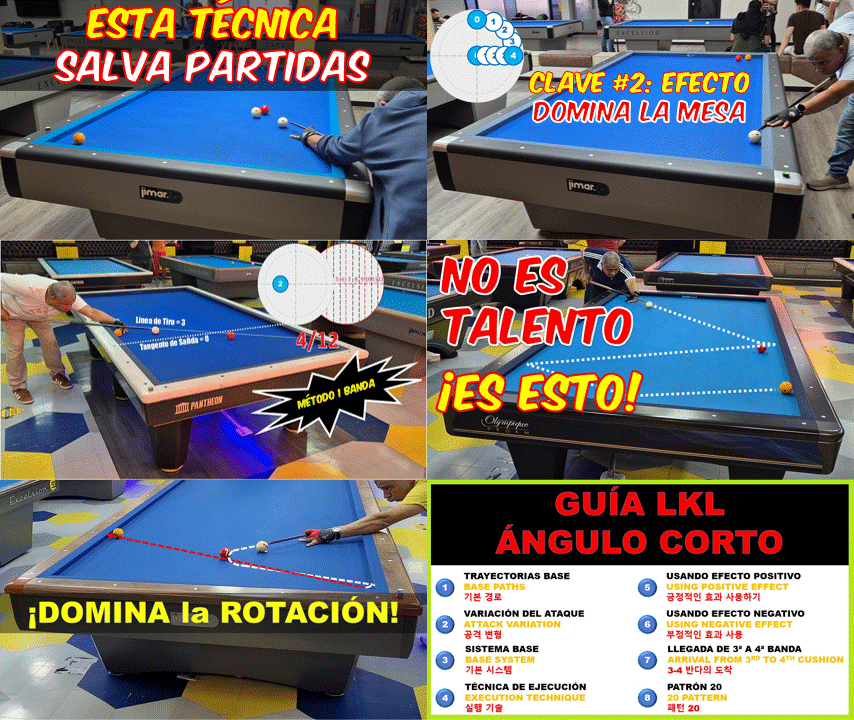
✅Key #6: Exit Tangent
✅Key #5: Shot Line
✅Banana Shot: Complete System
✅Key #4: Parallels
✅Chat with Billiards Psychologist
✅Hair Ball Hit Technique
✅Key #3: Mirror Technique
✅Key #2: English
✅Key #1: Halves System
✅Ball Hit for Pass Ball
✅1 Cushion Method
✅Vertical Pass Ball System
✅Cross Table System
✅Master Halves System
✅Vertical Counter Effect System
✅Master Rotation: Systems & Technique
✅X-Ray Plus System
✅LKL Short Angle Guide
Umbrella System (Umbrella System)

How to use the umbrella system:
- Determine the arrival value; for this, we must draw a line (red line) that goes from the origin point and passes close to ball 2 (1/4 ball distance). The origin point (small yellow circle) varies according to the departure point. The image shows an arrival value of 20.
- Determine the value of ball 2, which corresponds to 5 points per diamond of separation of ball 2 from the third cushion (long rail). The image shows a value of 5.
- The aim value is obtained by subtracting the arrival value and the ball 2 value from the departure point. The image shows an aim value of 25 = 50 – 20 – 5.
- Apply high spin 2 and a long stroke.
Departure from point 45

The method of use is the same; the only thing that varies is the origin point (small yellow circle) of the red line used to determine the arrival value.
Departure from point 40

The method of use is the same; the only thing that varies is the origin point (small yellow circle) of the red line used to determine the arrival value. The origin point varies according to the departure point; see the values in yellow.
Korean Systems for Three Cushion Billiards

Fernando Díaz presents a selection of Korean systems applied to 3-cushion billiards, the result of years of research, training and direct validation on the table.
Fernando Díaz is a multiple champion, coach of the main leagues in Colombia and recognized as one of the greatest billiards experts in Latin America.
Departure from point 35

The method of use is the same; the only thing that varies is the origin point (small yellow circle) of the red line used to determine the arrival value.
The umbrella system is a rail-first (bricole) shot and, as such, it should be considered only after ruling out other options.
Departure from point 30

The method of use is the same; the only thing that varies is the origin point (small yellow circle) of the red line used to determine the arrival value.
In the umbrella system, we must practice speed; although a long, soft stroke is usually used, it must be adapted to the conditions of the table and the player.
Departure from point 25

The method of use is the same; the only thing that varies is the origin point (small yellow circle) of the red line used to determine the arrival value.
The origin point is value 10, and that same value is used for departures from points 25, 20, and 15.
UNIBILLAR: The Billiards University
Access a wide variety of digital billiards content.
Study at UNIBILLAR, the Billiards University, with the best instructors in Latin America.
José “Pepe” Hernandez, Pedro Gonzalez, Marco Vallejo, Fernando Diaz, Mauricio Gutierrez, Carlos Vallejo, Fernando Castillo “El Flaco Billarista”, Rafael Galeano.
