
Are you looking for how to play three-cushion billiards in an easy way, without formulas, numbers, or calculations?
Maestro del Billar presents a ▶ versatile, easy, and quick technique for playing three-cushion caroms. We explain the spin to use and how to determine the aiming point on the first rail.
We will explain the parallel attack, a somewhat intuitive, quick, and universal technique, as it can be used to play caroms off the long rail, the short rail, or rail-first (bricole).
Join The Billiards Master
Access the PREMIUM content of Billiards Master, exclusive for MEMBERS:
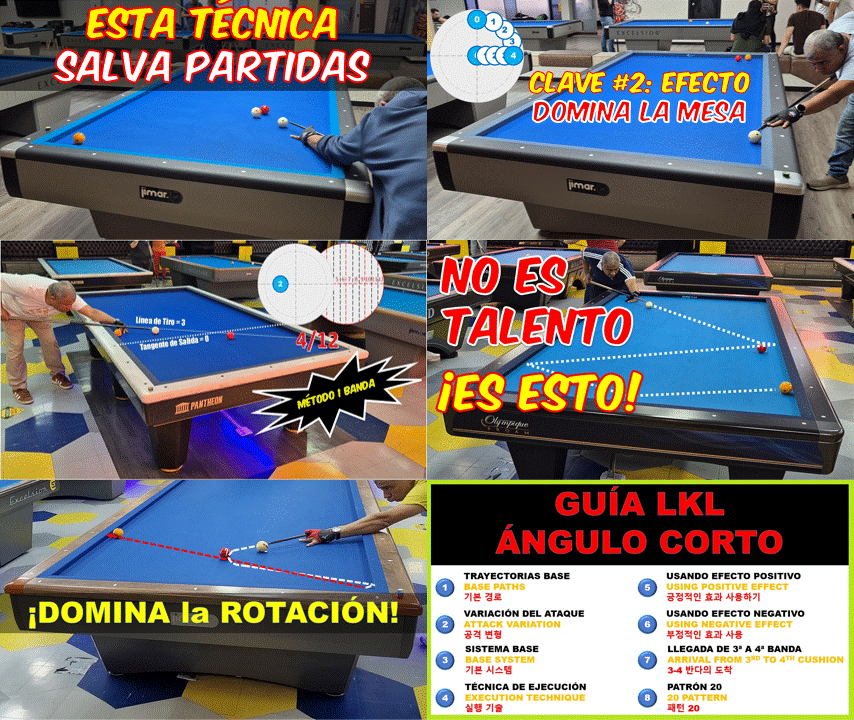
✅Key #6: Exit Tangent
✅Key #5: Shot Line
✅Banana Shot: Complete System
✅Key #4: Parallels
✅Chat with Billiards Psychologist
✅Hair Ball Hit Technique
✅Key #3: Mirror Technique
✅Key #2: English
✅Key #1: Halves System
✅Ball Hit for Pass Ball
✅1 Cushion Method
✅Vertical Pass Ball System
✅Cross Table System
✅Master Halves System
✅Vertical Counter Effect System
✅Master Rotation: Systems & Technique
✅X-Ray Plus System
✅LKL Short Angle Guide
Parallel Attack

Technique usage:
- Determine the starting position and arrival point (it must be between the second and third rails). In the image, these correspond to the gray circles near the red ball and the yellow ball.
- Determine the midpoint between the starting position and arrival point. In the image, this corresponds to the red circle on the thick black line.
- Using the cue (black arrow), connect the midpoint and the corner
- To find the aiming point, slide the cue (green arrows) parallel to the black arrow until it reaches the starting position.
- Apply spin 1 to the equator of the cue ball and visualize the ball hit to reach the aiming point.
In the following video, we see the application of the previous steps:
Rail-first:
In the following image, we have a position very similar to the previous one, but this time we play rail-first (bricole). The procedure to determine the aiming point on the first rail is the same. In this case, the origin point is the cue ball.

Let’s look at another example; in this position, the arrival point is on the second rail. In these cases, it is recommended to use zero spin (0).

Off the short rail:

Zero Reference
It is important to know the following trajectories, which we have named Zero Reference, because in these cases, the aiming lines to the first rail and the arrival lines to the third rail are practically identical:


Korean Systems for Three Cushion Billiards
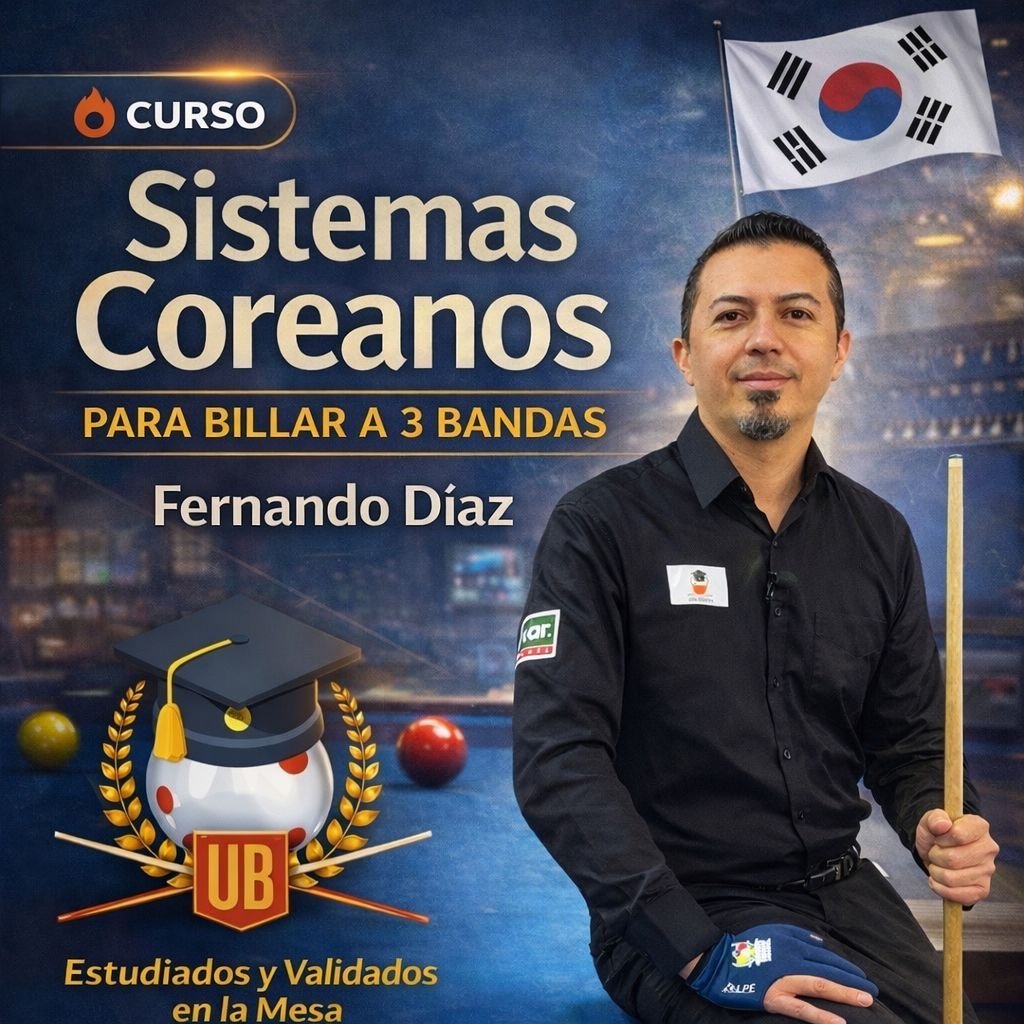
Fernando Díaz presents a selection of Korean systems applied to 3-cushion billiards, the result of years of research, training and direct validation on the table.
Fernando Díaz is a multiple champion, coach of the main leagues in Colombia and recognized as one of the greatest billiards experts in Latin America.
Advantages
- Easy, fast, no formulas, no numbers or calculations
- Very versatile, it can be played rail-first, with the ball, on the long rail or short rail, to 1, 2, 3 or more rails.
- Little spin is used, facilitating the ball hit and avoiding the deflection produced when maximum spin is used
- Better visualization of the trajectory, as the aiming lines to the first rail and the arrival lines to the third rail are almost parallel
- More tolerant to table conditions
Disadvantages
- Although in most positions it is suggested to use spin 1, there are some cases in which the spin must be modified slightly; with practice, one learns to identify them and make the necessary correction
- It is a bit intuitive to determine the midpoint and the parallel aiming line.
Essence of the parallel aim
The parallel aim technique is based on the double mirror theory:

The “Mirror Ball“, is used when playing to 1 rail without spin.
The “Double Mirror Ball“, is used when playing to 2 or more rails with spin. This little spin is used to compensate for the rotation that the cue ball naturally obtains when bouncing off the rails and which manifests after the second rail.
If from “any position” of the cue ball, you aim at the “Double Mirror Ball“, you will make the bricole carom.
Another very important detail: The “white arrow“, which goes from the arrival point to the “Double Mirror Ball”, has its midpoint at the corner!
Precise the midpoint
One way to locate the midpoint with greater precision is the following:

The midpoint is the intersection of the midpoints of the sides of the triangle!
UNIBILLAR: The Billiards University
Access a wide variety of digital billiards content.
Study at UNIBILLAR, the Billiards University, with the best instructors in Latin America.
José “Pepe” Hernandez, Pedro Gonzalez, Marco Vallejo, Fernando Diaz, Mauricio Gutierrez, Carlos Vallejo, Fernando Castillo “El Flaco Billarista”, Rafael Galeano.
