
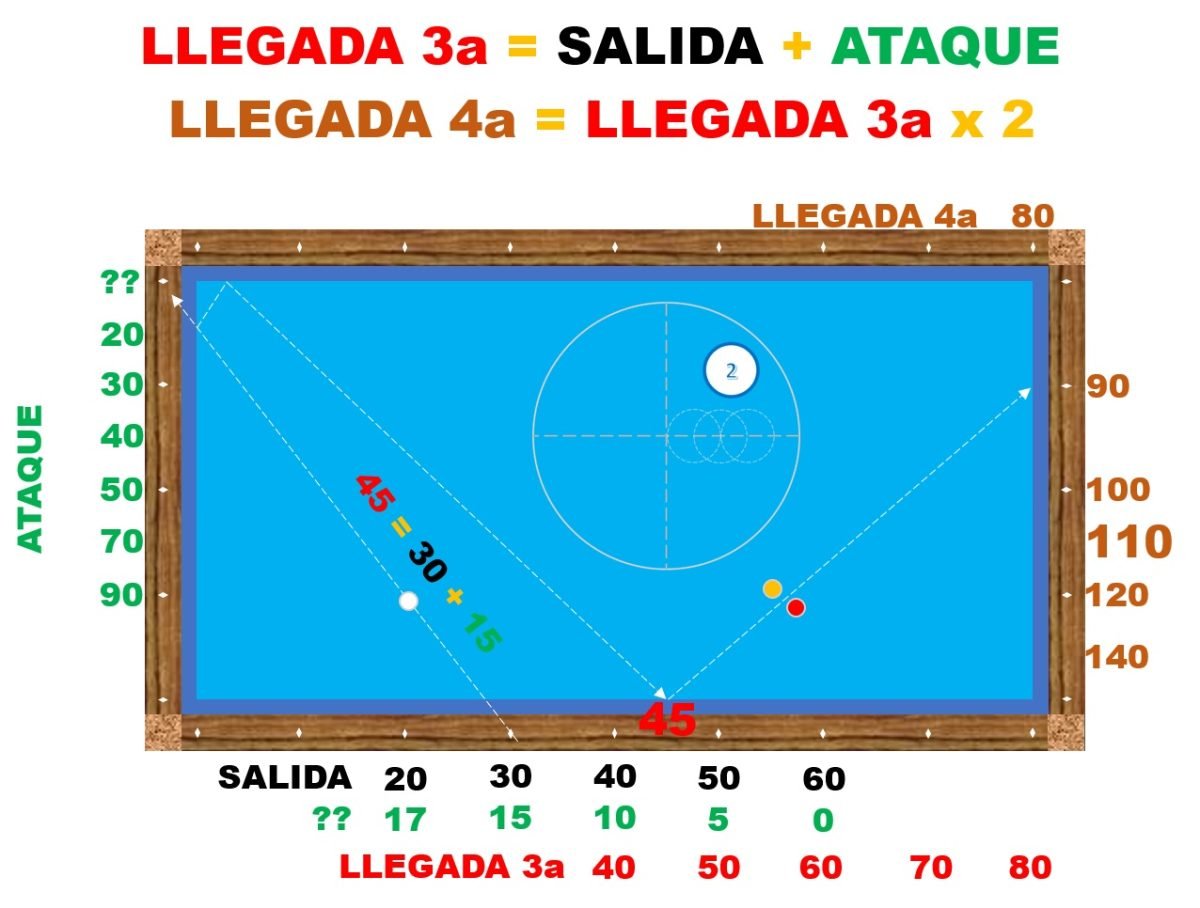
We present the Plus System Bible, a very important and common type of shot in three-cushion billiards. We offer a comprehensive guide of plus diamond systems, allowing us to cover most of the challenges presented by this type of carom shot and providing information to play them with any spin, thus giving us the option to modify the ball’s trajectory!
Mirror Plus System
New way to play the PLUS system using key #2 Effect and key #3 Mirror from the 7 keys of three-cushion billiards.
Classic Plus System
The Classic Plus System is one of the best known and most widely used by three-cushion billiards and pool players. It consists of three main sections based on the starting and ending values on the third rail.
- Starting from less than 20 with arrivals up to 40.
- Starting from less than 20 with arrivals greater than 40.
- Starting between 20 and 60.
Starting from less than 20 with arrivals up to 40
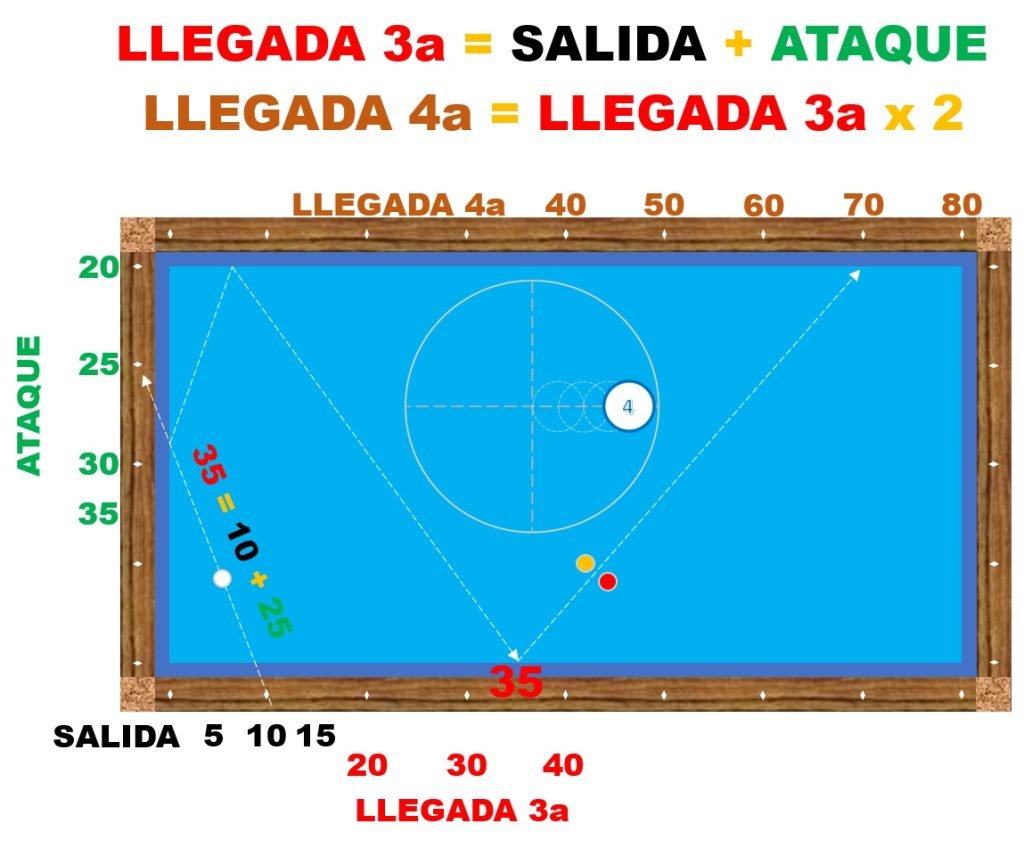
The graph above shows how to calculate the arrivals to the third and fourth rail. It uses an effect of 4 and applies to startings less than 20 and arrivals up to 40.
Calculation procedure:
First: Determine the arrival point on the third rail. In this case, the image shows a value of 35 .
Second: Find a combination of start and attack values that add up to 35 (the third-rail arrival value). The image shows a start of 10 and an attack of 25 .
Starting from less than 20 with arrivals greater than 40
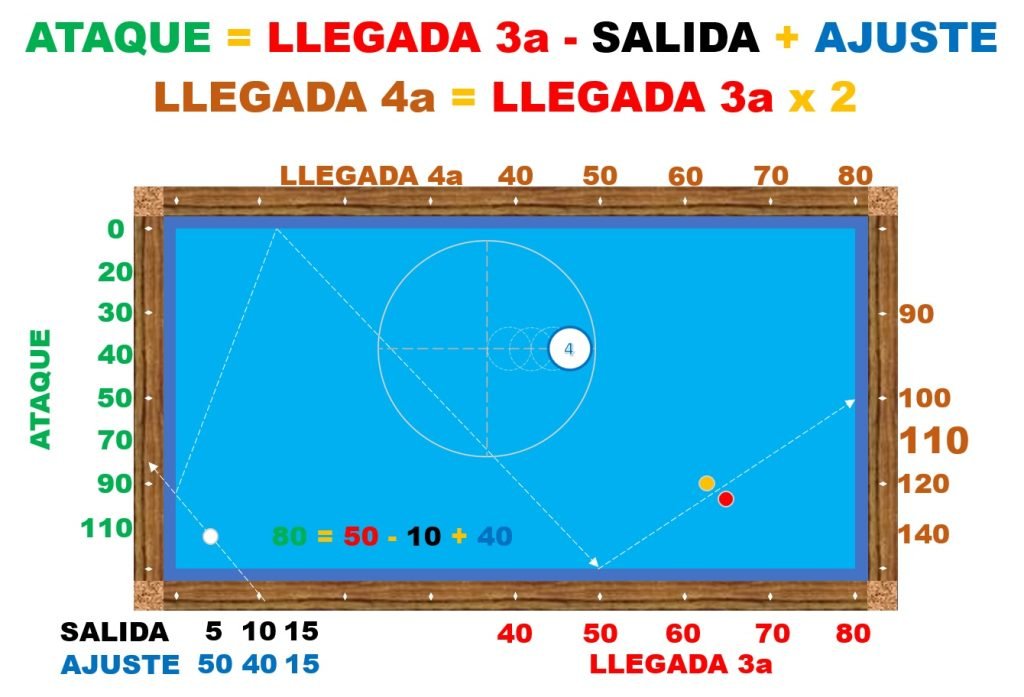
The graph above shows how to calculate the attack on the first rail and the arrivals on the third and fourth rails. It uses a effect of 4 and applies to startings less than 20 and arrivals greater than 40.
Calculation procedure:
First: Determine the arrival point on the third rail. In this case, the image shows a value of 50.
Second: Subtract the start value from the arrival value on the third rail (50). Sometimes several estimates of the start value are necessary. The image shows a start of 10, so we would obtain the value of 40 = 50 – 10.
Third: To determine the attack point on the first rail, add to the value obtained in the previous step (40), the adjustment value that corresponds to the start value 10, the image shows that the adjustment value is 40. Thus we would have an attack value of 80 = 40 + 40.
Starting between 20 and 60
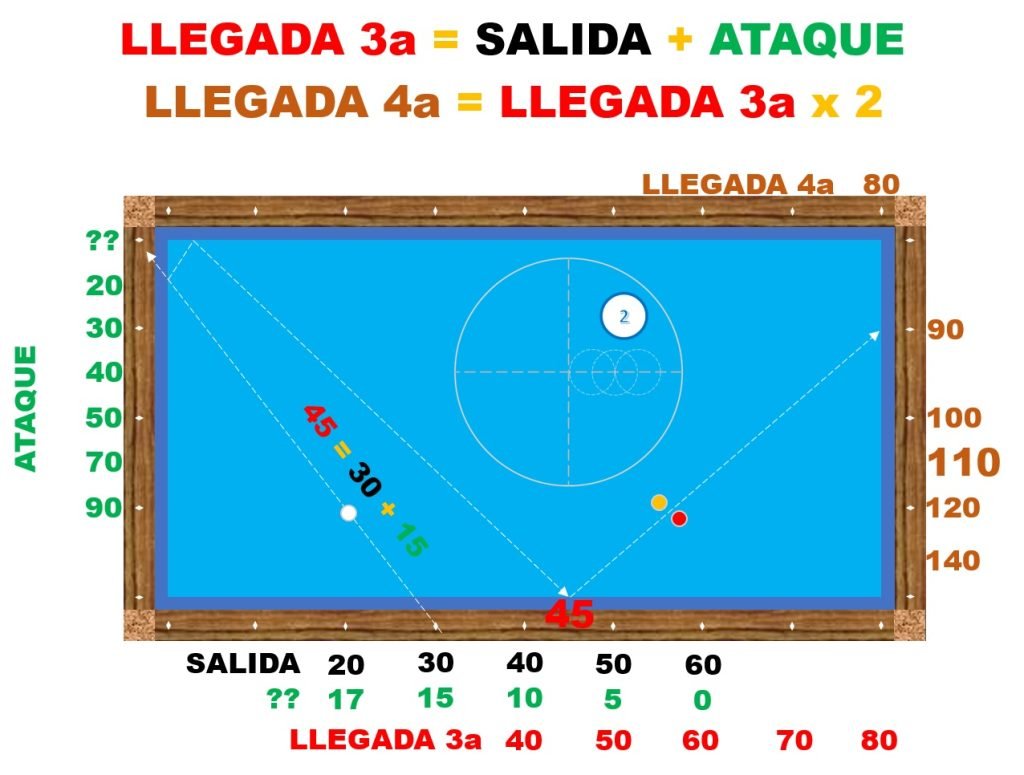
The graph above shows how to calculate the attack on the first rail and the arrivals on the third and fourth rails. It uses an effect of 2 and applies to starts between 20 and 60.
Calculation procedure:
First: Determine the arrival point on the third rail. In this case, the image shows a value of 45 .
Second: Find a combination of starting and attack values that add up to 45 (the third-rail arrival value). The image shows a starting value of 30 and an attack value of 15. Note that the attack value at the corner varies depending on the starting point.
Video of Classic Plus System
Below is a video where we explain the classic plus system and execute several caroms playing rail-first or normal shots.
X-Ray Plus System
There are many systems for playing plus, but none cover the zero-effect trajectories for starts from 0 to 40, except the x-ray plus system .
Introducing the X-Ray Plus System , an innovative, easy and efficient system for playing Plus carom billiards on the first half of the table.
Let’s watch the introductory video:
Speed Plus System
In the following video we explain the speed plus system and show how to play a variety of carom shots using this system.
Plus System by Spaces
The Plus System most used by professional three-cushion billiards players!
Imagine an exciting journey into the world of three-cushion billiards, where both players and game lovers can easily raise their level.
This ebook immerses you in more than 80 unique shots, breaking down each move clearly and simply.
Dare to improve your game and dazzle everyone in every match!

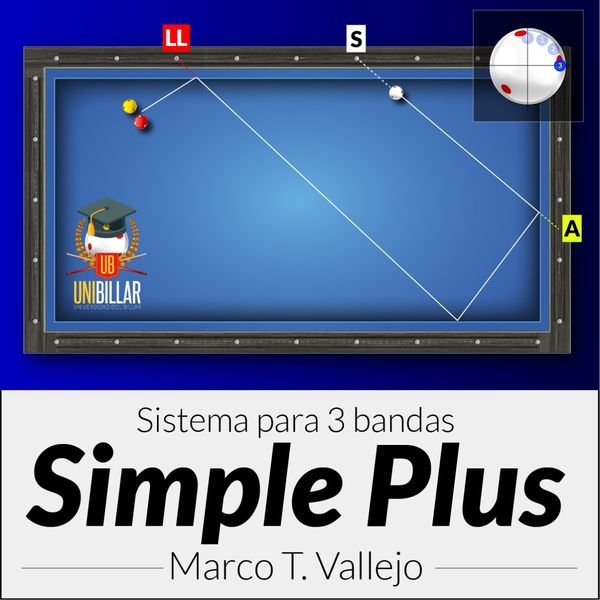
Simple Plus System
The Simple Plus System stands out as one of the most frequently adopted methods in three-cushion billiards.
Expert Marco Vallejo introduces us to an extraordinarily simple, yet exhaustively complete, version of the Plus system.
First, it details its numerical scheme using high-definition illustrations.
Secondly, it demonstrates how to execute rail-first and carom shots.
Third, it elaborates meticulously on how to establish connections to arrivals on the fourth rail and beyond.
Finally, it provides a wide range of examples and exercises that will help you become familiar with and solidify your mastery of the Plus system .
Multiply by 4 Plus System
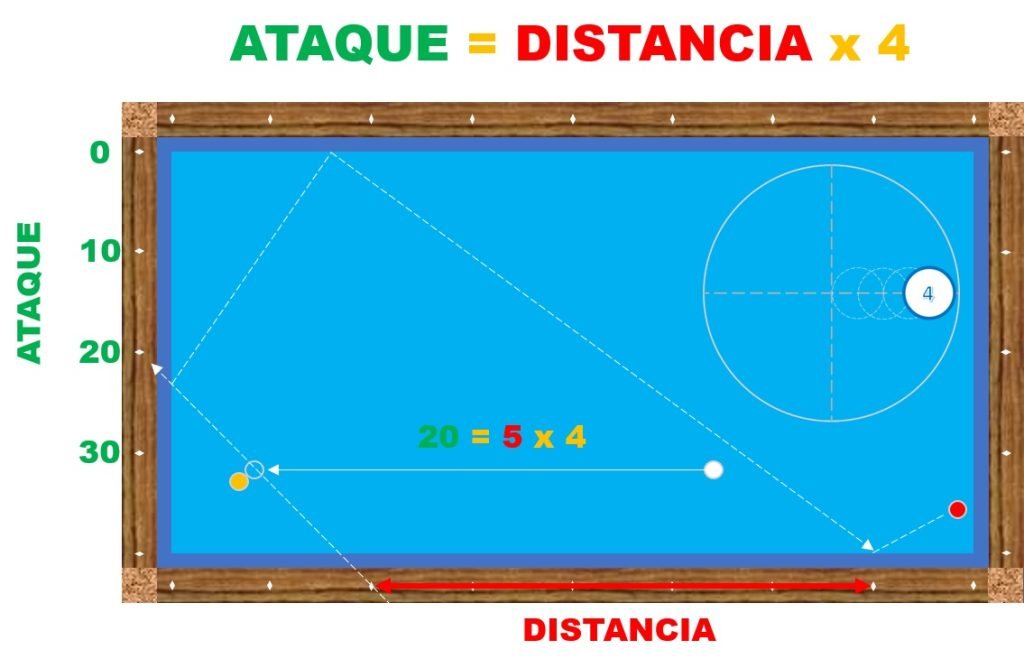
The diagram above shows a quick and easy way to calculate the attack on the first rail. This system is played with a 4-point effect.
The ATTACK is obtained by multiplying the distance in diamonds from the starting point to the arrival point by 4 .
The image shows a distance of 5 diamonds and therefore the attack value is 20 = 5 x 4.
Halves Plus System
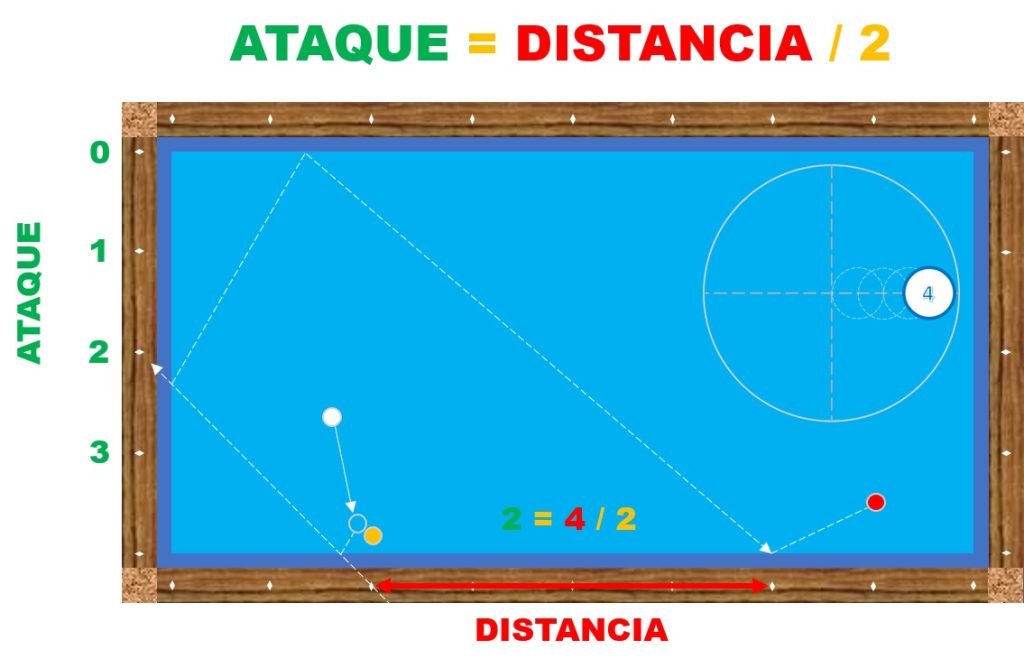
The graph above shows a quick and easy way to calculate the attack (in this case, on the second rail). This system is played with effect 4 .
The ATTACK is obtained by dividing the distance in diamonds from the starting point to the arrival point, by 2 .
The image shows a distance of 4 diamonds and therefore the attack value is 2 = 4 / 2.
It is recommended to use this system for shots shown in the graph; the additional rotation given by the ball hit and the additional rail compensate for the difference in results when compared to the multiply by 4 plus system .
A variant of the halves plus system is the Rodriguez System for box shots.
The Rodriguez System helps us determine the ball hit and spin to use in this type of shot.
VK+ Plus System
One of the most complex plus systems in existence, created by masters Frans Van Kuyk and Jean Michel Fray and published in the book “Billiards in Expansion” by Frederic Caudron.
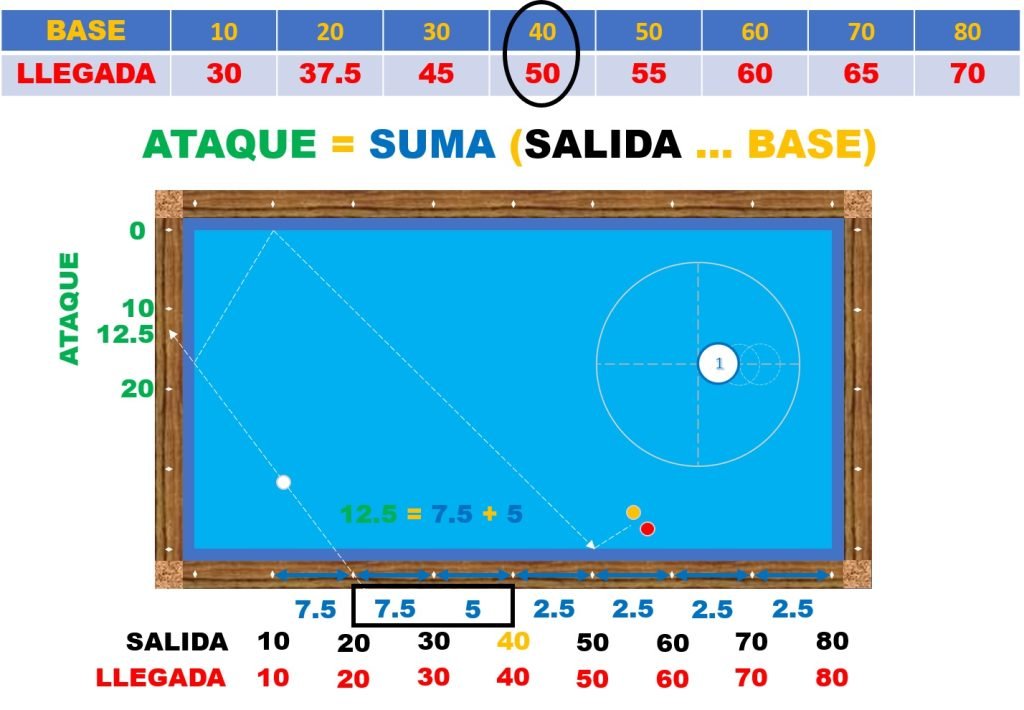
The graph above shows how to calculate the attack on the first rail. This system is played with 1-point effect and is recommended for shots from the second diamond (value 20).
Calculation procedure:
First: Determine the arrival point on the third rail. In this case, the image shows a value of 50 .
Second: Determine the BASE value that corresponds to the arrival value from the previous step. According to the table at the top of the image, the BASE value is 40 (for an arrival of 50).
Third: The ATTACK corresponds to the sum of the blue values between the starting point and the BASE . When the starting point is the same as the BASE point , the ATTACK is zero (0) .
In the image, the starting point is 20, therefore, to obtain the attack , we add the blue values that are inside the black box. 12.5 = 7.5 + 5.
Plus System without Effect
Learn how to lengthen the arrival on the third rail with the plus system without effect.
Playing without spin has many advantages, among them we avoid the deflection of the cue ball that occurs when we play with spin and we make it easier to hit the ball.
Corner Plus System without Effect
Incredibly, within the family of plus systems, the Corner Plus System without Effect is the least known and at the same time the easiest to memorize!

The system formula is very simple, since the arrival value on the third rail is obtained by adding 20 points to the start value.
In the publication “Sistema Plus sin Efecto” you will find a detailed explanation of the system and a video demonstration.
Extended Plus System without Effect
After studying the corner plus system without effect, we are left with the question: What about the rest of the attacks on the short rail?
Here is part of the answer:
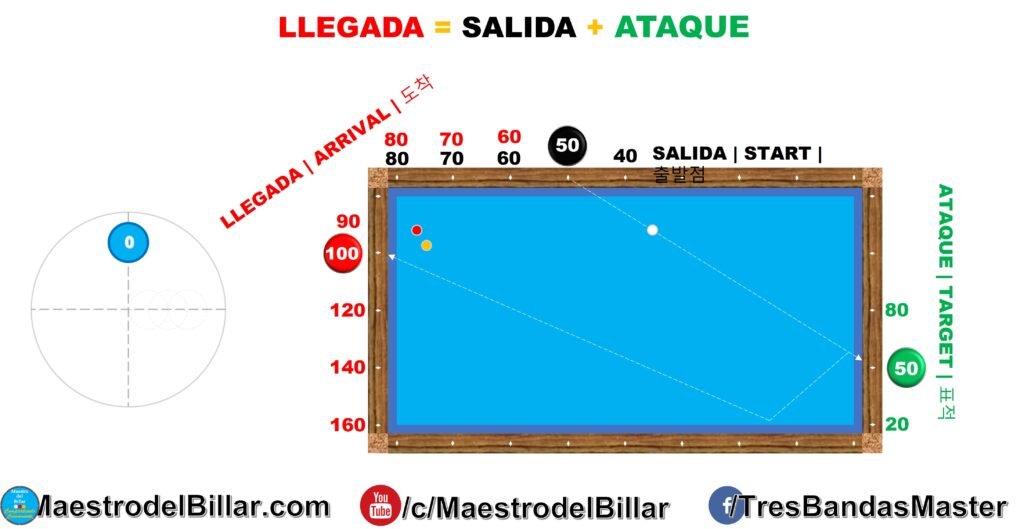
Find a complete explanation with graphics and video in the publication
Extended Plus System without Effect.
Negative Plus System
Avoid the typical “FINE” mistake with this incredible and innovative Negative Plus System in 3-Cushion Billiards.
Learn to say: “Take whatever rail you want!”
Renversé Plus System
In three-cushion billiards, security and confidence can make the difference between hesitating and executing a great carom shot.
Learn to solve KLLL positions with greater accuracy using the Renversé Plus System.
When we observe these types of shots, it is inevitable to think of two worlds.
On one hand, they are reminiscent of reverse caroms, although the first rail is not repeated.
On the other hand, they look like a KLLL plus shot, but executed with the opposite effect.
It’s as if we were right on the border between RENVERSÉ and PLUS.
Corner Plus System with Effect
With this system we avoid calculating the value of the attack on the first rail and only need to vary the effect to reach the desired point on the third rail.
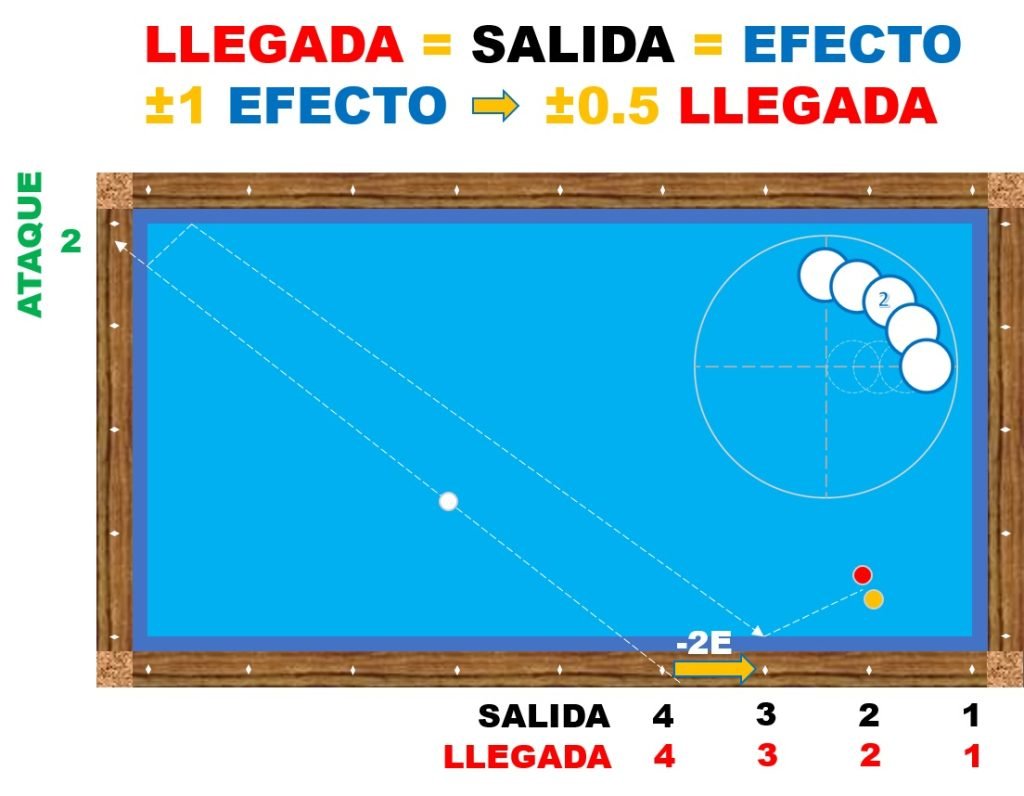
In the graph above we see an easy and quick way to calculate the effect, since the attack is a fixed value. This system applies to starts from the fifth diamond (value 4).
ARRIVAL = DEPARTURE = EFFECT.
If I want to reach 4, starting from 4, I use effect 4.
If I want to reach 3, starting from 3, I use effect 3.
If I want to reach 2, starting from 2, I use effect 2.
If I want to reach 1, starting from 1, I use effect 1 .
If I want to reach 3, starting from 4, I decrease 2 effects (1 for each half diamond between departure and arrival) and play with effect 2 = 4 – 2. This case corresponds to the one shown in the image.
If I want to reach 2, starting from 1, I increase 2 effects (1 for each half diamond between departure and arrival) and play with effect “3=1+2”.
Frederic Caudron’s Speed Plus System
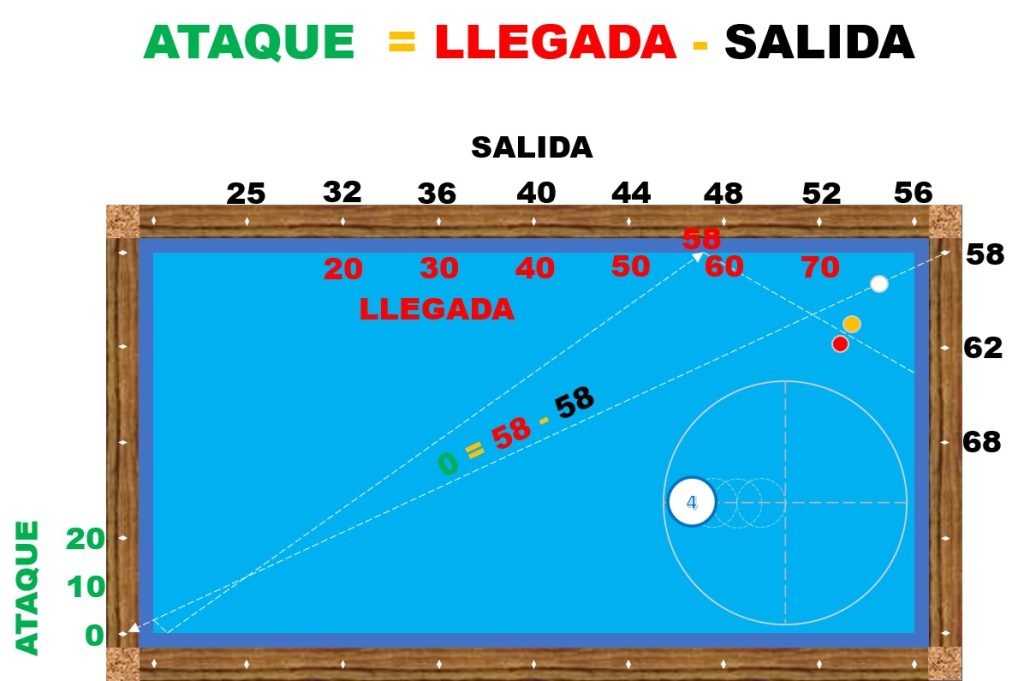
The graph above shows how to calculate attacks on the first rail and arrive to the third rail. The shot is played with effect (4) and speed.
Calculation procedure:
First: Determine the arrival point on the third rail, in this case the image shows a value of 58.
Second: Subtract the start value from the arrival value on the third rail (58). Sometimes several estimates of the start value are necessary. The image shows a start of 58, so we obtain the attack value 0 = 58 – 58.
Plus System Half of Zero
Masters Jaime Carrasco and the Skinny Billiards Player (Fernando Castillo) explain how to play plus with maximum effect to the bisector of the corner.
Playing in the Second Half of the Table.
Varying the Effect
Third to Fourth Rail Connections
TUZUL MOL Plus System
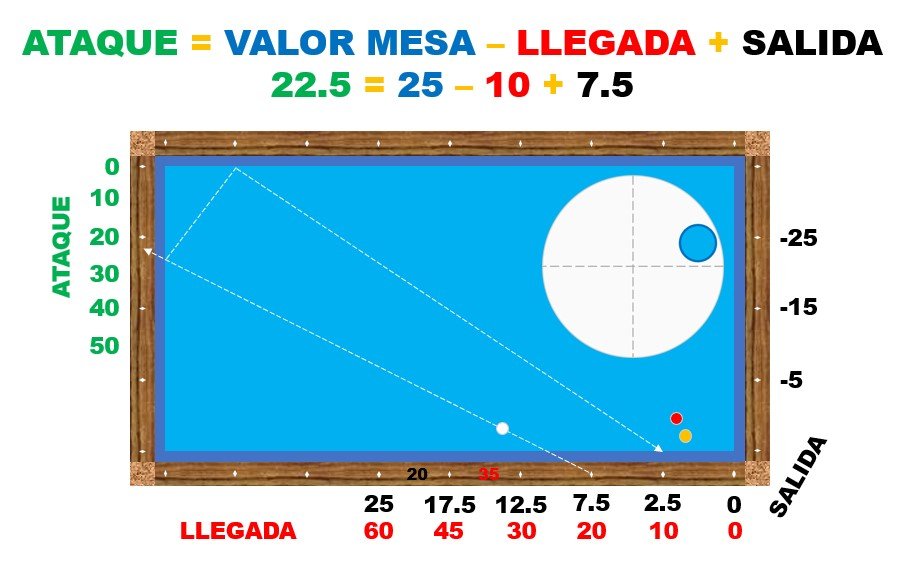
This system was created by the masters Murat Tuzul and Nuri Mol, and has the great advantage that its calculation formula includes a variable called table value, which allows the Tuzul Mol Plus System to be adapted to any type and condition of the playing table.
On a standard table, the table value will be approximately 25. This will increase to 27 or 28 on a table with worn and old cloth. And on a table with new cloth, it will be 23.
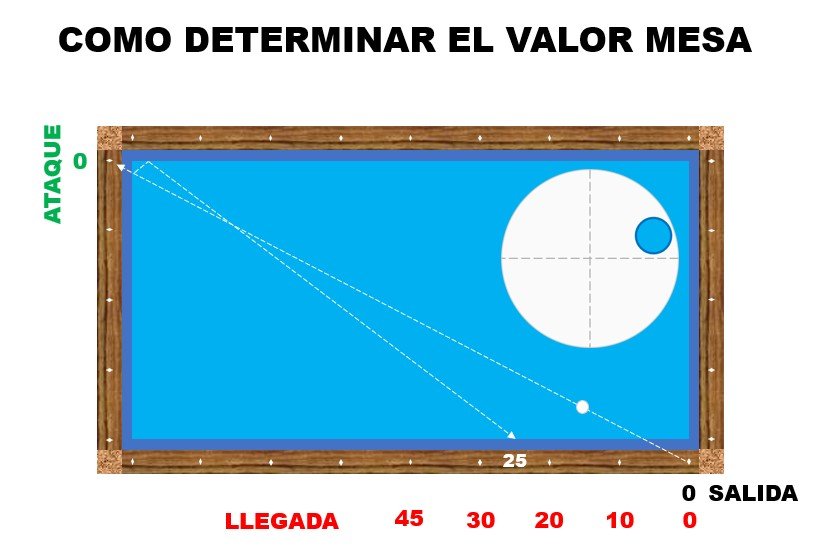
How to Determine the Table Value
To determine the table value, it is proposed to execute the following test shot and verify the arrival point on the third rail. Based on the red numbering, which corresponds to the third rail (the arrival rail), we will have the table value. In this case, the table value is 25.
Tuzul Mol Plus System Formula
The following graph shows the formula of the Tuzul Mol Plus System.
The arrival values go up to 50, we only include the value 60 as a reference for the scale that exists with respect to the arrival value of 45.
Note that the start values on the short rail are NEGATIVE.
Universal Plus System
A billiards master’s madness…
It’s an unknown and little-used system due to the complexity of its formula, but it has the great advantage that it can be used from any start point on the long or short rail!
The FACTOR is linked to the arrival value, that is, if I want to reach HALF of the short rail, the corresponding FACTOR is 7 .
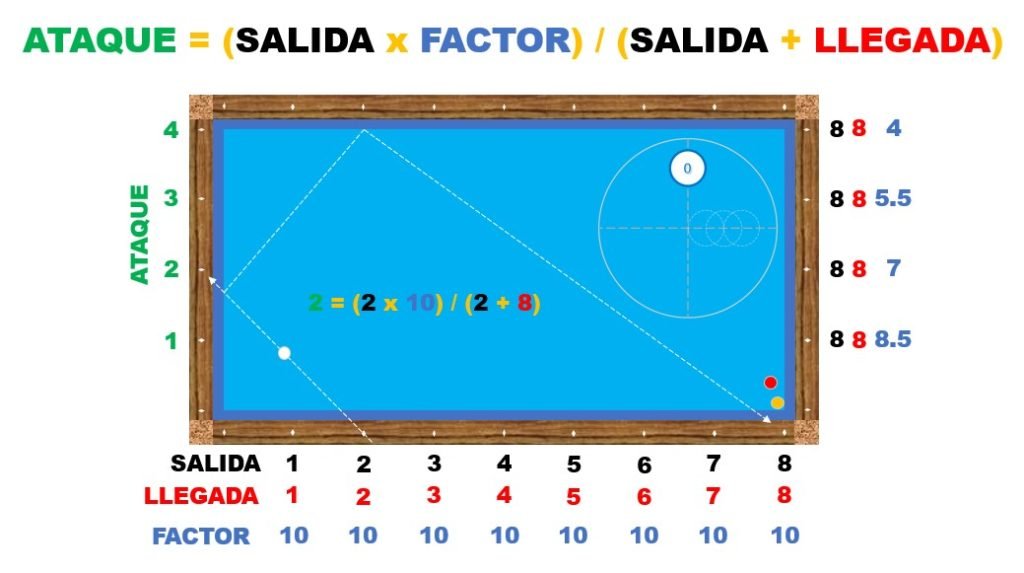
The diagram above shows how to calculate the attack on the first rail. This system is played without effect.
According to the image, to reach 8, starting from 2, we attack 2.
2 = (2 x 10) / (2 + 8).
2 = 20 / 10.