Three-cushion billiards lessons with Daniel Sanchez are a compilation of master classes by multiple world champion three-cushion billiards player Daniel Sanchez, offering a complete overview of the three-cushion billiards discipline, focusing on fundamental and advanced techniques for players of all levels.
How to configure subtitles in videos that are in a different language
Before starting the master classes by Maestro Daniel Sanchez, it is important that you know how to configure subtitles and automatic translation on YouTube.
In the following video, we will show you how to enable and disable subtitles. We will guide you so you can perform automatic translation into any language. We will explain a trick to allow you to do the above from your mobile device. And finally, we will see how to activate slow motion, forward and backward.
Bridge and Body Positioning
In this master class, multiple world champion Daniel Sánchez explains that it is very important to master the basic fundamentals, such as a balanced body posture and a solid bridge.
The Maestro emphasizes that there is no perfect universal technique, but rather each player must find a position that provides them with absolute comfort and stability when executing the stroke.
He details how adjusting the hand setup allows controlling the cue height to execute follow, draw, or curve spin shots with precision.
Additionally, this first class offers practical tips for assessing the table conditions and the reaction of the cushions during the brief warm-up periods prior to a competition.
Join The Billiards Master
Access the PREMIUM content of Billiards Master, exclusive for MEMBERS:
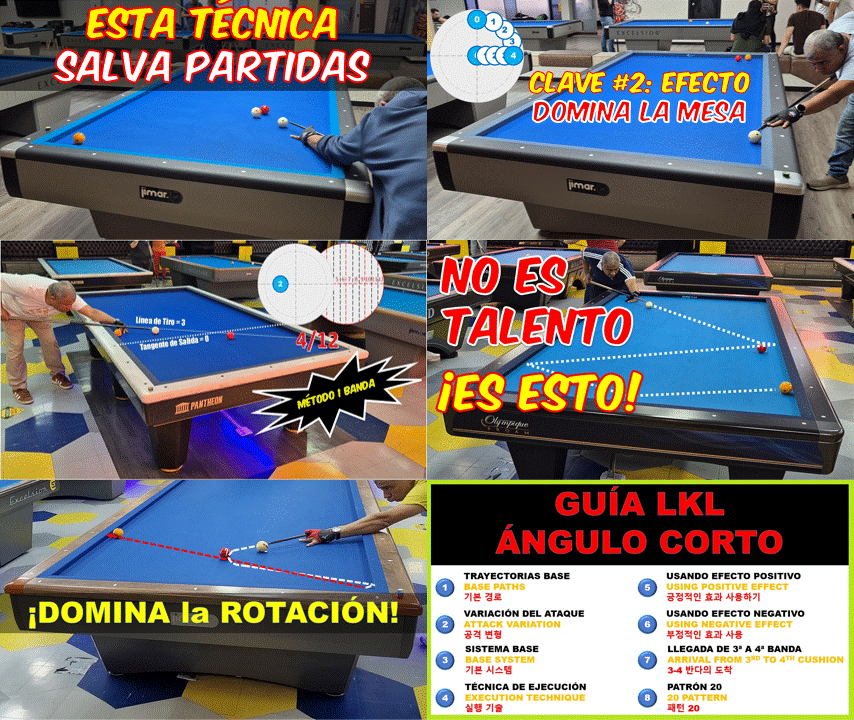
✅Key #6: Exit Tangent
✅Key #5: Shot Line
✅Banana Shot: Complete System
✅Key #4: Parallels
✅Chat with Billiards Psychologist
✅Hair Ball Hit Technique
✅Key #3: Mirror Technique
✅Key #2: English
✅Key #1: Halves System
✅Ball Hit for Pass Ball
✅1 Cushion Method
✅Vertical Pass Ball System
✅Cross Table System
✅Master Halves System
✅Vertical Counter Effect System
✅Master Rotation: Systems & Technique
✅X-Ray Plus System
✅LKL Short Angle Guide
Stroke Mechanics
Daniel Sanchez reveals the key principles of his stroke technique in three-cushion billiards. The class focuses on two fundamental topics. First, it details a personal and distinctive stroke technique that involves a deliberate “stop back” before executing the shot. This method is presented as a means to achieve superior precision, cleanliness, and control, by allowing the shot to be fully conceptualized in the player’s mind before releasing the cue. Second, it examines the principle that power generation in shots does not primarily depend on physical strength, but on speed. Danny argues that a combination of arm strength and, crucially, movement speed, allows for the execution of high-power shots, an essential skill for resolving complex game situations and ensuring the cue ball follows the correct trajectory.
Mastery and Application of Spin in Billiards
This class synthesizes Daniel Sanchez’s teachings and philosophy on the control and application of spin.
The main focus moves away from strict reliance on mathematical systems, instead promoting a deep intuitive understanding of ball behavior.
This understanding is cultivated through deliberate and repetitive practice. Key methods include spin calibration exercises at short and long angles, aiming at specific diamonds to memorize the ball’s reaction.
The advanced concept of “spin ball” (ball with maximum rotation) is introduced, a technique that uses a thick hit on the object ball to maximize the cue ball’s spin upon reaching the third rail, thereby increasing the chances of scoring.
The ultimate goal is to develop the sensitivity and muscle and mental memory that allow the player to visualize and execute complex shots with precision and confidence.
Korean Systems for Three Cushion Billiards
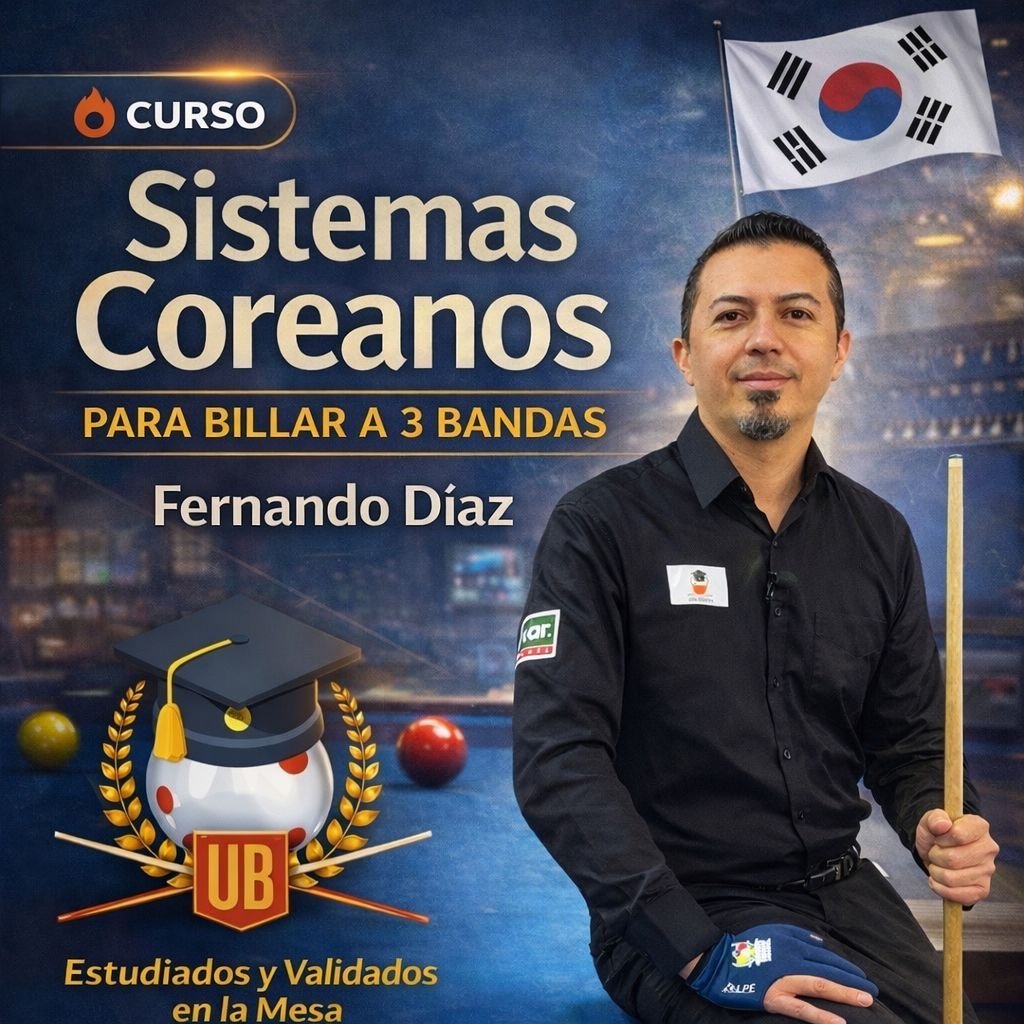
Fernando Díaz presents a selection of Korean systems applied to 3-cushion billiards, the result of years of research, training and direct validation on the table.
Fernando Díaz is a multiple champion, coach of the main leagues in Colombia and recognized as one of the greatest billiards experts in Latin America.
Mastering Hit Thickness
Mastery in billiards depends on the ability to simplify complex variables. Sánchez’s central thesis is that the half-ball hit should be the foundation of the game due to its predictability and ease of execution compared to thinner or fractional hits. Instead of constantly varying the amount of ball contact (which complicates the ball’s reaction), the recommended strategy is to maintain a constant thickness and adjust the shot outcome through variations in speed and spin.
1. Half-Ball Thickness: Reference and Execution
Thickness, colloquially referred to in Korean as tuk, is one of the pillars of Sánchez’s technique. Among the different impact options, the half-ball stands out for being less sensitive to error than thin hits.
The 45-Degree Rule
To master the half-ball, it is essential to know how to identify it precisely. Sánchez proposes a technical verification method:
- Positioning: Balls aligned in a straight line.
- The Test: If the ball is struck perfectly in the middle (with normal speed and no spin), the cue ball must travel at a 45° angle after the impact.
- Diagnosis: If the ball hits the red ball very thinly or not fully, it indicates that the perfect half-ball thickness has not been achieved.
Advantages of Consistency
The recurrent use of the half-ball offers a critical competitive advantage:
- Predictable reaction: By always using the same thickness, the balls’ reaction tends to be constant.
- Simplification of the game: Constantly alternating between three-quarter ball, half-ball, and quarter-ball increases complexity and the margin for error.
2. Adjustment Strategy: Spin and Speed
Sánchez bases his playing system on minimizing changes in thickness. Instead of “refining” or “thickening” the impact to reach different points on the table, he prefers to keep the half-ball as a constant and alter other variables.
| Adjustment Variable | Explanation |
| Speed | Increased or decreased to control the travel distance, while maintaining the half-ball thickness. |
| Spin | Used to compensate for the trajectory. If a half-ball shot comes up “short,” the spin is increased (for example, to maximum spin) instead of changing the amount of ball contact. |
This approach allows the player to become deeply familiar with a single “ball hit,” facilitating execution under pressure.
3. Handling Thin and Sensitive Balls
Unlike full or half-ball shots, thin shots are described as “very sensitive.” The slightest deviation in impact can result in a complete miss, as the perception of a thin hit is less clear for the player.
“Maximum Difficulty” Training Philosophy
Sánchez details a method of psychological and technical preparation based on limit training:
- Extreme practice: Players must practice shots with the thinnest possible hit thickness and at long distances (for example, hitting the yellow ball very thinly to achieve a long path).
- Fear reduction: By repeatedly practicing and missing these shots during training, the player loses the fear of failing.
- Perception of ease: When a position arises in a real match that requires a thin shot, but not as extreme as those practiced, it appears “easy” by comparison, which increases the player’s confidence and control.
4. Specific Training Exercises
The document identifies two essential practice routines that Sánchez has performed for years to perfect his control:
- Internal Thin Shot with Spin: Practice very thin hits on the inside of the ball using spin. The goal is to master sensitivity in tight positions so that open positions become simple.
- Long-Distance Thin Shot (No Spin): Hit the ball extremely thinly from the other end of the table to achieve specific trajectories. This exercise is fundamental for getting used to hitting minimal thicknesses at long distances.
Conclusion
Sánchez’s methodology does not seek complexity, but rather standardization. By making the half-ball the main tool and adjusting the shot through spin and speed, the billiard player reduces uncertainty. Training extreme thin hit thicknesses is not solely for the success of difficult shots, but for the psychological and technical facilitation of medium-difficulty shots during competition.
UNIBILLAR: The Billiards University
Access a wide variety of digital billiards content.
Study at UNIBILLAR, the Billiards University, with the best instructors in Latin America.
José “Pepe” Hernandez, Pedro Gonzalez, Marco Vallejo, Fernando Diaz, Mauricio Gutierrez, Carlos Vallejo, Fernando Castillo “El Flaco Billarista”, Rafael Galeano.

Master Guide to the Double Cushion Shot (Bounding) in Three-Cushion Billiards
The repetition shot, technically known as bounding, is an advanced billiards technique based on a follow shot (follow shot) with a considerable amount of ball. This movement allows the cue ball to bounce consecutively on the same rail or between nearby rails, facilitating the resolution of complex positions where a thin shot or a standard four-rail path would be imprecise.
The effectiveness of bounding lies in its high success rate when the angle is correct, being, in the words of master Daniel Sánchez, a shot “easier to make than to miss”.
Key elements for successful execution include using a high bridge, a deep follow shot, and a slight application of reverse spin (reverse spin) to favor the repetition.
1. Technical Fundamentals of the Bounding Shot
Bounding is not a shot of brute power, but of striking technique and understanding of the ball’s reaction against the rail. According to the analysis of Daniel Sánchez’s technique, the essential components are:
- Contact Point on the Cue Ball: The ball must be struck on the upper part (follow or follow). It is not possible to execute this shot by hitting the center of the ball, as the follow effect is what allows the ball to “stick” or bounce repeatedly on the rail.
- Hit Thickness: It is necessary to hit a large portion of the object ball (full ball or more than half ball).
- Use of Spin: Applying a small amount of reverse spin (reverse spin) is crucial, as it helps the ball react more intensely upon hitting the cushion, facilitating the multiple rebound effect.
- Stroke Mechanics: To achieve the necessary height on the ball, it is recommended to use a high bridge with closed fingers to elevate the hand. The stroke should be fluid and extended (follow stroke).
Reaction Dynamics
After hitting the first cushion, the ball may bounce two, three, or even four times depending on the quality of the stroke, the cloth, and the speed. The goal is for the ball to “dance” on the cushion or maintain a controlled trajectory toward the scoring point.
2. Strategic Application and Decision Making
The use of bounding is justified when it offers a higher probability of success than traditional alternatives. The master identifies specific scenarios for its implementation:
When to choose Bounding
- Natural Angles: It is ideal when the angle to the first cushion is natural after hitting half ball or more.
- Securing the Point: In high-pressure situations where a carom needs to be secured, bounding is preferable because, with the correct angle, the arrival zone is very wide.
- Alternative to Thin Shots: When a thin shot (thin shot) is too risky or difficult to control, bounding offers a more robust and easier-to-repeat route.
When to avoid Bounding
- Unfavorable Angles: If the cue ball position makes access to the first cushion difficult after impact, it is preferable to opt for a thin shot.
- “Large” Balls: If the object ball is in a position where a four-cushion path has a very wide margin of error (large ball), the complexity of bounding may not be necessary unless specific control of the subsequent position is sought.
3. Case Analysis and Competitive Experiences
The effectiveness and versatility of this shot are demonstrated through experiences in high-level competitive environments, such as the PBA (Professional Billiards Association).
The Challenge of the Triple Consecutive Cushion
Sánchez describes an extreme execution performed in a tournament, where the cue ball bounced three times on the same cushion before completing the carom. This level of execution represents the maximum potential of the technique and requires maximum follow and a high-precision stroke.
The Psychological and Confidence Factor
A notable case occurred in the team league, where a player (Chi) was suggested to execute a bounding instead of a conventional thin shot. Despite not having practiced the shot previously in competition, the simplicity of the mechanics (full ball, follow, and reverse spin) allowed her to execute it perfectly. This underscores that bounding, once its logic is understood, is an accessible shot that generates great confidence in the player.
4. Execution Comparison
The following table summarizes the key differences between the doubling shot and conventional options according to the game context:
| Feature | Bounding Shot (Bounding) | Thin Shot (Thin Shot) | Four-Cushion Path |
| Contact Difficulty | Low (Thick hit) | High (Minimal contact) | Medium |
| Trajectory Control | Based on rebound and spin | Based on angle precision | Based on the diamond system |
| Margin of Error | Very high (if the angle is good) | Low | Variable depending on position |
| Technical Requirement | High bridge and follow | Stability and aiming | Speed and spin control |
Conclusion
Bounding is established as an indispensable tool in the arsenal of a professional billiards player. It should not be considered an exhibition shot, but rather a practical, high-percentage solution for situations where angle control through cushion doubling surpasses the reliability of traditional methods. The key to success lies in the combination of an aggressive follow stroke, a thick hit on the ball, and a subtle application of reverse spin to master the cushion reaction.
The Role of Confidence and Tactics in Competitive Billiards
Daniel Sanchez analyzes game dynamics, technique, and the psychological factor in professional billiards, drawing on his experience as a PBA (Professional Billiards Association) player competing in the doubles format (fourset) alongside LPBA (Ladies Professional Billiards Association) players.
The main conclusions highlight that, while LPBA players possess exceptional technical skill —sometimes surpassing their male counterparts in rail-first systems (bankshots)—, they face critical barriers related to self-confidence and a tendency to overcomplicate their executions.
The analysis suggests that simplifying tactics, prioritizing power and hit thickness over extreme precision, along with positive mental reinforcement, are the determining factors for reaching the highest competitive level.
Strategies and Philosophy of Position Play in Three-Cushion Billiards
This lesson synthesizes the key lessons on position play in three-cushion billiards, based on the technical and strategic experience presented in session seven of “POSITION PLAY” by master Daniel Sanchez. The central concept transcends the simple placement of a ball; it is defined as the art of “opening the billiards” and giving meaning to each execution to avoid unfavorable positions.
The fundamental pillars identified are:
• Space management: Identifying critical zones on the table where balls should not be left.
• Ball 2 control: Doubling techniques to maintain a favorable position and chain long series.
• Risk-reward criterion: The absolute priority must always be securing the point before attempting a complex position shot.
• Creative mindset: Position play allows the professional player to dictate the flow of the match rather than relying on luck, which is essential for achieving high averages.
1. Definition and Concept of Position Play
Position play is not limited to placing the ball at an exact point; it is a proactive strategy to facilitate the future development of the game.
• Avoiding the negative: The primary objective is not just to reach a “perfect” position, but to actively avoid ending up in a “bad position.”
• “Opening up the billiards”: This means making the game bigger and more logical. Instead of viewing each shot as an isolated event, the goal is a fluid transition that increases the chances of success on the next shot.
• Creation vs. Execution: It is described as a creative process where the player does not just shoot to score, but moves the balls to set the desired stage.
2. Geographical Analysis of the Table
Mastering position requires a deep knowledge of the safety and danger zones within the billiards table.
Unfavorable Zones
• The two-diamond area: The space around (1 diamond) the central diamond of the rails is identified as a particularly negative place to leave the ball.
• Critical central zones: Sometimes, leaving the ball in the exact center of the table can be counterproductive if there is no specific control plan.
Favorable Zones
• Proximity to the rails: Generally, it is preferable to leave the ball near the rail rather than in uncertain intermediate areas.
• The strategic center: If playing with control, the center of the table is advantageous because it allows using multiple rails (3 to 5 rails) and offers various aiming options for the next point.
3. Execution Techniques and Ball Control
To master position play, it is necessary to apply specific techniques to the object ball (ball 2).
| Technique | Description | Objective |
|---|---|---|
| Thickness and Spin Control | Adjusting the impact (thicker or thinner) and the spin. | Pushing ball 2 toward a specific corner to secure the next shot. |
| Ball 2 Path | Hitting ball 2 so it makes a long-short-long path. | Make ball 2 return to its original position to repeat the shot. |
| Speed Control | Apply a moderate and controlled speed. | Keep the balls in the center of the table to have “the game under control.” |
The repetition practice method
A key training technique involves manually placing the balls after a successful shot to repeat the same execution. The goal is to ensure that, after scoring, the red ball returns to the same point, allowing for 4 or 5 consecutive points with minimal variation in the table layout.
4. Decision Making and Risk Management
Position play introduces a layer of technical difficulty that the player must evaluate according to the match context.
The Priority of the Point
The golden rule is: secure the point first. It makes no sense to attempt a position shot if the risk of missing the current shot is too high. If the point is missed, the position strategy is worthless.
The “Bonus” Concept
Position play is viewed as an investment. By choosing a more difficult path (for example, hitting thicker instead of a simpler thin shot), the player assumes a risk in exchange for a “bonus”: an easy second ball and the possibility of a high run.
Decision Factors
1. Score Status: If only one point is needed to win, the easiest path is chosen. If a long run is needed (e.g., 10 points), it is imperative to take risks in position play.
2. Confidence and Feel: If the player feels comfortable and “feels the table,” they should be aggressive with position. If there is no good feel, it is better to focus exclusively on scoring.
5. Conclusions on Professional Performance
The analysis concludes that position play is what differentiates a high-average player from one who relies on luck.
• Consistency: Without position play, high runs (5 or more points) depend on luck in how the balls are left.
• Control of Destiny: The professional player moves the balls at will to create opportunities, ensuring the game has continuous tactical sense.
• Final Result: By “opening the game” and avoiding dead zones on the table, the probabilities of maintaining control of the break and dominating the opponent are maximized.