The BEST thing about this Three-Cushion Billiards Course is that it is FREE and your best option to improve your three-cushion billiards level.
The content of this course is being progressively updated.
FREE COURSE · 4/4 · MASTER LEVEL
What you will learn: Develop position play, run preparation and the strategic decisions used by Caudron, Saygıner and Sánchez.
First lesson: 1.0 Introduction: The Strategic Art of Positional Play
Practice challenge: Before shooting, identify a possible position for all three balls for the next carom. Play the shot and compare the actual result with what you planned.
Before starting: if you do not know how to enable, remove, or configure the video subtitles in different languages, I invite you to watch the following video:
1.0 Introduction: The Strategic Art of Positional Play
Mastery in three-cushion billiards is not measured solely by the ability to execute complex caroms, but is forged in the art of anticipating and building the next shot. This mastery, known as positional play, is the fundamental difference that separates good players from elite masters. It is a strategic discipline where every stroke aims not only to score the current point but also to orchestrate the ball positions to facilitate the next carom, thereby creating long series and controlling the pace of the game.
At the pinnacle of this sport, Fred Caudron and Semih Saygıner stand out as two of its most influential exponents. Both are virtuosos of ball control and masters of positional play. However, although the result of their excellence is similar, their underlying philosophies and decision-making processes at the table present fascinating differences.
The objective of this course is to analyze and contrast their approaches to ball control, shot selection, and strategic mindset. Using exclusively the explanations and demonstrations provided by the masters themselves in their videos, we will break down Caudron’s pragmatic system and Saygıner’s conceptual mindset to offer a deep insight into two distinct paths to mastery in three-cushion billiards.
2.0 Fred Caudron’s Pragmatic Philosophy: A Rule-Based System
Fred Caudron’s approach to positional play can be codified as an eminently pragmatic and hierarchical system. It is not based on abstract intuition, but on a set of clear rules, developed through experience, designed to maximize efficiency and minimize the probability of error. This approach reduces cognitive load under pressure, allowing the player to rely on a proven process rather than depending on momentary inspiration. His method is a logical process where the security of the current point is the indispensable foundation upon which future opportunities are built.
Caudron’s Five Fundamental Rules
English version:
Caudron articulates his philosophy in five fundamental rules that guide his decision-making at the table.
- Rule 1: Secure the Point First: This is his most important and non-negotiable guideline. Caudron warns that it is very nice to leave a good position, but if you do not make the point, it is foolishness. This rule establishes a clear hierarchy: any attempt at positional play is useless if it puts the current carom at risk. The absolute priority is always to score the point.
- Rule 2: Make the Right Choice for an Automatic Position: When a position offers multiple solutions to score, Caudron advocates selecting the shot that generates a good position naturally and simply. Instead of forcing a complex solution, one should choose the option that, by its very nature, leaves a favorable continuation. He calls this an “automatic position”.
- Rule 3: Stay Close to the Third Ball: The logic behind this rule is distance management. When executing a shot, the goal is for the cue ball to finish its travel as close as possible to the third ball (the one not initially struck). This proximity greatly facilitates the next shot, as he himself states, a large distance is difficult to control, while a small one is very easy.
- Rule 4: Adapt the Speed if Necessary: This rule applies in situations where a slow, controlled shot guarantees a poor future position. In these cases, Caudron recommends using greater speed. The objective is “try to move the third ball” (‘try to move the third ball’) to break the unfavorable configuration, thereby increasing the probability that the balls reorganize into a favorable continuation. There is no guarantee, but the chances of obtaining an easy position increase.
- Rule 5: Avoid the Short Rails: Caudron defines the short rail zone as a positionally defensive and difficult area. He actively advises avoiding leaving balls in this zone, as it drastically limits playing options. The only exception is when the three balls are already clustered in that area, which can generate multiple possibilities.
Tactical Application on the Table
The application of this system is visible in his decisions during the game:
Ball Hit Master System
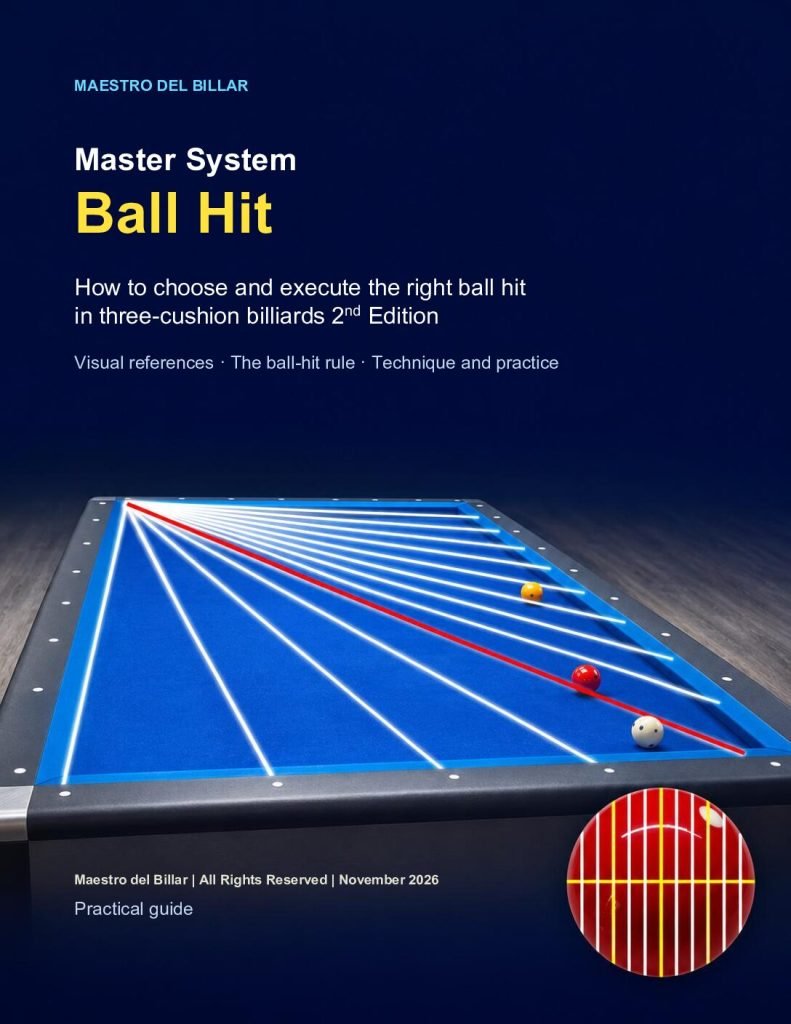
Even when you can read the path of a carom, one decision shapes the shot: how much of the object ball to hit to send the cue ball along that path. This guide shows how to read the key reference points, judge the thickness of the hit, aim with your cue, play feather-thin contacts, and use the reflections and shadows on the balls and cloth.
- In a situation with the red ball near the short rail, his first thought is to apply Rule 5 (avoid the short rail). However, he recognizes that the execution to get the ball out of there is risky. Immediately, he invokes Rule 1 (secure the point first) and prioritizes the safest execution. By prioritizing the carom, Caudron secures the point. The result is that the red ball ends up “not too bad” and, crucially, he is left close to the third ball, demonstrating how his rules support each other even when one takes priority.
- Facing an open position with multiple options, Caudron chooses the shot that offers him an “automatic position” (Rule 2). He selects a stroke that, with normal speed, moves the red ball toward the center of the table while his cue ball approaches the third, thus combining multiple principles in a single efficient decision.
- In a difficult shot with limited positional control, his objective is simplified: not to give too much speed to the cue ball in order to “stay close to the third ball” (Rule 3). Although the result may not be perfect, the proximity guarantees that he will have a feasible next shot thanks to the short distance.
Caudron’s system is, in essence, a disciplined and priority-based approach that seeks excellence through consistency and risk mitigation, a solid foundation that we will now contrast with the more conceptual philosophy of Semih Saygıner.
3.0 The Strategic Mindset of Semih Saygıner: Maximizing Future Variations
Unlike the regulated Caudron system, Semih Saygıner‘s approach is presented not as a set of rules, but as a holistic “mindset”. His philosophy does not focus on achieving a single, pre-defined “perfect” position, but on creating an ecosystem of opportunities on the table. The goal is to execute shots that increase the number of options and potential solutions for the next carom, transforming positional play into an act of proactively creating possibilities.
Key Principles of Saygıner’s Mindset
- Playing with Margin and Thickness: Saygıner criticizes the reliance on “delicate” or thin shots, arguing that they are inherently risky because, under pressure, the margin for error is minimal. Instead, he advocates hitting the ball thicker whenever possible. This approach has a dual benefit: first, it increases the “margin” for error to make the carom, making the point safer; second, it transfers more energy to the object balls (without exaggerating), allowing for superior control over their final position. This is a crucial lesson for intermediate players who often confuse thinness with precision. Saygıner teaches us that true precision often lies in creating a larger margin for error, a much more robust strategy under the pressure of competition.
- The Goal: Increase Options, Not Perfection: Saygıner’s central concept is that a “good position” is not a ball stopped at an exact point, but a ball located in a strategic zone that opens up multiple possibilities. His goal is to “make the potential positional variations much greater than normal”. Saygıner demonstrates this with a ball near the center: “look, it’s all mine… you have many variations”. He shows how from that zone he can attack inside, outside, to 5 rails, or direct, in contrast to a ball against the rail where there may be “no entry” at all. A “good position” is not a point; it is an epicenter of possibilities.
- Controlling the Second Ball’s Path: A pillar of his mindset is the understanding and active control of the trajectory of the second ball struck. While many players focus on the cue ball, Saygıner emphasizes that knowing where the second ball will travel is crucial. He uses shots where this second ball travels across the table to position itself in an ideal spot, demonstrating that positional play is a deliberate control over all three balls. To master this, he recommends practicing with only two balls to internalize their behavior.
Strategic Geography of the Table
Saygıner visualizes the table in terms of favorable and unfavorable zones, defined by the number of “variations” they allow.
- A ball in the corner or against the short rail is “dangerous”. Why? Because, in his words, there may be no “entry” (entrance) or angle of attack. It drastically limits the possible solutions, often forcing “forced shots”.
- In contrast, a ball in the center of the table or slightly away from the rail is ideal. Saygıner demonstrates how a ball in this zone opens up a fan of possibilities. A slight difference in the position of the third ball can drastically change the landscape from difficult to easy.
Saygıner’s strategy is, therefore, a proactive management of the table’s geography, a constant effort to create and expand future opportunities, which sets the stage for a direct comparison with Caudron’s pragmatic approach.
4.0 Comparative Analysis and Points of Convergence
While both masters tirelessly seek positional excellence, their paths to achieving it differ in their fundamental philosophy. Caudron builds his game on a foundation of safety and hierarchical rules, whereas Saygıner does so on a principle of expanding possibilities. This contrast in mental approach defines their unique styles.
| Strategic Characteristic | Fred Caudron (Pragmatic Approach) | Semih Saygıner (Conceptual Approach) |
| Primary Priority | Securing the point first (Rule #1) is the supreme commandment, above any positional consideration. | Choosing a shot that inherently creates more future options, which often facilitates executing the point by allowing play with more margin. |
| Definition of “Good Position” | A position that allows for an easy next shot, often defined by the proximity of the cue ball to the third ball. | A configuration on the table that maximizes the number of “variations” or possible solutions for the next point, placing the balls in strategic zones. |
| Mental Approach | A logical and hierarchical system based on 5 rules applicable to most situations. | A “mindset” for understanding the flow of the game, the geometry of opportunities, and the proactive creation of possibilities. |
| Ball Control | Focuses on controlling the cue ball (keeping it near the third ball) and preventing the object balls from ending up in bad zones (short rail). | Places crucial emphasis on the active control of the second object ball’s path to deliberately place it in a strategic zone. |
Despite their philosophical differences, there are clear points of convergence in their strategic analyses. Both masters recognize the crucial importance of speed control (tempo) as the main tool for executing positional play. Likewise, both fully agree on the table’s geography: the short rails and corners are unfavorable positional zones that must be actively avoided, as they limit options and complicate the game.
This shared foundation of fundamental principles underscores that, although their methods vary, their understanding of three-cushion billiards dynamics is deeply similar, leading us to the final conclusions of this course.
5.0 Conclusion: Two Paths to Mastery
This analysis has revealed two distinct but equally effective philosophies for mastering positional play in three-cushion billiards. On one hand, Fred Caudron’s system represents a structured, disciplined, and risk-mitigation-based approach. His five rules offer a logical framework that prioritizes consistency and efficiency. On the other hand, Semih Saygıner’s “mindset” embodies a more expansive and conceptual vision, centered on the proactive creation of opportunities and the maximization of future variations.
Ultimately, there is no single “correct” method. Both approaches demonstrate a deep understanding of the strategic principles that govern high-level billiards and have led both players to the top of the sport. The choice between a rule-based system and a mindset focused on creating options may depend on the player’s temperament and the specific situation of the game.
For the developing player, the most valuable lesson lies in synthesizing these two perspectives. The path to mastery begins with internalizing Caudron’s system to build a solid and consistent foundation. Once the discipline of “securing the point first” becomes a reflex, the player can begin to layer in Saygıner’s creative mindset, not to replace the rules, but to know when to transcend them in pursuit of a greater strategic advantage.
Position Play by Daniel Sánchez
Join Maestro del Billar
Get access to premium Maestro del Billar content, exclusive to members:
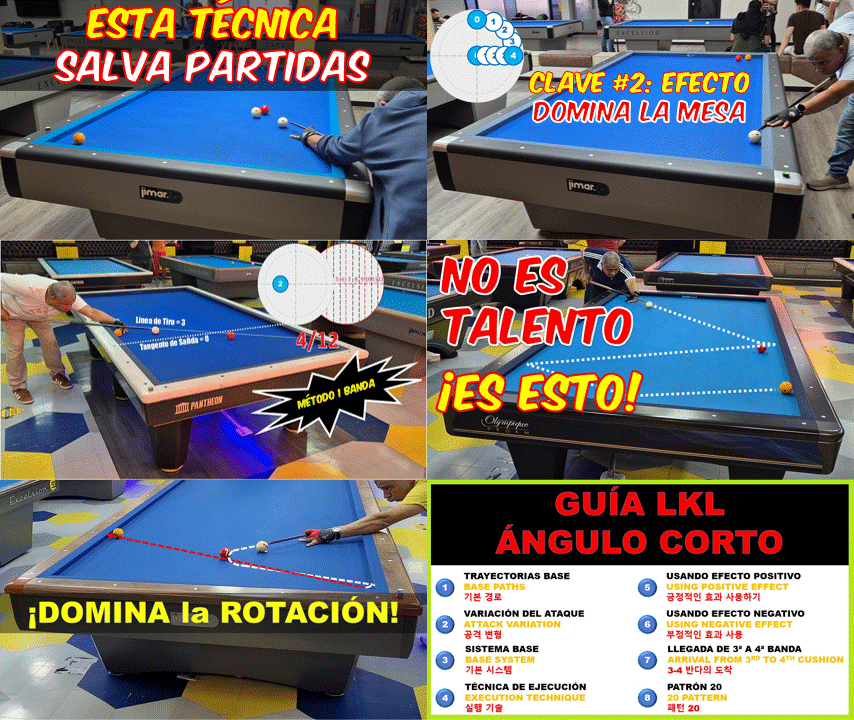
✅Key #7: Ball Hit
✅Speed Plus System
✅Key #6: Exit Tangent
✅Key #5: Shot Line
✅Banana Shot: Complete System
✅Key #4: Parallels
✅Talk with a Sports Psychologist
✅Feather-Thin Hits
✅Key #3: Mirror
✅Key #2: Spin
✅Key #1: Halves
✅Ball Hit for Pass-Ball Shots
✅One-Cushion Method
✅Vertical Pass-Ball System
✅Cross-Table System
✅Master Halves System
✅Vertical Reverse Spin System
✅Rotation Systems and Techniques
✅X-Ray Plus System
✅Short-Angle LKL Guide
Preparation Shots by Alexander Salazar
Don’t make this MISTAKE when preparing by Antonio Montes
Tips for preparing box shots
Torbjorn Blomdahl’s Preparation Triangle
TRICK for Preparing ROLLERS by Antonio Montes
Detecting the TAS TAS, Collision, Retruque, or Kiss
Winning Mindset and High Performance
Before finishing, we cannot forget that: many of the difficulties in billiards have a mental origin.
Understanding your mind is just as crucial as perfecting your technique with the cue. The following material is a roadmap not only to master your “mind” and trust your natural execution, but also to manage frustration and competitive pressure through solid routines and breathing techniques. Studying this will give you the concrete tools to invoke that state of concentration and flow you seek, rather than waiting for it to happen by luck.
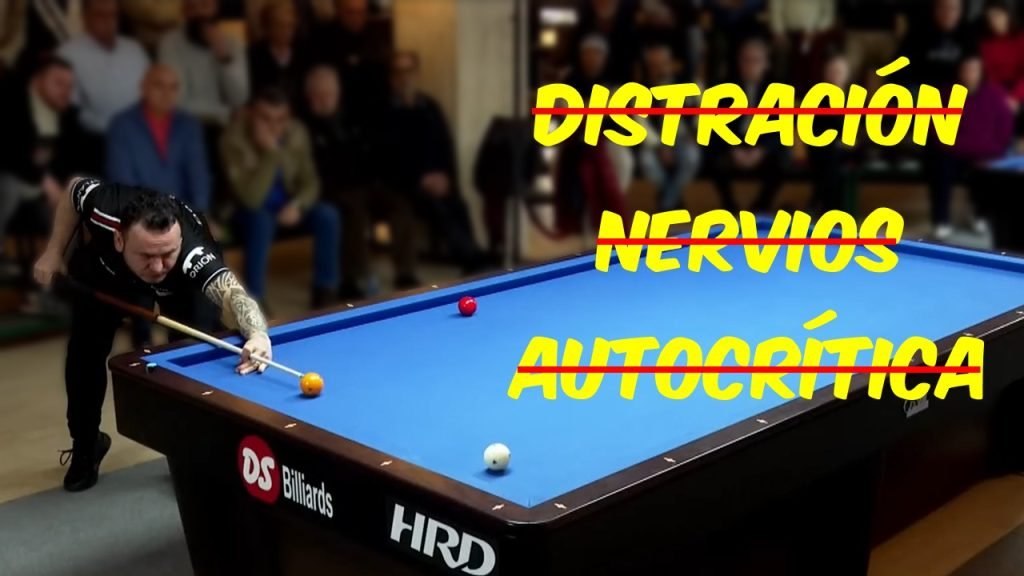
We have an expert in sports psychology applied to billiards, don’t miss the opportunity to chat with her and ask her anything about winning mindset and high performance.

Exercise to Calm Anxiety
The secret of concentration – How to increase attention
UniBillar: The Billiards University
Explore a wide range of digital billiards resources.
Study at UniBillar, the Billiards University, with leading instructors from Latin America.
José “Pepe” Hernandez, Pedro Gonzalez, Marco Vallejo, Fernando Diaz, Mauricio Gutierrez, Julián Torres, Jaime Carrasco, Carlos Vallejo, Fernando Castillo “El Flaco Billarista”, Rafael Galeano.
