
Three-cushion billiards lessons with Semih Sayginer are a compilation of master classes by the great master Semih Sayginer that offer a comprehensive view of various aspects of three-cushion billiards, focusing on fundamental and advanced techniques for amateur players.
How to configure subtitles in videos that are in a different language
Before continuing with a detailed description of the master classes by master Semih Sayginer, it is important that you know how to configure subtitles and automatic translation on YouTube.
In the following video, we will show you how to enable and disable subtitles. We will guide you so you can perform automatic translation into any language. We will explain a trick to allow you to do the above from your mobile device. And finally, we will see how to activate slow motion, forward and backward.
Positioning
An important topic is body and leg positioning, emphasizing the need for a 50/50 balance and proper alignment of the cue and hip to achieve a straight and controlled stroke.
Chalking
The lessons also cover chalking technique, explaining that side application is crucial to avoid errors, even if the cue tip is empty.
Hit the Ball
Additionally, the content emphasizes the importance of a follow stroke (penetration and advance) to maximize spin, explaining the difference between a “slap” (dry hit or stop stroke) and a “push” (penetration and advance) to obtain maximum kinetic impulse and ball control.
Position Recognition & Same Shots
The master reveals a secret of professional players that truly changes things: three-cushion billiards is, above all, a game of recognition.
When you understand this, your way of seeing the table changes completely: you stop feeling that you “don’t know” and start recognizing positions and trajectories that, without realizing it, you already have inside you. And that is when you stop missing so many shots that, in reality, you already master.
Tricky Shots
Have you ever found yourself staring at the table, feeling frustration in front of a shot that seems to defy the laws of physics? You see an almost impossible position and, while you barely manage an acceptable result, a professional player would make the cue ball move exactly as they want.
The difference is not magic. Behind that skill are small, great secrets: subtle technical details that make all the difference in the result.
Aiming
You have surely experienced this. You are at the table, you see the clear shot, and you know exactly how much sidespin you want to give the ball. You aim, execute with confidence… but the cue ball does not respond as expected and you miss by a margin that seems absurd.
And you tell yourself: “I didn’t aim that badly, the stroke felt good… what happened?”
The problem is usually not your aim or your execution, but a physical principle that most intermediate players overlook and that professionals know by heart: deflection.
In this class, we will ground what exactly this phenomenon is and why understanding it can become one of your master keys to taking your game to the next level.
Aiming 2
Have you ever aligned a billiards shot with total confidence, convinced that your aim was perfect, and yet still see the cue ball miss the target by a margin you do not understand? That feeling of frustration is one of the most common in the game.
The good news is that, in many cases, the problem isn’t your eyesight or your hand. The cause usually lies in a subtle, counterintuitive physics interaction between the ball, the cloth, and the spin you apply.
In this lesson, we will break down three of the most important concepts, learned from the experience of master Semih Sayginer, that will help you understand why you miss shots that felt “perfect” and, most importantly, how to start correcting them so the ball finally does what you want.
Shooting Timing
Have you ever known exactly what you needed to do… and still failed at the decisive moment? That painful gap between what you know in theory and what you can execute in practice becomes even wider when pressure enters the picture: in a sport, an important presentation, or a difficult conversation, we have all felt our skills seem to vanish just when we need them most.
Often, the key to closing that gap comes from unexpected places. In this case, from a billiards master who shares a complete system not just for playing better, but to reprogram how your body responds to stress. His method starts with a simple but powerful idea: we must consciously teach our muscles how to behave under pressure.
In this lesson, we will break down the three lessons that form this system, applicable to any skill requiring precision and mental control, so that you can gradually align what you know with what you actually do when the crucial moment arrives.
Position Play
If you play billiards, you surely know that feeling: that fine, delicate carom, the one that seems the ultimate symbol of “good hand.” We spend hours training to execute those nearly impossible shots, convinced that mastering the hardest shots is what makes us true players.
But what if I told you that, from a professional’s perspective, that approach might be holding back your progress, especially when there is pressure?
In this lesson, you will discover surprising principles of position play, where the key isn’t the perfect touch on the ball, but the strategy and the margin of error you allow yourself. We will shift the mindset from “showing off on one shot” to “controlling the table with intelligence.”
Get ready: after this, you will never look at the table the same way again.
Position Play 2
Every billiards player knows that feeling. You make a difficult shot, the carom is perfect, and for a moment you feel the satisfaction of success. But that joy fades when you look up and realize you have left yourself with no viable option for the next shot.
True masters don’t just think about executing the current shot; they operate with a different mindset, that of “position play,” to control the entire match.
This lesson will reveal some surprising principles, directly from an expert, that can completely transform your mindset and your game.
Ball Hit Master System
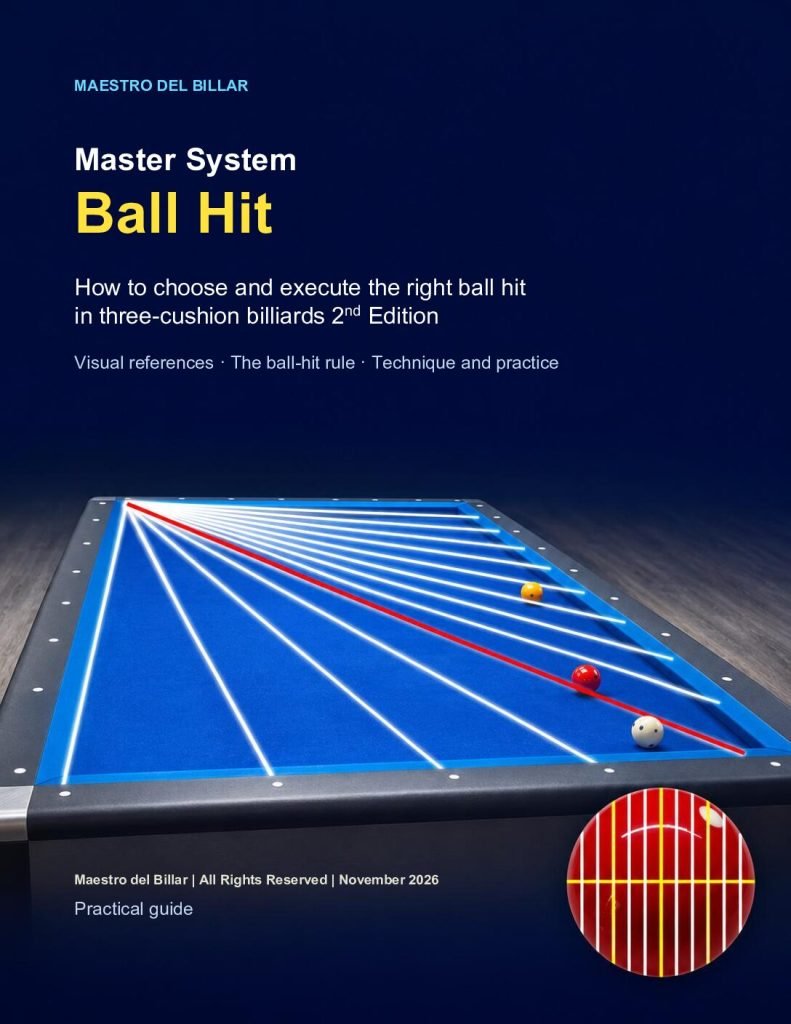
Even when you can read the path of a carom, one decision shapes the shot: how much of the object ball to hit to send the cue ball along that path. This guide shows how to read the key reference points, judge the thickness of the hit, aim with your cue, play feather-thin contacts, and use the reflections and shadows on the balls and cloth.
Discover the 3 Billiards Secrets Nobody Told You (and That Change Everything)
We have all been there: in a friendly billiards game, feeling that control over the cue ball is more of a mystical art than a real skill. One shot comes out perfect and the next deviates without apparent reason, leaving us with a sense of frustration. We believe we lack practice, or that perhaps we don’t have the necessary “touch.”
But what if the problem isn’t in complex shots, but in the most basic fundamentals we take for granted? According to Semih Sayginer, the secrets to absolute control aren’t hidden in impossible caroms, but in a few counterintuitive principles that most beginners (and many intermediate players) overlook.
This lesson distills the wisdom of a masterclass to reveal three of those fundamental secrets. These are ideas that, once understood, can radically change not only your game but your way of understanding the billiard table.
1. Your Stance Isn’t Intuitive: The 30° Angle That Frees Your Arm
The first mistake almost everyone makes is positioning themselves in a way that feels “natural.” We stand parallel to the table or with our feet together, believing this will make us more comfortable. The reality is that this stance is incorrect and limits all our potential.
Sayginer’s key concept is this: for a right-handed player, the toe of the left foot should point in the direction of the shot, but the toe of the right foot should be turned outward at an angle of approximately 30 degrees. Why is this detail so crucial? Because this angle opens the hips, creating a clear channel for the cue to align perfectly under the chin and between the eyes. Without this adjustment, the hip blocks the natural movement of the cue, forcing you into an off-center stance and, therefore, inaccurate aiming.
This position is also the foundation of balance. By placing your feet correctly, you distribute your weight 50/50 between both legs, creating a solid, immovable base. As the master explains, it’s like having an “automatic suspension” in your legs that prevents the body from moving during the stroke.
“if you have the suspension automatic suspension in your legs and just stable this position and then when you move as you see only your arm is moving there is no weight transfer”
(In Spanish: “if you have the suspension… automatic suspension in your legs and stabilize this position, then when you move, as you see, only your arm moves, there is no weight transfer”).
2. Hold the Cue Like You’re Carrying a Briefcase, Not Like You’re About to Strike
The second misconception is thinking that a firm, tight grip on the cue translates into a more powerful or controlled shot. Instinctively, when we want precision or force, we squeeze. In billiards, this is a fatal error.
The master’s advice is surprisingly simple: hold the cue as if you were carrying a briefcase or a bag. Don’t squeeze it, but don’t let it go loose either. Simply “hold” it. This relaxed grip is the key to a fluid and precise movement.
The benefit is purely mechanical. A relaxed grip allows your hand to open naturally during the backswing (backswing), ensuring the cue travels in a perfectly straight line. Conversely, a tense grip blocks this natural hand movement, which can cause the cue to deviate from its path and ruin the shot.
“you have to hold the cue like you’re carrying a bag, not squeezing, not too loose”
(In Spanish: “you have to hold the cue like you’re carrying a bag, not squeezing, not too loose”).
3. Spin Isn’t “Applied,” It’s Pushed in a Straight Line
Here comes the most surprising revelation for many players: how to apply spin to the cue ball. Most beginners try to put spin on the ball with a wrist flick, a curved motion, or some kind of “whip.” They believe that spin is something “added” to the stroke with a special gesture.
The master completely dismantles this myth. Controlled and powerful spin does not come from any strange movement, but from a simple, straight stroke aimed at an off-center point on the cue ball (left, right, top, or bottom).
The key is to keep the cue movement perfectly straight, exactly as if you were hitting the center of the ball. The “magic” of spin is not in how you strike, but in where you strike. The motion must always be a clean, direct push. Trying to “help” the ball with the wrist only introduces inconsistency and destroys accuracy.
“to control the spin you need to shoot straight but to the left or to the right or to the top or to down but it has to be straight”
(In Spanish: “to control the spin, you need to shoot straight, whether to the left or to the right, or to the top or to the bottom, but it has to be straight”).
Conclusion: Mastery is Hidden in the Basics
True control in billiards is not found in learning spectacular shots, but in internalizing these fundamentals that often go against our intuition. The next time you play, forget for a moment the carom you want to achieve and focus on the foundations of your technique.
Remember the three secrets: a precise stance with a 30-degree angle to free your body, a relaxed grip as if holding a briefcase to ensure a straight motion, and a stroke that is always straight for all shots, even those with spin.
The next time you approach a billiard table, what will you focus on first: the shot you want to make or how you place your feet?
3 Secrets for Better Play
Have you ever lined up the perfect shot, only for the cue to slip and you to make a frustrating miss? Or have you tried to apply subtle spin and the cue ball simply doesn’t obey? Think about it: how many games have you lost to that seemingly inevitable error? It is a common feeling for many players, but the difference between an amateur and an expert often does not lie in power, but in a series of counterintuitive details that control the game. You are about to discover three interconnected secrets that will change the way you approach the table.
First Secret: You Are Chalking Wrong (and Why It Matters)
Most beginner players make the same fundamental mistake: they rub the cue tip against the chalk quickly and carelessly. They think they are applying chalk, but in reality, they are cleaning off the valuable powder needed for grip, leaving it unprotected.
Here is the crucial detail that few understand: misses almost never occur on the top of the tip, but on the sides. Why? Because the top is used to hit the center of the cue ball, where the risk of a miss is practically zero. The real danger appears when you apply spin, and it is the edge of the tip that makes the critical contact. Therefore, the correct technique is to apply chalk with a fine motion, ensuring you cover the entire lateral surface.
The slip always happens on the side, so what you need to do is apply this chalk dust to the side, as if you were spreading cream.
Resist the temptation to blow away or wipe off the excess dust; that “mess” is exactly what you need for the cue to grip the ball. Next time you pick up the chalk, do it with intention. Observe how you cover the sides. This is the first step to gaining the confidence needed to execute shots with spin.
Second Secret: The Spin Is Not in the Stroke, But in the Follow-Through (Penetration and Advance)
Once you have the confidence that your chalk won’t let you down, you can focus on the actual mechanics of spin. Many believe that to apply spin, you just need to hit the cue ball on one of its sides. However, even players with a good straight stroke often “cut” it abruptly right after impact, drastically limiting the result.
The true secret to maximizing spin is that the cue must follow the cue ball. Instead of just hitting it, you must move the cue as if you were trying to make a hole through the ball. Think about table tennis: to generate heavy spin, the player doesn’t just hit the ball, but their paddle accompanies it in a fluid motion. In billiards, the principle is the same. This follow-through is what transfers the maximum energy and rotation to the ball.
If you cut your stroke in an instant, then you won’t be able to have the maximum kinetic energy in the ball and the spin, so this is very important.
This principle is universal. Whether you are applying left, right, top (follow or top spin), or bottom (draw or draw shot) spin, allowing the cue to continue its trajectory is what unlocks the full potential of your shot.
Third Secret: The True Power Comes from Your Body, Not Just Your Arm
This is where we separate good players from great ones. When you need to execute a shot with extreme power and spin, the isolated movement of your arm simply won’t be enough. Players who try to generate all the force from the arm end up losing control and precision.
The advanced technique for generating massive power involves using the whole body. This does not mean moving during the stroke, but after the impact. With a correct and stable initial stance, once the tip hits the ball, your torso and shoulder continue the forward motion along with the arm, as a solid and connected unit. This combined action generates a significantly greater and more controlled energy transfer than an arm could achieve on its own.
Mastering this movement is impossible without a solid foundation. It depends entirely on practicing and perfecting a correct body position. Without that stable base, you will never be able to progress to this level of power and control in your game.
Conclusion: Small Details, Big Changes
Mastery in billiards is not achieved overnight, but through understanding a system where each part depends on the previous one. It is a philosophy that unites the micro-detail with the global movement: the correct chalk (the micro) gives you the confidence to execute a full follow-through (the macro-mechanics), which in turn can be amplified by the power of your body (the core). By integrating these secrets into your practice, you will not only improve your technique, but also build the confidence to face any shot.
Which of these secrets will you apply first at your table to transform your game?
Join Maestro del Billar
Get access to premium Maestro del Billar content, exclusive to members:
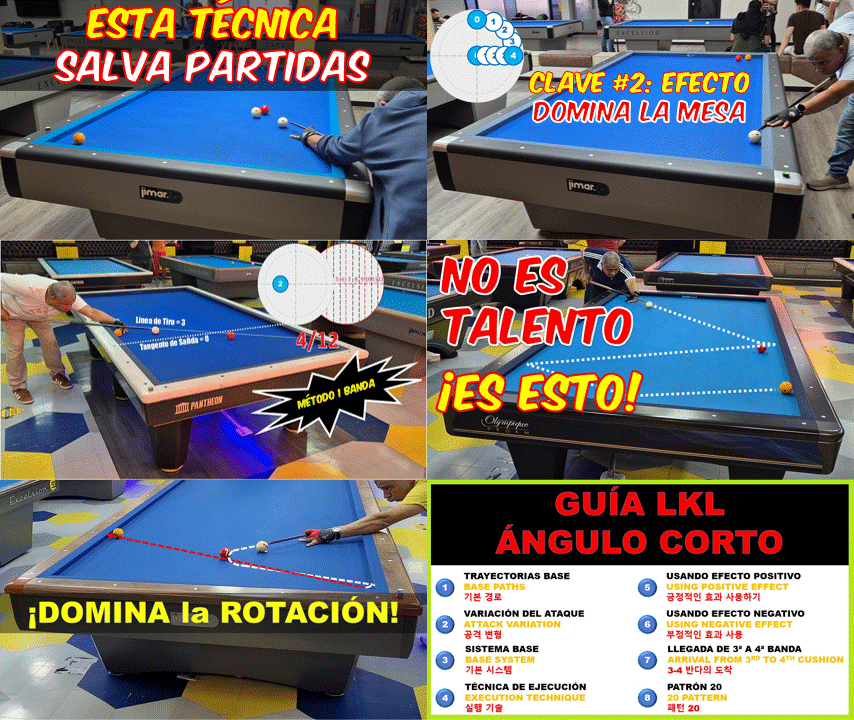
✅Key #7: Ball Hit
✅Speed Plus System
✅Key #6: Exit Tangent
✅Key #5: Shot Line
✅Banana Shot: Complete System
✅Key #4: Parallels
✅Talk with a Sports Psychologist
✅Feather-Thin Hits
✅Key #3: Mirror
✅Key #2: Spin
✅Key #1: Halves
✅Ball Hit for Pass-Ball Shots
✅One-Cushion Method
✅Vertical Pass-Ball System
✅Cross-Table System
✅Master Halves System
✅Vertical Reverse Spin System
✅Rotation Systems and Techniques
✅X-Ray Plus System
✅Short-Angle LKL Guide
Hit or Push? The Billiards Secret That Old-School Professionals Used to Dominate the Table
Have you ever felt the frustration of not getting the desired spin on the cue ball? Or of watching it deviate from its path right after contact, ruining your position for the next shot? Many amateur players get stuck at this point, not realizing that the solution isn’t hitting harder, but hitting differently.
There is a fundamental difference between a simple “hit” and a technical “push.” This nuance is the heart of a nearly lost art, a secret that the great masters of past generations knew intimately. Understanding it will not only change how you execute shots, but it will elevate your control over the table to a level you didn’t think possible.
First Secret: Not All Strokes Are the Same: The Key Difference Between “Hitting” and “Pushing”
At a fundamental level, there are two ways to transfer energy from the cue to the cue ball. Most players, especially those of the modern era, only learn one.
The first type is the dry hit or “slap” (hit or slap). It is a short, quick stroke where the cue strikes the ball and withdraws almost immediately. While this technique offers a good sense of control due to the brevity of the movement, its ability to generate spin and control the trajectory is limited.
The second type, much more advanced, is the “push” (push). This movement involves “following” or “carrying” the ball with the cue tip, executing a complete follow-through of the motion (follow-through). Instead of an abrupt impact, the cue remains in contact with the ball for a fraction of a second longer, making the cue ball feel more “relaxed” and predictable.
But the difference isn’t just in the arm. Body biomechanics are crucial. A “push” stroke is executed from a solid base, with a subtle transfer of body weight that stabilizes the entire movement; the body remains still. In contrast, a dry hit is often an isolated arm movement that can cause the rest of the body to move or lose balance, introducing inconsistencies.
Second Secret: Maximum Spin Doesn’t Come from Force, But from Prolonged Contact
If you have tried to apply maximum spin and seen that the ball doesn’t respond, you are probably “hitting” it instead of “pushing” it. The key to optimal spin transfer is not the speed of the impact, but the duration of the contact.
When you “push” the ball, by following it in its initial path, the cue tip has more time to impart its rotation. The spin is transferred completely and efficiently. Conversely, a dry hit interrupts this transfer almost instantly. As the master explains in the demonstration, the logic is impeccable: “when you hit the ball and your cue is no longer in contact, the spin cannot be maximum… to get maximum spin, you need to follow the ball.”
Third Secret: A Rolling Ball Is “Heavier” and Defies Intuition
This is where the physics of the game, understood by the old masters, gave them an almost unfair advantage. A cue ball that has already begun to roll at the moment of impact behaves as if it were “heavier” than one that is simply sliding. It is not that its mass changes, but its angular momentum and forward inertia give it immense authority in the collision.
This acquired “heaviness” allows the cue ball to dominate the impact, pushing the object ball and keeping it on its line with greater firmness. A deeper analysis reveals that the rolling cue ball tends to “climb” slightly over the object ball upon impact, exerting a downward force that locks it even more into its trajectory. As the expert summarizes, “when the ball starts to roll, it is heavier than a ball that stops… the rolling ball, being heavier, physically pushes the other ball and holds the line better. That is the point.”
A practical example is when you need to play a thicker hit to avoid a tas tas (kiss). With a dry stroke, the cue ball would deflect. With a “push,” the rolling ball maintains its line, displaces the object ball with authority, and continues its intended path.
Fourth Secret: The Sound Tells You the Truth: Learn to Listen to Your Stroke
One of the simplest ways to know if you are hitting or pushing is to close your eyes and listen. The sound of the contact reveals the truth of your stroke.
A dry “hit” produces a sharp, short sound, an almost instantaneous “kick.” It is a crisp but hollow sound. In contrast, a “push” produces a different sound, deeper and more sustained. It is the sound of energy being transferred over a prolonged period, not a simple collision. The next time you practice, pay attention to the sound. It will tell you exactly what type of contact you are achieving.
Fifth Secret: An “Old School” Technique in the Era of Fast Tables
This distinction is not a new discovery; it is fundamental knowledge from the “old school.” Previous generations perfected the “push” stroke out of necessity: they played on much slower tables that required long, powerful strokes to move the balls with authority.
In contrast, the new generation has developed a style based on short hits, partly because modern tables are incredibly fast and do not require as much physical effort. Although the game has evolved, this technique remains an invaluable tool that many new players are unaware of. It represents a hidden competitive advantage: the ability to solve problems on the table that a simple hit cannot resolve.
Conclusion: Are You Ready to Stop Hitting and Start Guiding the Ball?
Mastering the difference between a simple hit and a deliberate push is a transformative step for any player. It is not just about hitting balls, but about controlling every aspect of the game: position, spin, and trajectory. It is the transition from being a player who reacts to one who directs the action.
The next time you face the table, do not just think about where you want the ball to go. Think about how you will get it there. Are you ready to stop simply ‘hitting’ the ball and start ‘guiding’ it toward victory?
UniBillar: The Billiards University
Explore a wide range of digital billiards resources.
Study at UniBillar, the Billiards University, with leading instructors from Latin America.
José “Pepe” Hernandez, Pedro Gonzalez, Marco Vallejo, Fernando Diaz, Mauricio Gutierrez, Julián Torres, Jaime Carrasco, Carlos Vallejo, Fernando Castillo “El Flaco Billarista”, Rafael Galeano.

The Three-Cushion Carom Billiards Secret Your Brain Ignores
For any three-cushion billiards enthusiast, the scene is familiar: you face a position that seems new and challenging. You measure the angle, calculate the force, and despite everything, you miss. The frustration is doubled because, deep down, you feel that shot should have been yours.
What is happening? The problem does not lie in your technique, but in a deceptive perception that makes you believe you are facing a new and difficult shot, when in reality it is a known one.
Today we will reveal a professional secret that changes the rules of the game: three-cushion billiards is, above all, a ‘game of recognition’. Understanding this will transform your approach and allow you to stop missing shots that, without knowing it, you already master.
Revelation #1: Your Goal Is Not to Execute the Shot, but to Recognize It
The game-changing idea is simple yet profound: before thinking about how to strike the ball, the spin, or the power, your first task is mental. As master Semih Sayginer explains:
…three-cushion billiards is a game of recognition, so first you have to read the position…
This mindset shift is incredibly powerful because it reduces cognitive load and anxiety. When you recognize a position, you are not inventing a solution under pressure; you are retrieving a known from your mental archive. This frees you to focus exclusively on clean and precise execution. Instead of facing an infinite number of shots, you begin to see a limited set of familiar patterns. This is the first step to playing with the confidence of someone who knows what they are doing.
Revelation #2: The Same Line, The Same Shot
Here comes the most revealing concept: two shots that appear completely different are, in reality, identical. The key factor is not the distance, but the geometric line. The human brain instinctively uses distance to judge difficulty, but the professional’s secret is to override that faulty instinct. The example is brilliant: an amateur almost never misses a shot with the red ball in the back of the corner. However, if the cue ball moves away but stays on the same line, most players miss. Why? Because it “feels different.” The brain perceives a difficulty that, technically, does not exist.
…it is not another shot, it is the same shot, the same line, and to execute the shot you have to use the same technique…
This revelation is crucial. It demonstrates that the barrier is not skill, but the psychological block that prevents us from recognizing an already internalized pattern. You need to recalibrate the definition of difficulty in your brain. Master Sayginer demonstrates this principle with multiple examples—balls frozen to the rail, short shots, long shots—proving time and again that the line, and not the position of the cue ball, is what defines the shot.
Revelation #3: Build Your “Collection” of Shots with Visualization
This is where you apply the professional’s mental technique: superposition. When you face a position that seems complicated, stop and ask yourself: is this arrangement on the same line as a “easy” shot that I already master? If the answer is yes, the next step is purely mental: superimpose the image of the comfortable position over the current situation. Imagine that the ball is exactly where you know it well and execute the shot with the same technique, force, and spin you would use in that easy situation.
This method will not only help you solve shots you used to miss, but it will exponentially expand your repertoire. Each “difficult” shot you solve this way becomes another tool in your mental arsenal, giving you more confidence every time you approach the table.
…that is how you build a larger shot collection. This is the little secret I would like to share today…
This is the “little secret,” as the master himself calls it, that allows you to build your arsenal and play with the confidence of someone who feels comfortable at the table because they recognize the terrain.
Final Warning: Every Table Has Its Own Personality
While line theory is a fundamental pillar, the master adds an important warning: its exact application will always depend on the “table conditions.” The speed of the cloth, the reaction of the cushions, and the response of the balls can vary significantly. Therefore, part of your training must be to “calibrate” your known shots on your regular table, so that your mental map perfectly matches the physical reality of the cloth and cushions.
Conclusion: Are You Playing Billiards or Just the Appearances?
The biggest quality leap for an amateur player does not always come from polishing technique, but from transforming the way you see the table. The key is not to master thousands of unique shots, but to develop the ability to see the hidden similarities behind superficial differences. Stopping the reaction to every position as if it were new and starting to recognize it as an old acquaintance is what separates a good player from an excellent one.
Next time you face a shot that intimidates you, ask yourself: what are you really seeing: a new difficulty or an old friend in disguise?
Revealed: 3 Professional Billiards Lessons That Will Change the Way You Play
Have you ever stared at the table, frustrated by a shot that seems to defy the laws of physics? You face an impossible position, and while you barely manage a mediocre result, a professional player would make the cue ball dance at their will. The difference is not magic. Behind that amazing skill are “little secrets” of technique, subtle details that can completely change your game. In this lesson, we will reveal three of those secrets, taken directly from a masterclass, that will help you think and play like a true expert.
Lesson 1: The Draw Shot Is Not Power, It Is “Table Tennis” Technique
The draw shot or draw shot is one of the most desired and, at the same time, most misunderstood tools by amateur players. Intuition tells us that to make the cue ball draw back with force, we must hit it harder on its lower part. However, the real secret is not in the power, but in the movement of the cue.
The key is to think about how spin is generated in table tennis. It is not a simple hit, but a movement that follows through and “brushes” the ball to maximize rotation. In billiards, it is the same: the secret is that, after the low hit, the cue must continue its journey forward through the original position of the cue ball, not stop or pull back.
“When you want to apply spin like in table tennis, the racket does this, not this… so the action of your cue must be a draw, but continuing the movement.”
This concept is a turning point for many players who try to solve this shot with brute force. Next time you need a strong draw, focus less on the force of the impact and more on the fluidity and follow-through of your stroke.
Lesson 2: The Power of a “Fine” Hit for Total Control
The master presents a challenge that seems impossible: hitting the object ball with a very fine contact so that the cue ball travels along four rails and settles in a specific position for the next shot. While most would look for a more direct hit, the master reveals a surprising solution.
The lesson consists of hitting the object ball in a “very fine” manner, almost a graze, while simultaneously applying a massive amount of spin and power to the cue ball. This combination, which seems contradictory, is what allows the cue ball to release and travel across the table with a controlled and precise trajectory that would otherwise be impossible.
“Very fine… lots of spin, lots of spin. Very fine, yes! With power! Yes, yes, yes, yes, good!”
This point is revealing because it teaches us that precision and spin, even with minimal contact, can be more powerful and strategic than a fuller hit. Control does not always come from hitting more of the ball, but from knowing how to transfer energy and rotation more efficiently.
Lesson 3: Sometimes, the Best Spin is No Spin
In this lesson, the objective was clear: to make the cue ball travel a long distance to a specific diamond in the opposite corner and then contact the object ball. The student misses; the cue ball “dies” halfway. The problem? The almost unconscious tendency to apply sidespin or execute a push shot instead of a clean hit.
The master’s instruction is pure and direct: hit the ball in the center, but on the lower part, with a firm stroke and no sidespin. The mastery here lies in executing a pure stroke that transfers all energy forward.
“No sidespin, no sidespin. Center, but hit, hit, hit… don’t push, hit.”
This lesson is a fundamental reminder: before trying to add complex spins to your game, you must master the fundamentals. A centered, powerful, and precise stroke is the foundation upon which all other advanced skills are built.
Conclusion: Beyond Tricks, the True Secret
These three lessons go beyond being simple “trick shots.” They are revelations about the fundamental principles of physics and technique that govern billiards. Draw as a continuous motion, the power of a fine contact with maximum spin, and the discipline of a pure, centered stroke are concepts that elevate any amateur’s game.
Ultimately, the true secret that connects these three lessons is a mindset: the ability to “read every position.” It is not about always using draw or spin, but about reading the table and knowing when to apply a follow-through stroke to maximize draw (Lesson 1), when to use a fine contact with maximum rotation for a complex travel (Lesson 2), or when the purity of a centered stroke is the only answer to conserve energy (Lesson 3).
Now that you know these keys, what is the “little secret” you will start looking for to transform your own game?
Why Your Billiards Cue Deceives You? The Secret of “Deflection” That Professionals Master
You’ve probably experienced this. You’re at the table, the shot is clear, and you know exactly how much sidespin you need to apply. You aim, execute the stroke with confidence, but the cue ball doesn’t behave and you miss by a margin that makes no sense. It wasn’t a misaim or a bad stroke. The cause is a physical principle that most intermediate players ignore, but that professionals master perfectly: deflection. What exactly is this phenomenon, and why is it the secret key to taking your game to the next level?
First Discovery: Hitting to the Right Makes the Ball Go Left
The fundamental concept of deflection is actually quite simple, though counterintuitive. When you strike the cue ball at any point other than the center to apply sidespin (or spin), the ball does not travel in a line perfectly parallel to your cue. At the moment of impact, the ball deflects slightly in the opposite direction to the point where you struck it. For example, if you hit the cue ball on its right side to apply spin, its initial trajectory will momentarily deflect to the left.
This principle is a law of the game’s physics, not an opinion.
…when you play with spin, the cue ball can never go straight and parallel to the cue… because if you hit the right side, it has to go a bit to the left. This is called deflection.
Second Discovery: Your Cue Has Its Own “Personality” (and It Affects Your Aiming)
This is where things get complicated: deflection is not a universal constant. Each cue reacts differently. There are “ultra low deflection” (ultra low deflection) cues designed to minimize this effect, and others with “more deflection” (more deflection). That’s why the first step isn’t to practice more, but to measure the deflection of your own cue.
Imagine this real scenario: an experienced player tries someone else’s cue and, when attempting a shot with spin, misses completely. Why? This demonstrates why blindly trusting “habit” is a recipe for stagnation. Their intuition, calibrated for one cue, proved useless with another. Your cue is not just a tool; it is an active variable in the aiming equation.
Third Discovery: To Hit, Sometimes You Have to Aim to Miss
If the ball deflects, how do professionals solve it? They compensate consciously. Instead of aiming directly at the target, they adjust their aiming point so that the deflection does the correcting work for them.
For example, to hit a specific point on the rail, a professional player might aim their cue at a nearby diamond, knowing that by applying spin, the deflection will steer the cue ball right toward the actual target. To an observer who doesn’t understand this principle, it would look like the player is deliberately aiming wrong.
“If you look at my cue line, you might think I’m going to miss the ball completely. However, thanks to deflection, the ball corrects its course toward the target.”
Conclusion: Do You Play by Habit or by Understanding?
To move from being an intermediate player to an advanced one, it is not enough to rely on “habit” or intuition. True mastery arrives when you stop compensating by intuition and begin to measure the deflection of your equipment with precision. The next step is to determine, with the cue in a horizontal position (flat cue), how much deflection yours produces so you can master it.
As the expert explains, many players operate “within the margins”: a bit more spin, a slightly thinner hit… and luck does the rest. Mastery consists of eliminating those margins.
Now that you know this secret, how will you see your next shot with spin? Are you playing by habit, or are you starting to play with the laws of physics in your favor?
3 Counterintuitive Revelations About Billiards Aiming That Will Change Your Game
Have you ever lined up a billiards shot with absolute certainty, feeling that the aim was perfect, only to see the cue ball miss the object ball by an inexplicable margin? It is one of the game’s greatest frustrations. The good news is that the problem is probably not your eye or your stroke. The cause is hidden in a subtle and counterintuitive physics that occurs between the ball, the cloth, and the spin you apply. Below, we will reveal three of the most impactful concepts, drawn from the experience of a professional player, that will help you understand why you miss those “perfect” shots and, most importantly, how to start correcting them.
1. Your Greatest Enemy Is Not Your Eye, It Is “Deflection”
The fundamental concept you need to master is “deflection” (deflection). In short, when you apply sidespin to the cue ball, it does not travel in the perfectly straight line marked by your cue. By striking the ball off-center, the intense lateral rotation interacts with the friction of the cloth. This interaction is what causes the ball to deviate from its initial trajectory, in a direction dictated by the spin you have applied.
This phenomenon is the culprit behind countless misses, especially on long shots. Over a considerable distance, that small initial deviation is magnified so much that the difference between your aiming line and the ball’s actual trajectory becomes enormous. Even if your initial aim was perfect, deflection can cause you to miss the shot entirely.
“You can aim at the middle of the ball and maybe miss by half a ball, you cannot touch the ball.”
Understanding this is strategically liberating. It takes the weight off believing that you are “aiming wrong” and gives you a physical and measurable reason for your misses. This completely restructures your practice time: instead of spending hours trying to “fix” your eyes, you can dedicate productive minutes to calibrating your compensation for a known and predictable physical force.
2. The Way You Strike (“Push”) Inverts the Rules of Compensation
Every intermediate player learns the golden rule of compensation: to counteract deflection, you must aim toward the opposite side of the spin. It is a basic principle: if you apply left spin (which deflects the ball to the right), you aim slightly to the right of the desired contact point. If you apply right spin (which deflects the ball to the left), you aim to the left. As the expert says about a standard shot, "normally not much spin, I aim out because I am playing with left spin and aim outside the ball to have spin".
This is where professionals reveal a secret that breaks this rule. When you need a massive amount of spin, you often achieve it by “pushing” the ball with the cue (pushing). This stroke imparts such extreme rotation that the ball literally “grips” the cloth, causing it to trace a slight curve in the direction of the spin before straightening out. Surprisingly, this curve can completely negate the need for traditional compensation, and even reverse the logic.
“if I need a lot of spin, then I don’t have to aim even further out… because I aim in and make it curve.”
This revelation demonstrates the deep complexity of three-cushion billiards. There is no single aiming rule. Correct compensation is a dynamic calculation that depends on your stroke technique, the distance, and the amount of spin. Advanced billiards is not just a game of instinct, but a game of applied knowledge about when to follow the rules and, more importantly, when to break them.
3. You Are Not a Machine: The Key Is Measuring Your Own Personal Deflection
Deflection is not a universal value carved in stone; it is a deeply personal phenomenon that varies according to your cue, your bridge, the strength of your stroke, and your particular technique. As the expert rightly points out, we are not laser-precision machines; we are “human beings, flesh and bone,” and therefore, there will always be a margin of error. The goal is not perfection, but minimizing error through knowledge.
Therefore, the goal is not to eliminate deflection, but to understand and know it. You have to measure your deflection. The recommendation is clear: go to a table and run tests. Place the cue ball and strike straight, but applying different amounts of sidespin. Observe and measure how much the ball deviates from the center line. This simple exercise will give you a clear and personal database on how this phenomenon affects you.
“you can create your own account, so to speak, and gain the knowledge of what your deflection is when you play with spin.”
This is perhaps the most valuable and empowering piece of advice of all. Instead of seeking an external “perfect” technique or blindly imitating other players, true mastery comes from deep self-knowledge. It is about understanding your own style, measuring your inherent “error,” and learning to incorporate it into your aiming system. You stop playing by habit and start playing “with knowledge.”
Conclusion: Beyond Aiming
True aiming in advanced billiards is not simply about pointing at a spot. It is about understanding and controlling a dynamic system of forces, where your stroke, spin, and cloth friction combine to determine the ball’s trajectory. By accepting the existence of deflection, understanding how your technique modifies it, and measuring your personal tendency, you transform frustration into control.
Now that you know every miss has a physical explanation, what will be the first experiment you run on the table to understand your own game?
The Secret of a Maestro del Billar for Performing Under Pressure: 3 Steps to Master Your Mind and Muscles
Have you ever known exactly what you had to do, only to fail at the crucial moment? It is that frustrating gap between theoretical knowledge and practical execution, an abyss that deepens under the pressure of the moment. Whether in a sport, an important presentation, or a difficult conversation, we have all felt skill fade when we need it most.
The wisdom to close this gap often comes from unexpected places. In this case, from a billiards master who reveals a complete system not just to play better, but to reprogram our body’s response to stress. His method is based on a central idea: we must actively teach our muscles how to behave under pressure. Below, we break down the three lessons that make up this system and apply to any skill requiring precision and mental control.
Lesson 1: The power of the deliberate pause, the key to moving forward
The first pillar of the system is deeply counterintuitive: just before the final stroke, at the point of maximum tension, you must take a deliberate pause. It is not about doubting, but a conscious moment of stabilization and control. Psychologically, this pause interrupts the automatic “fight or flight” response triggered by pressure, allowing our executive brain to take control over the impulse to rush.
This idea is not a rigid rule. The master explains that the duration of the pause can change “according to your personality.” He points out that some elite players, like Daniel Sanchez, are known for a longer pause, demonstrating that there is no single correct duration, but a universal principle of control. It is a microsecond of calm that changes everything, ensuring the following movement is controlled and precise, not a rushed reaction.
“I stop for a moment, it’s not stopping and waiting and sleeping, no, it’s just taking the cue back, stopping for a moment…”
Lesson 2: Stop practicing for comfort, start training for pressure
But this momentary control is useless if you have not prepared your body for the physical reality of stress. This leads us to the master’s most critical idea: the goal of training is not perfection in an ideal environment, but resilience in a real one. He dismantles the myth of “playing well without stress,” arguing it is a useless thought because under pressure “all muscles become rigid and it is no longer the same.”
The true goal is to build muscle memory that is resilient to stress. As he says, “muscles can learn, so you have to train your muscles and teach them how to behave in the game.” Practice must simulate and normalize stress, not avoid it. Consistency does not come from the absence of pressure, but from the ability to execute reliably despite it.
“…when you have pressure in the game, it’s a different story, because all the muscles get stiff and it’s no longer the same. So there is no such thing as ‘when I play without stress, I play very well.’ No, no, no, you have to learn to play with stress…”
Lesson 3: Knowledge is useless without a process
Knowing what to do is not enough if you do not have a clear path to execute it under fire. The final piece of the system is a rigorous process, a pre-execution routine that transforms abstract knowledge into reliable action. In performance psychology, these routines are crucial because they offload cognitive stress, allowing the body to execute a learned skill without the interference of conscious thought.
The master’s process is a sequence of verification and balance:
- Take the Stance: Align yourself physically according to the shot plan.
- Internal Dialogue: Mentally confirm the details: “a bit more than a quarter ball, a slight draw spin.”
- Sensory Verification: Use practice strokes not just to feel the shot, but to visually verify that the alignment is correct.
- Controlled Execution: Pull the cue back to generate energy and, crucially, apply the deliberate pause just before the final stroke.
Without a process, knowledge remains trapped in the mind. With a process, we have a script to follow, even when pressure threatens to derail us.
“…knowing is not enough, you have to execute it…”
Conclusion: Your Next Shot
Mastery is not magic, but the result of a well-designed system. These three lessons form a cohesive whole. The Process (Lesson 3) is the script you write for success. The Training under Pressure (Lesson 2) is the rehearsal that makes that script second nature. And the Deliberate Pause (Lesson 1) is the final check at the moment of truth, ensuring you are still following your script.
The next time you face a decisive moment, ask yourself a question: In what area of your life could you apply a deliberate pause to act with greater control the next time you feel pressure?
Play with Margin, Not Absolute Precision: The Secret of a Billiards Professional
Introduction
Any billiards player knows the feeling: that fine, delicate carom that seems to be the quintessence of skill. We spend hours practicing to execute those shots with millimetric precision, believing that mastering the difficult is what defines us as good players.
But what if I told you that, from a professional’s perspective, this approach could be precisely what limits your game, especially under pressure? This lesson reveals several surprising principles of position play that prioritize strategy and margin for error over delicate precision. Prepare to change the way you see the table.
1. The Myth of Precision: Why Playing “Thicker” is Safer
Imagine a common position: the most obvious solution seems to be a thin hit so that the cue ball travels across the table in three rails (one-two-three). It is a shot that appeals to the eye, but it hides a fundamental strategic weakness.
The professional’s argument is that thin shots are “very delicate” and have a minimal margin for error. With the tension of the match or “stiff muscles,” the probability of missing a shot that requires an exact contact point skyrockets.
Instead, the professional method prefers a counterintuitive approach: playing “thick” on the second ball, meaning hitting 75%, 80%, or even 85% of its surface with a follow shot. This technique sends the cue ball on a safer trajectory (short-long) and, most importantly, creates a huge margin for error. You no longer need the perfect contact point; a wider range of impacts will still carry the ball to the desired zone.
“…to follow this line, it doesn’t matter if your hit is a bit thicker or a bit thinner, as long as you are in the 75%, 80%, 85% range of the ball; all of that works… ‘Trushion’ (three-cushion billiards) is played with margin, we are using the margin of hitting the ball…”
This technique of hitting “thick” is not just to secure the current carom; it is the fundamental tool that allows us to redefine the objective of position play: instead of seeking a point, we start controlling a zone.
2. The True Objective of Position Play: Creating Options, Not a Perfect Point
There is a widespread belief that position play consists of placing the cue ball at a single perfect point for the next shot. However, this concept is a simplification that can lead to dead-end positions.
The advanced concept proposed by the professional is that true position play consists of bringing the cue ball to a zone that offers the maximum number of possible variations for the next carom.
Think about it: if your plan depends on the cue ball stopping at an exact point, but it overshoots or falls short by just a centimeter, you may be left with no favorable position. In contrast, by aiming for a broad and strategic zone, you ensure that, even if the result is not perfect, you still have multiple good options to continue the match.
“playing position is not just to do it perfectly, it is to make the potential position variations much greater than normal, because if you are only playing position with a specific shot and the ball has to stop here, but it doesn’t stop here and goes there, then you have no position”
The goal is that, once the cue ball stops in this zone, you have multiple paths for the next carom: outside, inside, with more spin, with less… The position belongs to you because you have created a fan of solutions, not just one.
3. The Invisible Map of the Table: Identifying “Good” and “Dangerous” Zones
From a strategic point of view, not all areas of the table are equal. An expert player does not see a uniform green surface, but a map of zones with different strategic value. The key is to anticipate where the shot will end to avoid getting trapped.
- Danger Zone: A clear example is executing a three-rail sequence (
one-two-three) that leaves the cue ball trapped in a corner. From there, the options for hitting the next ball are very limited. It forces you to make a “forced shot,” often with excessive speed or spin, compromising future control. - Good Zones: In contrast, the central areas of the table are strategically superior. The professional points out that leaving the ball
"in here is always good", referring to zones that offer open angles and access to multiple trajectories. These positions keep many variations alive for the next shot.
However, identifying the correct zone is only half the battle. Controlling the tempo, or the speed of the cue ball, is equally crucial. A player must apply the precise speed so that the ball not only reaches the good zone but stops there. A shot that is too strong can pass through the safe zone and end up in a dangerous one, undoing all the strategic advantage.
Conclusion: A Change in Mindset
The true level-up in billiards does not come from executing impossible shots, but from a change in mindset. It is about shifting from a focus on executing isolated, precise caroms to a broader strategy that seeks to create high-percentage opportunities and maximize future options.
Playing “smartly,” as the professional demonstrates, is giving yourself a margin for error, controlling the table through strategy and not just technique. It is, ultimately, playing with your head as much as with your cue.
Next time you are at the table, will you look for the perfect carom or the position that offers you the most possibilities? The change could transform your game.
The Secrets of Billiards Your Instinct Ignores: Master Position Play
Introduction: The Hidden Frustration of a “Good” Shot
Every billiards player knows that feeling. You make a difficult shot, the carom is perfect, and for a moment you feel the satisfaction of success. But that joy fades when you look up and realize you have left yourself with no viable option for the next shot.
True masters do not just think about executing the current shot; they operate with a different mindset, that of “position play,” to control the entire match. This article will reveal some surprising principles, directly from an expert, that can completely transform your mindset and your game.
1. The Counterintuitive Secret: Stop Aiming for the Corner
The most common mistake players make, even experienced ones, is sending an object ball to a corner. It may seem like a safe zone, a place to “park” the ball, but in reality, it is a trap that severely limits your options. By sending the ball to the corner, you are left without rails in that area, without an “entry” for the next carom.
The expert’s logic is clear: “if the ball is in the corner, I have a problem.” By cornering a ball, you eliminate crucial angles and access to the rails, which are the fundamental tools for continuing a series. The key is not to hide the ball, but to leave it in a position that offers you a future opportunity.
“Why here? Why not in the corner? Because when you get to the third ball, you can hit. And if the ball is here [en la esquina], you might not have any entry to make another carom. That is why it is so important that this ball ends up right there.”
2. The True Objective: It Is Not the Next Shot, It Is Multiple Options
This is where the fundamental shift in mindset occurs. The goal is not to plan a single perfect shot next. The goal is to create a situation that offers you maximum flexibility and multiple possibilities. Superior position play is defined by the number of options you have after executing your shot. The aim is to place the cue ball in a zone from which, no matter if you hit the next ball “a bit thinner” or “a bit fuller,” you still have a good continuation.
The physical principle underpinning this philosophy is simple: if the balls are closer, they are easier to control. The goal of creating multiple options is not an abstract idea; it is a strategy to design a configuration on the table where the balls remain in a controllable proximity. This reduces the pressure of having to be perfect and drastically increases the odds of maintaining control.
Of course, achieving this depends not only on the angle but also on precise tempo and speed. As the expert rightly says: “If you hit too hard, you can’t control it.” The balls scatter, and you lose the proximity you were aiming for. But beware, because a shot that is “too slow” can also “kill the position,” leaving you without the energy needed for the next play. You have to find the right touch.
Now, let’s be realistic. No one can control the table perfectly on every shot. The goal is not absolute perfection, but always doing your best to maximize the odds in your favor.
“Look, I have more options everywhere. That’s the key, you see?… Position play is about generating more options based on where you placed the object ball”
3. The Forgotten Protagonist: Control the Travel of the Second Ball
Most players obsess over the path of the cue ball. However, controlling the travel and final position of the second object ball is equally critical, if not more so.
To avoid kisses and set up the table for future plays, a player must learn to predict and manipulate where the second ball will travel after the impact. One way to develop this skill is through a practical exercise known as the “two-ball” game: hit the object ball, make the cue ball travel one, two, or three rails, and hit the same object ball again. This exercise, which may seem like a simple game, teaches you to feel and control the movement of that second ball.
This concept redefines billiards strategy. It is no longer about a series of isolated problems, but about seeking “harmony between two moving objects”. When you start to see the game this way, as a coordinated dance between the cue ball and the object ball, you will not only avoid more kisses, but your position play will reach a completely new level of fluidity and control.
4. The Golden Rule: Every Shot is a Position Shot (Even the Easy Ones)
The final principle is to apply this mindset to every shot you take, no matter how simple it may seem.
The expert uses the example of a double-cushion carom, a shot he considers a “big ball” (professional jargon for a shot that is, or should be, easy to make). Most players focus solely on the carom. In doing so, they often lose position because they do not control where the object ball stops. The result is that, after making an easy point, they are forced to execute a much more difficult power shot on the next turn, breaking their rhythm and their run.
The expert’s advice is to always think about how to strike the ball to guide both balls into a more advantageous setup for the next shot. This discipline—seeing the positional opportunity in every shot—is what truly separates advanced players from amateurs.
Conclusion: Change Your Mindset, Change Your Game
Mastering position play is less about learning specific techniques and more about adopting a new “mindset” of control, options, and harmony. It is not just about making the carom in front of you, but about dictating the one that follows.
Now that you know this, the next time you are at the table, which “easy” shot in your own game will you look at in a completely different way?