
We are not presenting a basic principle of billiards, but rather 5 basic principles of three-cushion billiards that will allow us to reveal one of the most important secrets of three-cushion billiards: how to visualize the path of the cue ball, the one that starts each carom and determines success in our game.
In this video, I will show you how, with a little knowledge and practice, you can predict the path of the cue ball. I assure you that after this video, you will see billiards from a completely different perspective.
Watch the video of this new system.
Join The Billiards Master
Access the PREMIUM content of Billiards Master, exclusive for MEMBERS:
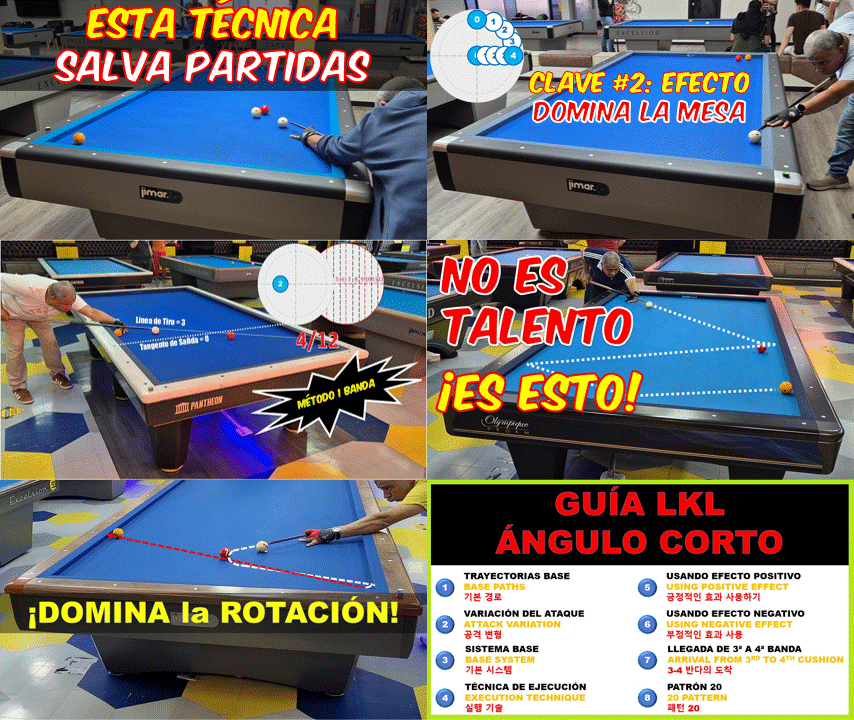
✅Key #6: Exit Tangent
✅Key #5: Shot Line
✅Banana Shot: Complete System
✅Key #4: Parallels
✅Chat with Billiards Psychologist
✅Hair Ball Hit Technique
✅Key #3: Mirror Technique
✅Key #2: English
✅Key #1: Halves System
✅Ball Hit for Pass Ball
✅1 Cushion Method
✅Vertical Pass Ball System
✅Cross Table System
✅Master Halves System
✅Vertical Counter Effect System
✅Master Rotation: Systems & Technique
✅X-Ray Plus System
✅LKL Short Angle Guide
Basic Principle of Billiards No. 1: The Triangle Law
Let’s dive into one of the most fundamental basic principles of billiards for visualizing the path of the ball that every billiards player must master: the triangle law. But how exactly does it work in the context of three-cushion billiards?

When a ball hits without spin the cushion of a billiards table, a triangle is formed whose corners are the starting point, the aiming point on the cushion, and the arrival point. This triangle has a special property: if a perpendicular line is drawn from the vertex to the base, it will divide the base into two equal parts. This type of triangle is known in geometry as isosceles.

In billiards, the triangle law is better known as the law of halves.
Korean Systems for Three Cushion Billiards

Fernando Díaz presents a selection of Korean systems applied to 3-cushion billiards, the result of years of research, training and direct validation on the table.
Fernando Díaz is a multiple champion, coach of the main leagues in Colombia and recognized as one of the greatest billiards experts in Latin America.
Projected Triangle and Its Application in Three-Cushion Billiards
One of the conditions for using the triangle law is that both the starting point and the arrival point must be corners of the base. But what do we do when this condition is not met? We look for a triangle, which we will call a “projected” triangle, that does meet that condition. This sounds simple, although it is not as easy as it seems.

The projected triangle represents the second basic principle of three-cushion billiards.
Mirror Law: Third Basic Principle of Billiards

Another interesting resource is the mirror law. In this technique, once we manage to reflect our arrival point through the mirror, by simply aiming at the reflected point, regardless of the starting position, we will always reach the arrival point.

This type of technique involves using references off the table, and achieving it is quite a challenge.

UNIBILLAR: The Billiards University
Access a wide variety of digital billiards content.
Study at UNIBILLAR, the Billiards University, with the best instructors in Latin America.
José “Pepe” Hernandez, Pedro Gonzalez, Marco Vallejo, Fernando Diaz, Mauricio Gutierrez, Carlos Vallejo, Fernando Castillo “El Flaco Billarista”, Rafael Galeano.

And remember, in some cases you can state with some certainty “take whichever rail it takes”.
So, in the middle of my discovery, I realized that sometimes, in billiards as in life, “no matter which rail you hit”, the result can surprise us, opening unexpected paths to success.
Third Rail Law
Now we will explore the fourth basic principle of three-cushion billiards: the third rail law.

According to the laws we have seen so far, in the diagram shown on screen, we would expect the cue ball to reach where the object ball is. However, when testing it on the billiard table, this does not happen. The reason for this variation in the arrival point on the third rail is that the ball, after hitting the first rail, acquires spin, and this manifests when contacting the second rail, modifying its trajectory toward the third rail.

To make the cue ball reach the position of the object ball, we must adjust the position of the mirror ball by applying a factor of 1.5 and, from there, proceed with the triangulation.
The third rail law also applies when we play along the long rail. Let’s look at a couple of examples.


Fifth Basic Principle of Three-Cushion Billiards: Law of Spin
Spin represents the fifth basic principle of three-cushion billiards and is a special ingredient that not only adds an additional dimension of skill to the game, but also makes it incredibly diverse and exciting.
There are mainly two ways to mark spin in billiards: the standard and the clock.

In the standard method:

Spin value 1 modifies the ball’s angle to cover a distance equivalent to 1 diamond, measured from short rail to short rail.

Spin value 2 corresponds to an angle that covers 2 diamonds, and so on up to spin 4, which reaches 4 diamonds.


In the clock method:

The spin values correspond according to the positions of the clock hands, with spin value 3 on the clock being equivalent to spin value 4 in the standard method. The above establishes a relationship of 1 + 1/3 between the two ways of marking spin.

When we play from long rail to long rail, the spins correspond to angles that cover half the distance, so spin value 4 in the standard method corresponds to an angle that covers 2 diamonds.
And how do we combine the law of spin with the laws seen previously?

The simplest and most direct way is by modifying the arrival point. Suppose that in the next shot you want to head to the short rail and then hit the ball in the center of the billiard table. In a first visualization, you imagine your cue ball going to the first diamond on the short rail without spin, and you realize that you need a wider rebound angle, precisely one more diamond. Now you know that you must play with a spin value of 1 in the standard form to achieve the desired shot.
In the following position, if you mark a spin value of 4 in the standard form and apply the law of the third rail, you will realize that you can make the carom.

Remember what Albert Einstein said: Imagination is more important than knowledge.