

Maestro del Billar presents ▶ Classic System: Follow into the Cushion. We explain how to use the well-known classic system for playing follow-into-the-cushion caroms, doubling the long rail.
With this system, we can determine the arrival on the fourth cushion.
Classic System: Follow into the Cushion – Video
Ball Hit Master System
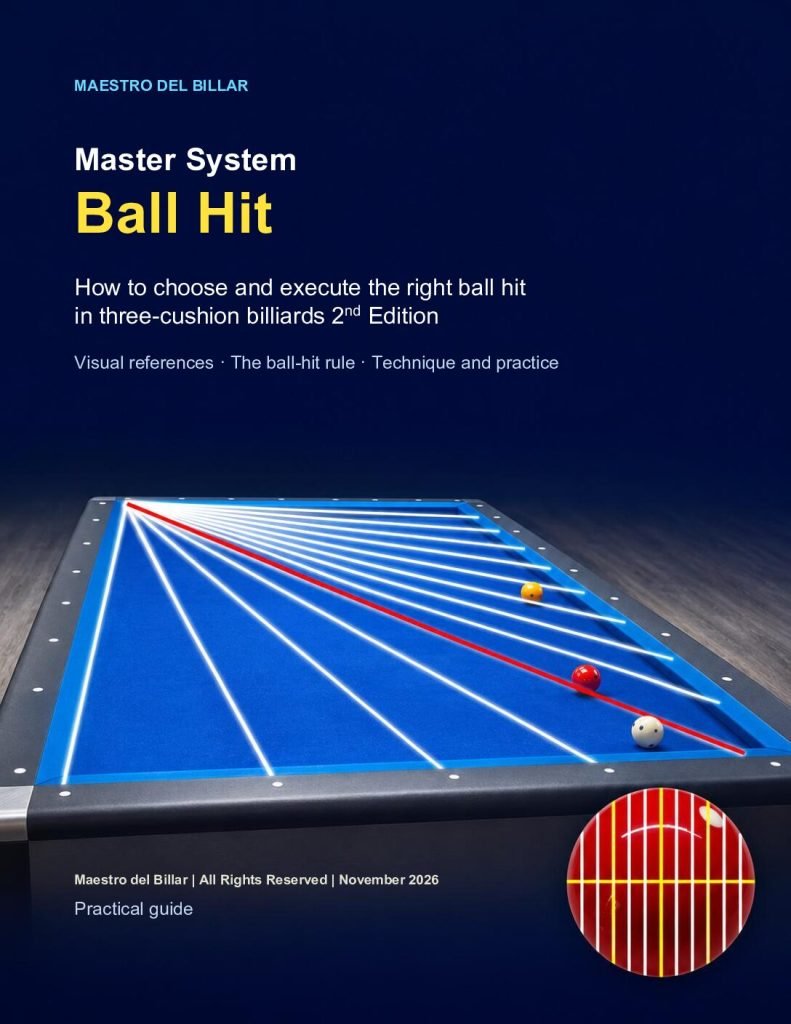
Even when you can read the path of a carom, one decision shapes the shot: how much of the object ball to hit to send the cue ball along that path. This guide shows how to read the key reference points, judge the thickness of the hit, aim with your cue, play feather-thin contacts, and use the reflections and shadows on the balls and cloth.
Classic System
Before getting into the details, let’s quickly recall the numbering and formula of the classic system.

In the position shown on screen, to arrive at 30 on the third cushion, departing from value 60; we aim at value 30 on the first cushion.
System Departing from the Long Rail
In the following diagram, we have a position that can be solved by playing follow into the cushion off the red ball and doubling the long rail.

To determine the arrival on the fourth cushion, and validate if the shot makes sense; we use the following procedure.
First: We determine the point on the cushion where our cue passes, when aiming at ball 2, in this case the red ball. The continuous black line represents the direction of our cue.
Second: When our cue passes over the long rail, the departure point increases by 2 diamonds; as shown by the white arrow on the long rail.
Third: We determine the aim value by drawing a line from the departure point that passes very close to ball 2. See the dashed black line. Based on the above and using the classic system numbering, our departure value is 45; our aim value is 25, and therefore our arrival value will be 20.
Let’s look at another example:

In this case, we have a typical 40 pattern position, but let’s see how it is solved using the classic system.
By increasing the point on the long rail where our cue passes by 2 diamonds, we obtain a departure value of 60.
Our aim value will be 20, and therefore our arrival value will be 40.
Join Maestro del Billar
Get access to premium Maestro del Billar content, exclusive to members:
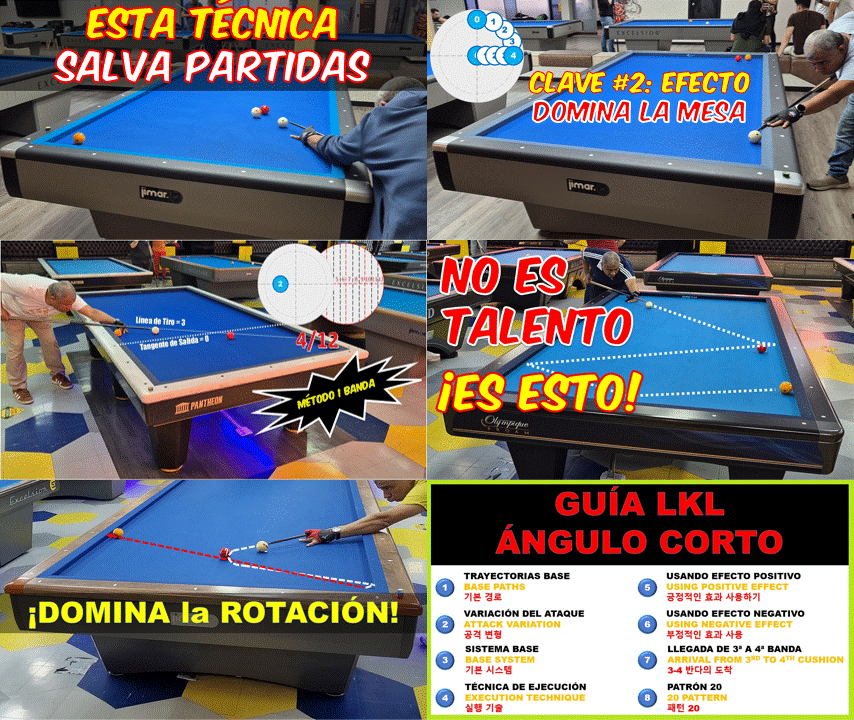
✅Key #7: Ball Hit
✅Speed Plus System
✅Key #6: Exit Tangent
✅Key #5: Shot Line
✅Banana Shot: Complete System
✅Key #4: Parallels
✅Talk with a Sports Psychologist
✅Feather-Thin Hits
✅Key #3: Mirror
✅Key #2: Spin
✅Key #1: Halves
✅Ball Hit for Pass-Ball Shots
✅One-Cushion Method
✅Vertical Pass-Ball System
✅Cross-Table System
✅Master Halves System
✅Vertical Reverse Spin System
✅Rotation Systems and Techniques
✅X-Ray Plus System
✅Short-Angle LKL Guide
System Departing from the Short Rail
And what happens when our cue, when aiming at ball 2, passes by the short rail?

We apply the same procedure, but instead of increasing by 2 diamonds, we increase by 20 points; as shown by the white arrow on the short rail.
In the previous diagram, our cue, when aiming at ball 2; passes by the value 60 of the short rail.
By increasing by 20 points, our starting position will be 80. The aim value is 0, and therefore our arrival value will be 80.
UniBillar: The Billiards University
Explore a wide range of digital billiards resources.
Study at UniBillar, the Billiards University, with leading instructors from Latin America.
José “Pepe” Hernandez, Pedro Gonzalez, Marco Vallejo, Fernando Diaz, Mauricio Gutierrez, Julián Torres, Jaime Carrasco, Carlos Vallejo, Fernando Castillo “El Flaco Billarista”, Rafael Galeano.
