

Maestro del Billar presents ▶ Reverse Spin, Learn how to play with reverse spin, in reverse, off the short or long rail, using spin 1, 2, 3, or 4, in three-cushion billiards.
Reverse Spin – Video
Join The Billiards Master
Access the PREMIUM content of Billiards Master, exclusive for MEMBERS:
✅Key #6: Exit Tangent
✅Key #5: Shot Line
✅Banana Shot: Complete System
✅Key #4: Parallels
✅Chat with Billiards Psychologist
✅Hair Ball Hit Technique
✅Key #3: Mirror Technique
✅Key #2: English
✅Key #1: Halves System
✅Ball Hit for Pass Ball
✅1 Cushion Method
✅Vertical Pass Ball System
✅Cross Table System
✅Master Halves System
✅Vertical Counter Effect System
✅Master Rotation: Systems & Technique
✅X-Ray Plus System
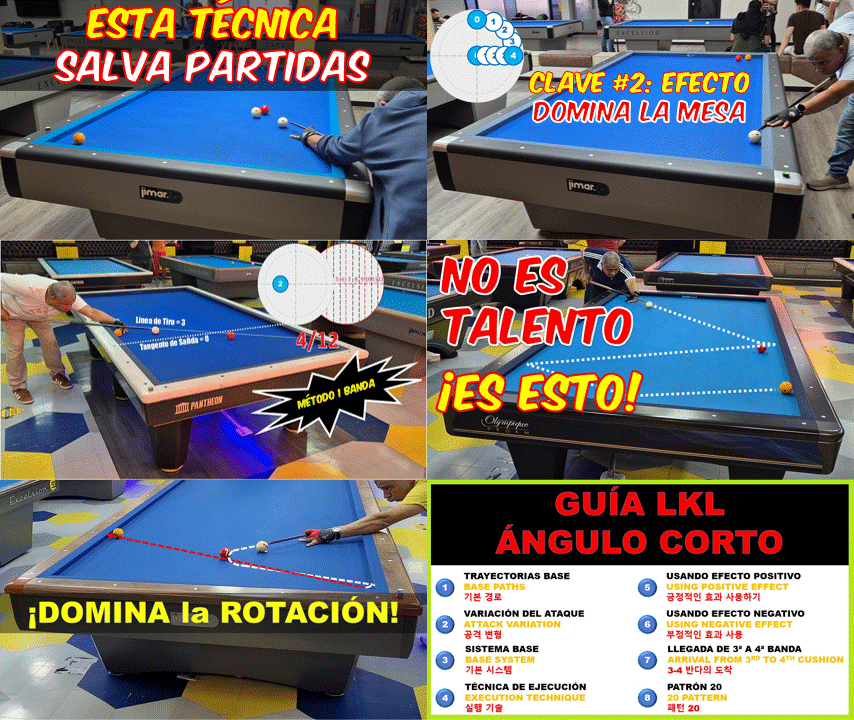
✅LKL Short Angle Guide
Reverse Spin off the Short Rail
Although there are many more options for playing reverse spin off the long rail, it is important to know the basic trajectories when playing reverse spin off the short rail.
Basic Trajectories with Reverse Spin 1 and 2

The basic trajectory diagrammed in the previous graphic shows that when we play with one reverse spin, and with an angle of one diamond inclination. We manage to neutralize the ball, and therefore it will leave without spin and parallel to the long rail.
With this simple concept you can already perform one of the positions shown at the beginning of the video.

The previous diagram shows that when we play with two reverse spins, and with an angle of two diamond inclination. We manage to neutralize the ball, and therefore it will leave without spin and parallel to the long rail.
Execute with a flat cue, a penetrating and extended stroke, and speed upon arrival.
Basic Trajectories with Reverse Spin 3 and 4
We continue with the basic trajectories, playing off the short rail, with spin three and four.
The following base trajectory shows that three opposite spins are not enough to neutralize an angle of three-diamond inclination.

In this case, there is a gain of half a diamond, measured on the second short rail. The ball will leave the second short rail with half of the initial spin.
Execute with a flat cue, a penetrating and extended stroke, and speed upon arrival.
The base trajectory in the following diagram shows that four opposite spins are not enough to neutralize an angle of four-diamond inclination.

And in this case, there is a gain of one diamond, measured on the second short rail. The ball will leave the second short rail with half of the initial spin.
To neutralize an angle of three-diamond inclination, it is necessary to use spin 4. This causes the ball to return parallel to the long rail and leave the second short rail with half of the initial spin.

Korean Systems for Three Cushion Billiards

Fernando Díaz presents a selection of Korean systems applied to 3-cushion billiards, the result of years of research, training and direct validation on the table.
Fernando Díaz is a multiple champion, coach of the main leagues in Colombia and recognized as one of the greatest billiards experts in Latin America.
Opposite Spin via Long Rail
Below we present the base trajectories for opposite spin when playing via the long rail. These paths are very important for knowing the arrival on the second rail and the subsequent calculation for playing 3 or more rails.
Basic Trajectories with Reverse Spin 1 and 2

When playing via the long rail, the base trajectories have the same behavior as when playing via the short rail, but with the following consideration:
The angles of inclination are measured in half-diamonds, as the distance is exactly half.
In this way, half a diamond of inclination has a value of one. And one diamond of inclination has a value of two.

Execute with a flat cue, a penetrating and extended stroke, and speed upon arrival.
Basic Trajectories with Reverse Spin 3 and 4
Now let’s look at the base trajectories, playing via the long rail, with spin three and four.


When playing via the long rail, the base trajectories have the same behavior as when playing via the short rail, but with the following considerations:
First: The angles of inclination are measured in half-diamonds, as the distance is exactly half.
Second: The gains for spins 3 and 4 are measured on the long rail and also correspond to half. This means we will gain 1/4 of a diamond with spin 3, and 1/2 diamond with spin 4.
Third: Spins 3 and 4 are preserved for angles of inclination equal to or greater than 3.
Just as we saw via the short rail, four opposite spins manage to neutralize an inclination angle of value 3.

How to Calculate the Arrival on the Second Rail
Now we will see how to calculate the arrival on the second rail, playing with maximum spin on the long rail.
The following graphical representation shows what happens when we increase the value of the inclination angle relative to the base inclination value of 2 diamonds used for spin 4.

That difference between the values of the inclination angles, which here equals the value of the aim, is doubled and the value of the gain of the base trajectory for spin 4 is added to it, to finally obtain the value of the arrival on the second rail.
In this case, we have an inclination angle of 3 diamonds; the base value of the inclination angle for spin 4 is 2 diamonds; therefore, the difference between these angles is one diamond.
The value of the gain of the base trajectory for spin 4 is half a diamond.
The value of the arrival on the second rail is obtained by doubling the value of the aim and adding the value of the gain.
Given the above, the value of the aim is 10. Doubling it gives a value of 20, and adding the value of the gain, which is 5, results in a value of 25.
How to Calculate the Arrival on the Fourth Rail
Next, we present a technique for calculating the arrival on the fourth rail when playing with maximum spin on the long rail.

The technique for calculating the arrival on the fourth rail combines the value of the arrival on the second rail with the well-known classic system.
The thick, dotted white line connects the departure and aim values in the classic system, used to calculate the arrival value on the fourth rail.
32 minus 15, equals 17.
Execute with a flat cue, a penetrating and extended stroke, and speed upon arrival.
It is suggested to make successive approximations of the aim value on the first rail, adjusting as necessary.
UNIBILLAR: The Billiards University
Access a wide variety of digital billiards content.
Study at UNIBILLAR, the Billiards University, with the best instructors in Latin America.
José “Pepe” Hernandez, Pedro Gonzalez, Marco Vallejo, Fernando Diaz, Mauricio Gutierrez, Carlos Vallejo, Fernando Castillo “El Flaco Billarista”, Rafael Galeano.
