

Maestro del Billar presents ▶ the backward PASONES system, which consists of playing along the long rails, and will allow us to solve a variety of difficult positions and give us more confidence, by providing a guide for playing this family of 3 or 4-cushion caroms.
With this system, you will overcome difficult moments, surprise the audience, and receive a big round of applause!
Backward PASONES System – Video
Join The Billiards Master
Access the PREMIUM content of Billiards Master, exclusive for MEMBERS:
✅Key #6: Exit Tangent
✅Key #5: Shot Line
✅Banana Shot: Complete System
✅Key #4: Parallels
✅Chat with Billiards Psychologist
✅Hair Ball Hit Technique
✅Key #3: Mirror Technique
✅Key #2: English
✅Key #1: Halves System
✅Ball Hit for Pass Ball
✅1 Cushion Method
✅Vertical Pass Ball System
✅Cross Table System
✅Master Halves System
✅Vertical Counter Effect System
✅Master Rotation: Systems & Technique
✅X-Ray Plus System
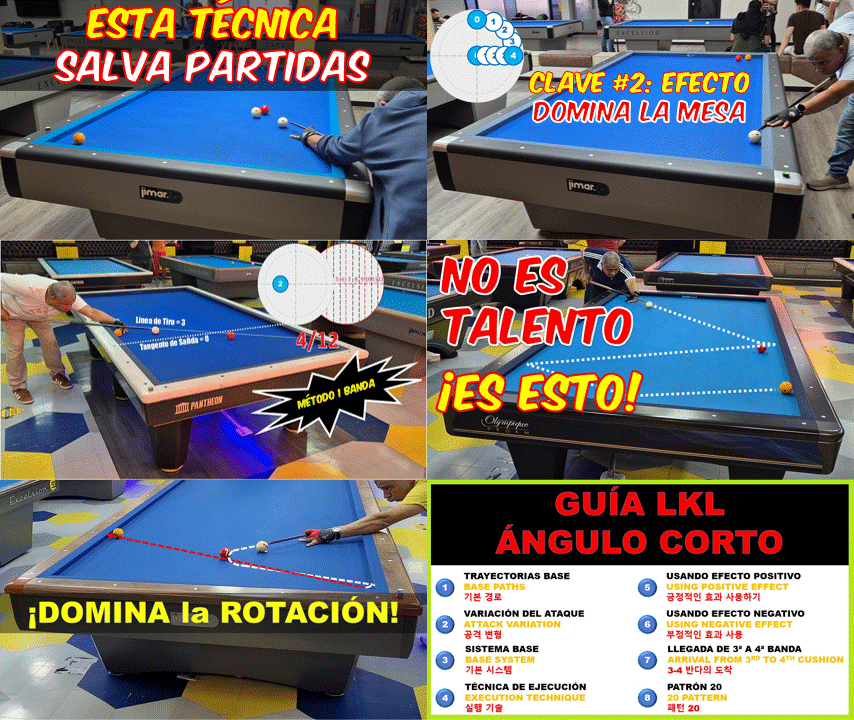
✅LKL Short Angle Guide
Backward PASONES System – Ball Hit
We will present how to define the ball hit, using the 12 parts. technique.
Later, we will see how to calculate and where to apply the spin to use on the cue ball.
Let’s start with the procedure to define the amount of ball to hit.
As mentioned previously, this system uses the 12 parts technique. This consists of dividing the object ball into 12 equal parts.
The amount of ball to hit is defined by the angle of inclination, measured in diamonds, between balls 1 and 2.

In the example shown in the previous image, the angle of inclination between the white and red balls is 3 diamonds.
Therefore, the value of the ball hit will be 3, which corresponds to the red shaded section.
Backward PASONES System – Spin to Use
Let’s continue with the method to calculate, which shows us where to apply the spin to use on the cue ball.
The value of the spin to use is obtained by subtracting the value 2 from the angle value, and adding the arrival value on the second rail.

Following the previous example, we have an angle value of 3, and an arrival value on the second rail of 1.
By applying the formula shown in the image, we will have a result of 2.
An angle value of 3, minus the value 2, gives a result of 1, plus an arrival value on the second rail of 1, gives a total of 2.
2 = 3 – 2 + 1.
The chart shows the arrival values on the second rail, and where to apply on the cue ball, the different spin values.
Korean Systems for Three Cushion Billiards

Fernando Díaz presents a selection of Korean systems applied to 3-cushion billiards, the result of years of research, training and direct validation on the table.
Fernando Díaz is a multiple champion, coach of the main leagues in Colombia and recognized as one of the greatest billiards experts in Latin America.
And how do I determine the arrival value on the second rail?
The arrival point on the second rail is equivalent to one-third of the distance in diamonds between balls 2 and 3 when playing to four rails.
Or, half of the distance between balls 2 and 3 when playing to three rails.

Use of Parallels

In this case, we use a parallel, as shown by the black dotted line, to more easily calculate the value of the angle between balls 2 and 3.
Variation of Ball Hit and Spin

In this particular example, we decrease the value of the ball hit and increase the value of the spin.
Since the value of the angle is 3, the value of the ball hit should also be 3 and according to the system formula, the value of the spin should be 2.
For each point of variation in the value of the ball hit, we must vary the value of the spin by 2 points.
Therefore, the graph shows a ball hit value of 2 (-1) and a spin value of 4 (+2).
This variation can be used to obtain a better arrival trajectory toward ball 3.
UNIBILLAR: The Billiards University
Access a wide variety of digital billiards content.
Study at UNIBILLAR, the Billiards University, with the best instructors in Latin America.
José “Pepe” Hernandez, Pedro Gonzalez, Marco Vallejo, Fernando Diaz, Mauricio Gutierrez, Carlos Vallejo, Fernando Castillo “El Flaco Billarista”, Rafael Galeano.
