

We present ▶ the technique of the Cacharrera system (Reverse Backout system) for playing three-cushion caroms of the long rail, ball, short rail, and repeat long rail type. We explain how to calculate the aim when departing from the short or long rail, with the object ball close to or far from the second rail.
Cacharrera System Video
Join The Billiards Master
Access the PREMIUM content of Billiards Master, exclusive for MEMBERS:
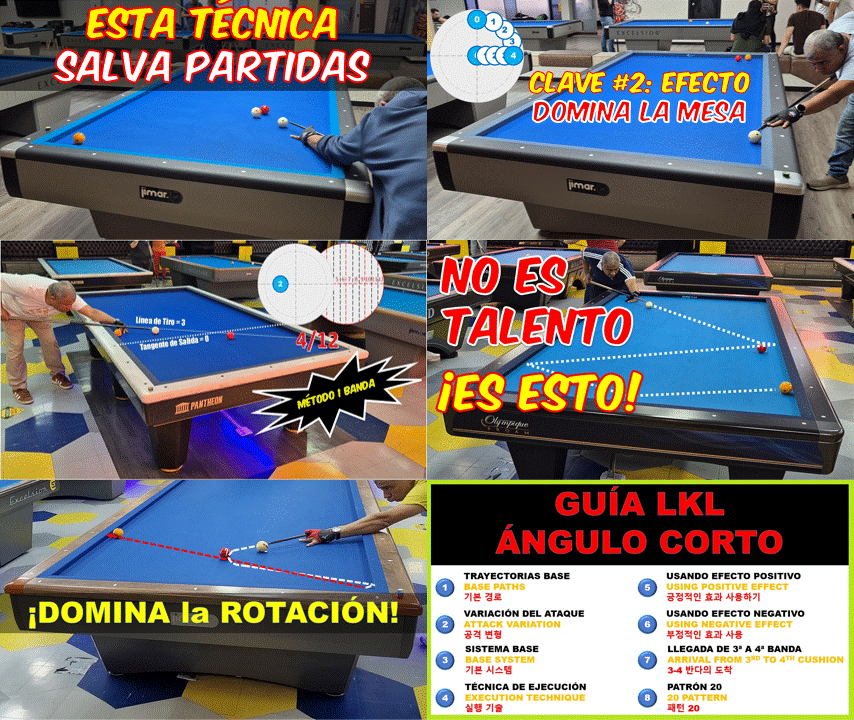
✅Key #6: Exit Tangent
✅Key #5: Shot Line
✅Banana Shot: Complete System
✅Key #4: Parallels
✅Chat with Billiards Psychologist
✅Hair Ball Hit Technique
✅Key #3: Mirror Technique
✅Key #2: English
✅Key #1: Halves System
✅Ball Hit for Pass Ball
✅1 Cushion Method
✅Vertical Pass Ball System
✅Cross Table System
✅Master Halves System
✅Vertical Counter Effect System
✅Master Rotation: Systems & Technique
✅X-Ray Plus System
✅LKL Short Angle Guide
Cacharrera System (Reverse Backout)

Although the Cacharrera system is useful for the most common positions of this type of carom, we need to have an alternative for the following cases:
- We depart from the long rail
- The object ball is far from the second rail (short rail)
- The aim is greater than 40
Essence of the Cacharrera system
The Cacharrera system, like all rail-first systems to one rail (bank shot), has its origin in the Unequal Halves system
Let’s validate the above with a couple of examples:

If we perform the following calculation: 8 / (3 + 1) = 2. We obtain the value 2, which matches the corresponding departure value of the Cacharrera system.

If we perform the following calculation: 8 / (4 + 1) = 1.6. We obtain the value 1.6, which is very close to the corresponding departure value (1.5) of the Cacharrera system.
The departure values (1.5, 2, 3, 4) of the Cacharrera system are approximate abbreviations to facilitate the calculation of the aim, as the formula of the Unequal Halves system is somewhat complicated to perform.
Korean Systems for Three Cushion Billiards

Fernando Díaz presents a selection of Korean systems applied to 3-cushion billiards, the result of years of research, training and direct validation on the table.
Fernando Díaz is a multiple champion, coach of the main leagues in Colombia and recognized as one of the greatest billiards experts in Latin America.
And the opposite spin?
Does opposite spin modify the angle of reflection on the first rail?
The opposite spin alters the angle of reflection on the first rail; however, that alteration is very minimal for angles of incidence less than 30 degrees. For angles of incidence of 30 degrees or more, we compensate by decreasing the aim by 2/10 of a diamond.
And how do we measure a 30-degree angle?

We use the rails as if they were the sides of a right triangle. The following rail values form triangles with a 30-degree angle:
- 5 and 3
- 4 and 2.4
- 3 and 1.8
- 2 and 1.2
- 1 and 0.6
- Any multiple of the previous combinations!
Departures from the long rail

In the previous diagram, we must assume that we move the departure rail 2 diamonds closer to the arrival rail (second rail), which is why we change the 8 to 6 in the formula.
6 / (4 + 1) = 1.2
DEPARTURE x 1.2 = 4 x 1.2 = 4.8
ARRIVAL x 1.2 = 1 x 1.2 = 1.2
Observe that we obtain the same aiming point whether we count from the departure rail (4.8) or from the arrival rail (1.2), since 4.8 + 1.2 = 6.
Here we aim at 1 instead of 1.2, to compensate for 2/10 the alteration of the reflection angle caused by the opposite spin.
A good approximation and easier to calculate is the following:

Ball 2 far from the second rail

In the previous diagram, we must assume that we move the arrival rail (second rail) 2 diamonds closer to the departure rail, which is why we change the 8 to 6 in the formula.
The calculation of the aim follows the same logic explained for departures from the long rail.
Ball 2 close to the first rail
When Ball 2 is close to the first rail, at a distance of 3 balls or less, it is easier and faster to use the reflected ball technique
When Ball 2 is at a one-ball distance, aim at the inner edge of the rail, directly in front of Ball 2.
When Ball 2 is at a two-ball distance, aim at the diamond directly in front of Ball 2.
When Ball 2 is at a three-ball distance, aim at the outer edge of the table, directly in front of Ball 2.

Conclusion
The unequal halves system, although a bit difficult to calculate, is a very powerful system for various rail-first shots, and we should make the effort to learn to use it and develop the skill to perform small multiplications and divisions.
UNIBILLAR: The Billiards University
Access a wide variety of digital billiards content.
Study at UNIBILLAR, the Billiards University, with the best instructors in Latin America.
José “Pepe” Hernandez, Pedro Gonzalez, Marco Vallejo, Fernando Diaz, Mauricio Gutierrez, Carlos Vallejo, Fernando Castillo “El Flaco Billarista”, Rafael Galeano.
