

We present a simple and practical three-cushion billiards system for executing ZIGZAG caroms. We show how to use the zigzag system playing off the long rail (LLK) and playing off the short rail (KKL)
ZIGZAG System off the Long Rail
Formula for the ZigZag System off the Long Rail

In the previous graph, we see how to calculate the aiming points for arrivals at the third cushion. This system is played without spin and is quite precise for departures up to the 4th diamond.
Calculation procedure:
First: Determine the arrival point on the third cushion; in this case, the image shows a value of 6.
Second: The aiming point is obtained by multiplying the departure value by the arrival value on the third cushion. The image shows a departure of 4 and an aiming point of 24 = 4 x 6.
Video of the ZigZag System off the Long Rail
Join The Billiards Master
Access the PREMIUM content of Billiards Master, exclusive for MEMBERS:
✅Key #6: Exit Tangent
✅Key #5: Shot Line
✅Banana Shot: Complete System
✅Key #4: Parallels
✅Chat with Billiards Psychologist
✅Hair Ball Hit Technique
✅Key #3: Mirror Technique
✅Key #2: English
✅Key #1: Halves System
✅Ball Hit for Pass Ball
✅1 Cushion Method
✅Vertical Pass Ball System
✅Cross Table System
✅Master Halves System
✅Vertical Counter Effect System
✅Master Rotation: Systems & Technique
✅X-Ray Plus System
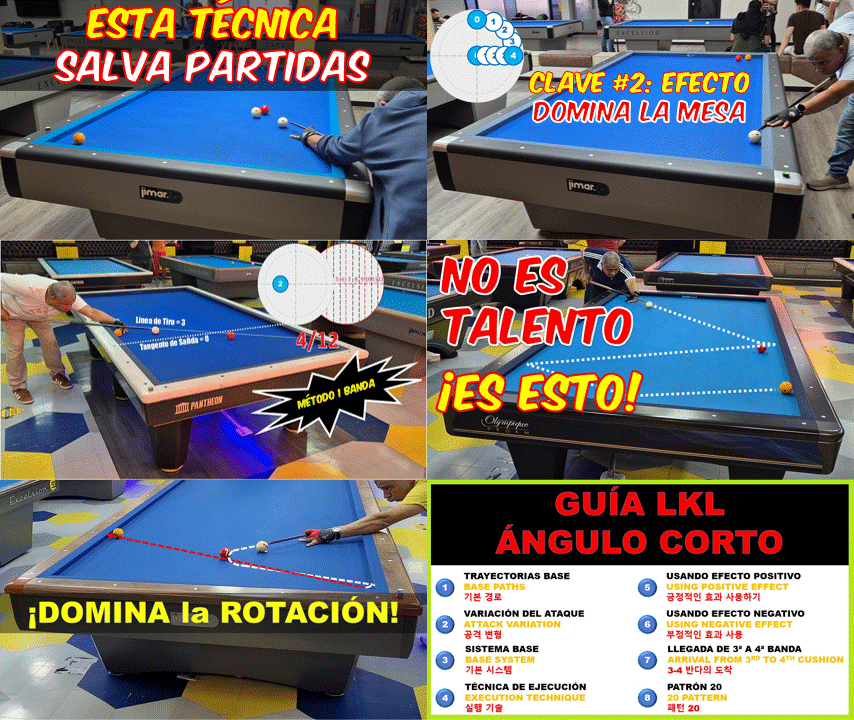
✅LKL Short Angle Guide
Essence of the ZIGZAG System

In a previous post “Spin, angles, and systems in billiards“, we explained the origin of the mathematical expression Dr/Di+Dr, which is very useful in the research of systems in three-cushion billiards. On this occasion, we use it to calculate the arrival values on the third cushion (5.5, 6, 6.5, and 7) of the zigzag system. To reduce the use of decimals, we have multiplied x 10 the arrival and aiming point values.
In this system, we also use the mirror theory to find the reflection points of the arrivals on the third cushion on the imaginary extension of the short rail.
Video of the mirror theory
We explain the concept of the mirror or ghost ball, how to use it, and some calculation formulas.
Korean Systems for Three Cushion Billiards

Fernando Díaz presents a selection of Korean systems applied to 3-cushion billiards, the result of years of research, training and direct validation on the table.
Fernando Díaz is a multiple champion, coach of the main leagues in Colombia and recognized as one of the greatest billiards experts in Latin America.
ZIGZAG System off the short rail

In the previous graph, we see how to calculate the aiming points for arrivals at the third cushion. This system is played without spin.
Calculation procedure:
First: Determine the arrival point on the third cushion; in this case, the image shows a value of 6.5.
Second: The aiming point is obtained by multiplying the departure value by the arrival value on the third cushion. The image shows a departure of 2 and an aiming point of 13 = 2 x 6.5.
ZigZag System off the short rail, departing from the long rail

In the previous graph, we see how to calculate the aiming points for arrivals at the third cushion, but departing from the long rail. This system is played without spin.
Calculation procedure:
First: Determine the arrival point on the third cushion; in this case, the image shows a value of 6.
Second: The aim is obtained by multiplying the value 4 (base departure) by the value of arrival on the third rail, and to the result obtained (24) we add the value of the adjustment (5), according to the departure point. The image shows an adjustment value of 5 and an aim of 29 = 4 x 6 + 5.
UNIBILLAR: The Billiards University
Access a wide variety of digital billiards content.
Study at UNIBILLAR, the Billiards University, with the best instructors in Latin America.
José “Pepe” Hernandez, Pedro Gonzalez, Marco Vallejo, Fernando Diaz, Mauricio Gutierrez, Carlos Vallejo, Fernando Castillo “El Flaco Billarista”, Rafael Galeano.
