
Have you ever felt trapped, as if there were no solution in sight? Where the shot seems impossible, and you think: “I couldn’t solve this even on my best days”. Well today, using the piqué technique, I will show you that those are the situations that can turn you into the star of the table.

In this video, you will learn how to execute 3 fantasy caroms that, although impressive, are not as difficult as they seem. With a small piqué or a touch of semi-massé, you will be able to escape from almost impossible positions, surprise your opponent and, best of all, win the applause of the audience.

Are you ready to discover the secret behind those magical shots that seem on another level? Then, stay with me, because this is going to transform you as a player.

Let’s begin!
Join The Billiards Master
Access the PREMIUM content of Billiards Master, exclusive for MEMBERS:
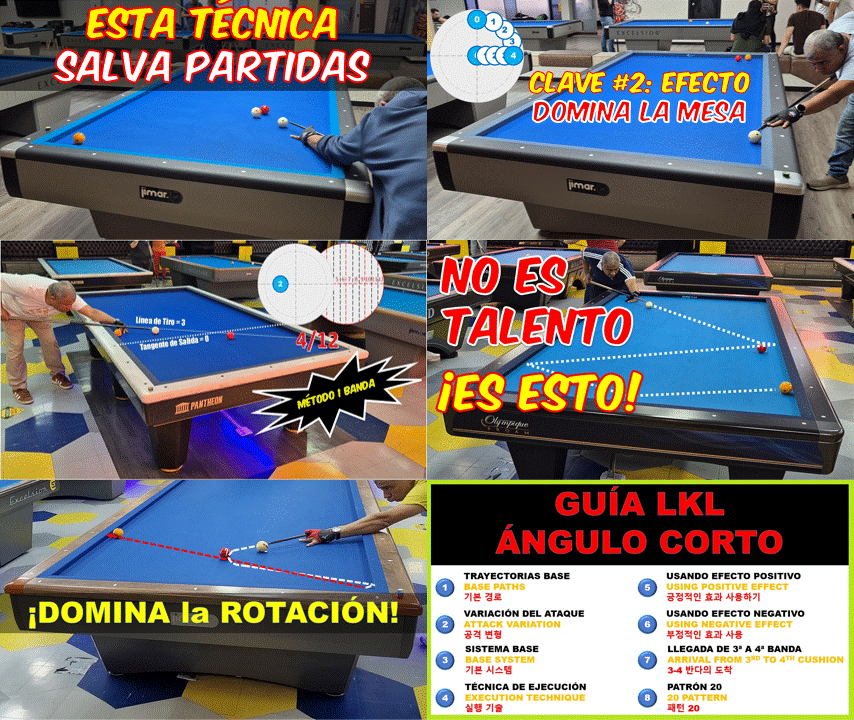
✅Key #6: Exit Tangent
✅Key #5: Shot Line
✅Banana Shot: Complete System
✅Key #4: Parallels
✅Chat with Billiards Psychologist
✅Hair Ball Hit Technique
✅Key #3: Mirror Technique
✅Key #2: English
✅Key #1: Halves System
✅Ball Hit for Pass Ball
✅1 Cushion Method
✅Vertical Pass Ball System
✅Cross Table System
✅Master Halves System
✅Vertical Counter Effect System
✅Master Rotation: Systems & Technique
✅X-Ray Plus System
✅LKL Short Angle Guide
Piqué Technique and Spin Marking
Now that you know these fantasy caroms, it’s time to dive into one of the most important secrets for executing them with precision: spin marking.

In this type of shot, we take advantage of the proximity to the rail to generate a cushion double, and this is where the spin does all the magic. The key is to mark the spin slightly below the equator of the ball, always on the same side where the rail is located.

For example:
If the rail is to your right, mark the spin to the right.

If the rail is to your left, mark the spin to the left.

This simple yet powerful detail is what allows the ball to take the necessary turn to return to the rail and continue the path toward the carom.
Now tell me: have you tried this type of marking before, or did you think it was more complicated? Leave a comment with your experience and let’s keep learning together.
Korean Systems for Three Cushion Billiards
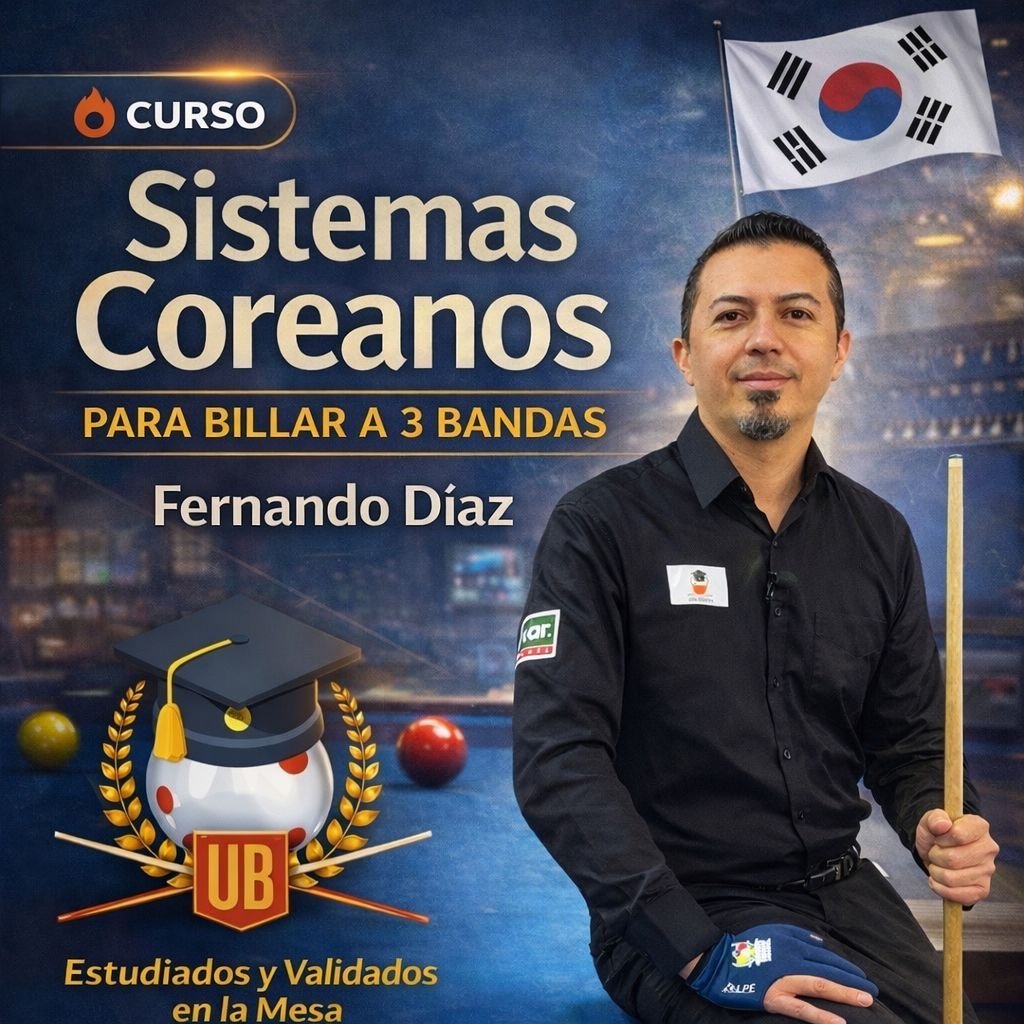
Fernando Díaz presents a selection of Korean systems applied to 3-cushion billiards, the result of years of research, training and direct validation on the table.
Fernando Díaz is a multiple champion, coach of the main leagues in Colombia and recognized as one of the greatest billiards experts in Latin America.
How Much to Elevate the Cue in Piqué Shots?
To master these fantasy caroms, there is a technical detail we cannot overlook: cue elevation. And to understand it better, let’s think about something very simple and familiar: a square.

We know that a square has 4 equal sides and that its angles are right angles, of 90 degrees. Now, if we draw a diagonal inside that square, we divide it into two right triangles. What is special about these triangles? That in addition to the right angle, they have two equal sides and two angles of 45 degrees.

Why is this important? Because in these fantasy shots, we will elevate the cue to approximately 45 degrees. That elevation is the key for the spin combined with the piqué or semi-massé to have the precision we need.

Remember: the elevation should not be too steep or too flat. Aim for those 45 degrees and you will see how the ball responds exactly as you need it to.

Do you dare to try it? Adjust the angle of your cue, test what you have learned, and be surprised by the results. Let’s go for the next shot!
How to grip the cue when playing piqué or massé caroms?
Another fundamental aspect we must address: the way to grip the cue when playing piqué or massé caroms. This detail can make the difference between a precise execution and an error in ball control.

When the cue elevation is around 45 degrees or less, it is most advisable to use the normal grip, like the one you are seeing on screen. This type of grip provides enough stability and control for piqué shots with a moderate elevation.

However, in massé shots or when the cue is practically vertical, some advanced players still use the normal grip. But most prefer the technique known as the inverted hand or candle grip.

With the inverted hand technique, we rotate the hand so that the thumb and fingers are in a position opposite to the traditional grip. This allows greater freedom of movement in shots that require an extreme spin, while maintaining stability and precision in the cue elevation.
Do you dare to try it? Leave your comments and share your experience. Let’s keep learning together!
The Stroke in the Piqué Technique
Now that we know the spin to use, the cue angle, and the ideal grip for these shots, it’s time to discuss another key aspect: the stroke in piqué caroms.

To execute these shots with precision, it’s not about hitting hard, but doing so with the correct technique. The secret here is to pinch and penetrate the ball, bringing the cue tip almost to the table’s cloth.
The most common mistake is trying to generate spin with too much power, but in reality, we need the right speed to achieve the point. If we hit too hard, the ball may rebound uncontrollably or lose precision.
On the other hand, a well-executed stroke, with the proper angle and just the right pressure, will make the ball react correctly, double the cushion, and complete the fantasy carom without unnecessary effort.
Remember: in billiards, elegance and precision always trump brute force. So, the next time you attempt a piqué carom, focus on the pinch, the penetration, and speed control.
Try it out and let me know how it works for you! Have you found it easier to master this technique with these tips? Leave a comment and let’s keep learning together.
The Secret of the Piqué Technique: Where to Aim on the First Cushion?
We’ve reached the final chapter, where we’ll reveal a key secret for greater effectiveness with this technique: where to aim on the first cushion? This detail can make the difference between an average shot and a perfect fantasy carom.

The technique is simple but precise. Imagine a ghost ball at a key point in the trajectory, just after doubling the first cushion. From there, we determine the distance between the short cushion of departure and that ghost ball. Then, we divide that distance by three. The result will be our aiming point on the diamond line of the first cushion.
Let’s look at some examples:

In another case, we imagine the ghost ball near ball 2, but now 7 diamonds from the short cushion of departure. We divide 7 by 3, which gives us approximately 2.3. Again, this will be our aiming point on the first cushion.

Finally, in a more advanced position, the ghost ball is between balls 2 and 3, 6.5 diamonds from the short cushion. Dividing 6.5 by 3, we get 2.2, which will be the ideal aiming point on the first cushion.
Remember: the key is to visualize the ghost ball well, calculate the distance, and apply this technique with confidence. With practice, it will become increasingly natural and effective for you.
I hope this method helps you execute your first fantasy caroms successfully. If you enjoyed this content, don’t forget to visit our website, maestrodelbillar.com, to learn more techniques and advanced systems.
Billiards is an art of precision, patience, and creativity. Keep practicing, surprise your rivals, and above all, enjoy every moment at the table. See you in the next post!
UNIBILLAR: The Billiards University
Access a wide variety of digital billiards content.
Study at UNIBILLAR, the Billiards University, with the best instructors in Latin America.
José “Pepe” Hernandez, Pedro Gonzalez, Marco Vallejo, Fernando Diaz, Mauricio Gutierrez, Carlos Vallejo, Fernando Castillo “El Flaco Billarista”, Rafael Galeano.
