
Changing Spin and Follow into the Cushion is a spectacular and rarely studied technique.
Today, I will teach you how to adjust the spin in each case so that you can master this carom and leave all your opponents speechless.
Ready to turn the impossible into the possible? Let’s go!
I assure you that, with the correct hit thickness, spin, and stroke, you will be able to execute it perfectly.
Do you want to learn how to do it? Stay with me and discover the secrets of this magic shot!
Let’s watch the video on changing spin and follow into the cushion.
Join The Billiards Master
Access the PREMIUM content of Billiards Master, exclusive for MEMBERS:
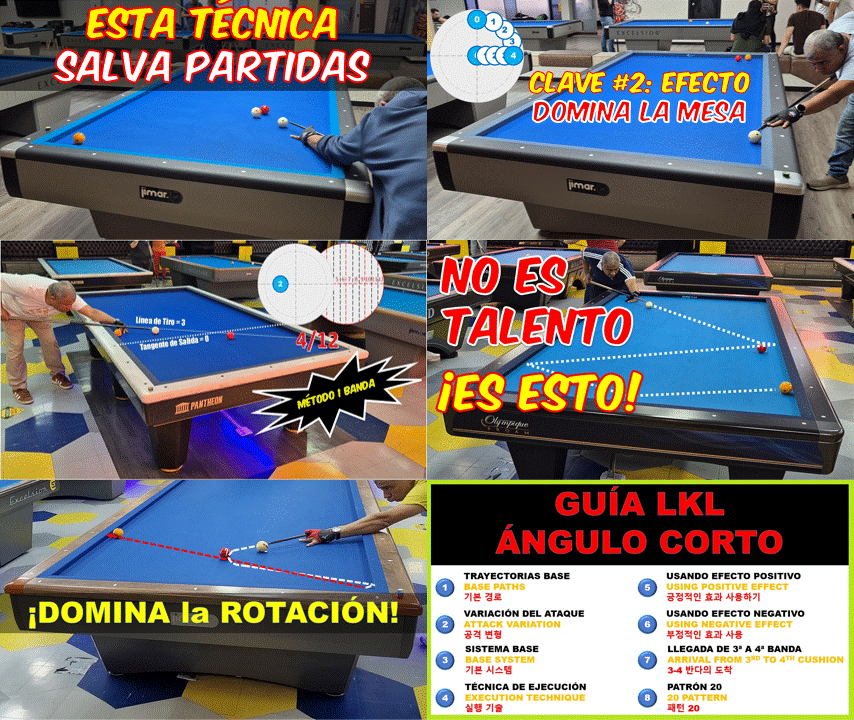
✅Key #6: Exit Tangent
✅Key #5: Shot Line
✅Banana Shot: Complete System
✅Key #4: Parallels
✅Chat with Billiards Psychologist
✅Hair Ball Hit Technique
✅Key #3: Mirror Technique
✅Key #2: English
✅Key #1: Halves System
✅Ball Hit for Pass Ball
✅1 Cushion Method
✅Vertical Pass Ball System
✅Cross Table System
✅Master Halves System
✅Vertical Counter Effect System
✅Master Rotation: Systems & Technique
✅X-Ray Plus System
✅LKL Short Angle Guide
Changing Spin
The technique of changing spin and follow into the cushion in three-cushion billiards allows us to play caroms with a double of the first cushion, using follow spin, no spin, or draw spin. We will see how and when to use each of the following spins:

We represent negative spins in red.
Changing Spin and Follow into the Cushion with Spin 2
Let’s recall a key concept we discussed in a previous video: the 30 pattern. When using Spin 2 follow, our ball will head to the area of the third diamond on the long rail, the fourth cushion.

This reference is fundamental for playing a variety of caroms, as long as ball 3 is located on the arrival line of that trajectory.

Execution Technique
The execution technique for follow into the cushion has four characteristics:

- Cue angle: The cue must be flat and parallel to the playing surface.
- Late grip: Use a grip further back on the cue. This helps the cue tip rise at the end of the stroke, a technique known as an “up stroke.”
- Loose grip: Maintain a loose grip to maximize the cue’s forward travel.
- Penetrating and extended stroke: Execute a deep stroke with good follow-through.
Effect 1 in Cushion Change and Follow into the Cushion
When we use effect 1, the path of our cue ball changes, directing it to the second diamond on the long rail, fourth cushion.

This reference is crucial for adjusting our play and creating precise and surprising caroms.

It is important to remember that for this technique to work perfectly, we must use a penetrating and extended stroke.
What does this mean? It means we must ensure the cue follows a straight and continuous line, striking the ball firmly and maintaining contact for as long as possible.
Korean Systems for Three Cushion Billiards
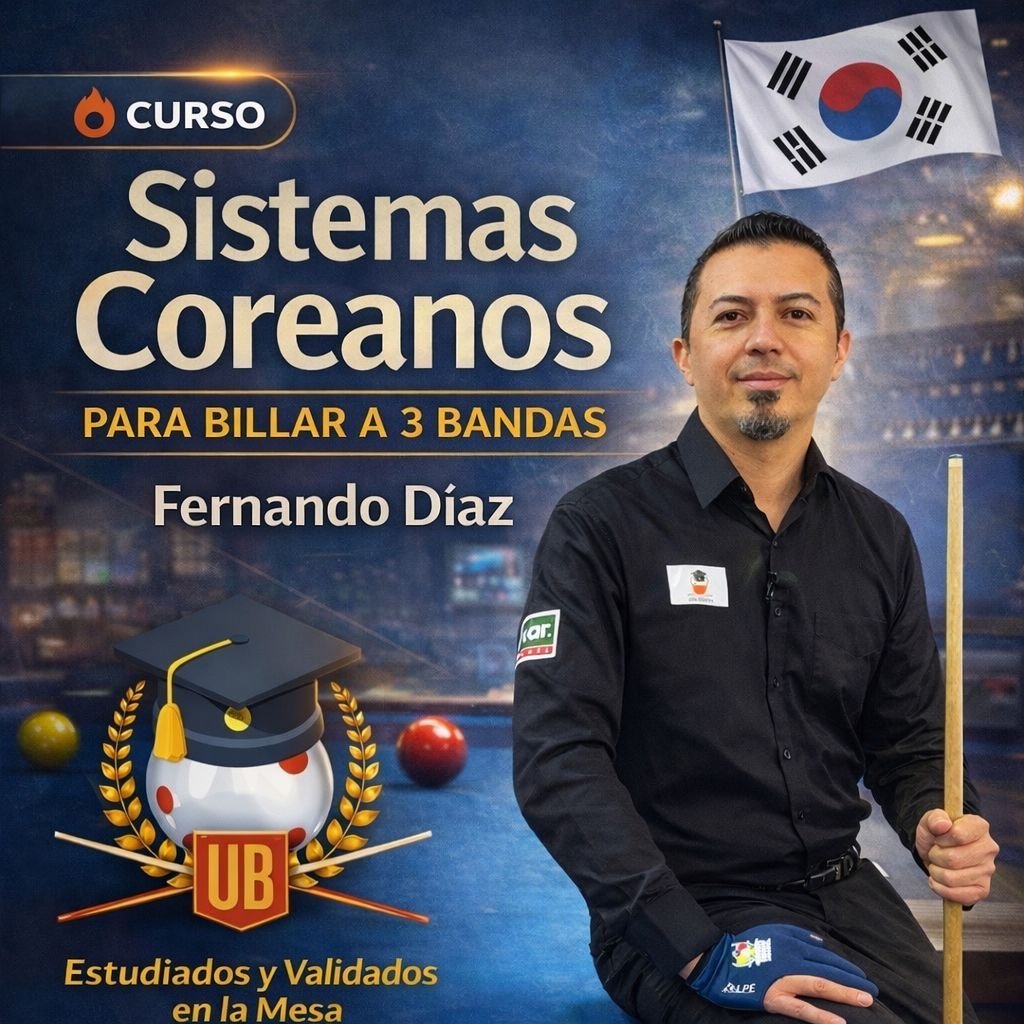
Fernando Díaz presents a selection of Korean systems applied to 3-cushion billiards, the result of years of research, training and direct validation on the table.
Fernando Díaz is a multiple champion, coach of the main leagues in Colombia and recognized as one of the greatest billiards experts in Latin America.
When Playing Without Spin
Now we will explore the path of our cue ball when playing without spin.

When applying zero spin, the ball follows a different path, heading toward the first diamond on the long rail, fourth cushion.

This reference is essential for positions where ball 3 approaches the first cushion, short rail; and complex caroms are set up.

Playing with Negative Effect 1: Cushion Change and Follow into the Cushion
Let’s take another step in our journey, exploring the fascinating world of negative spins.

When applying effect one negative, our ball takes a unique path, returning almost parallel to the short rail.

This technique is incredibly useful, especially when you find ball 3 behind ball 2 and very close to or touching the short rail.
UNIBILLAR: The Billiards University
Access a wide variety of digital billiards content.
Study at UNIBILLAR, the Billiards University, with the best instructors in Latin America.
José “Pepe” Hernandez, Pedro Gonzalez, Marco Vallejo, Fernando Diaz, Mauricio Gutierrez, Carlos Vallejo, Fernando Castillo “El Flaco Billarista”, Rafael Galeano.

Renversé with Negative Effect 2
We are approaching the exciting end of our journey through paths and spins. Now, we will explore negative effect 2 and its incredible possibilities.

When we apply negative effect 2, our ball takes a fascinating path. After performing a renversé on the short rail, the cue ball will go to the first diamond on the long rail, fifth cushion.

This technique may seem complicated, but once mastered, it will allow you to make impressive and precise caroms.
Visualize this: you strike the ball with negative effect 2. The ball performs a renversé on the short rail and then heads toward the first diamond on the long rail.
Practice Makes the Master
Try this technique in your next game and watch how your ball follows that magical trajectory. Practice, adjust, and refine, and soon you’ll see it become a valuable tool in your arsenal as a player of three-cushion billiards.
In conclusion, we have explored together the wonders of spins and paths in billiards, from positive to negative effects. I hope this knowledge helps you improve your game and surprise your opponents with spectacular caroms.
Always remember to practice and experiment. Every stroke is an opportunity to learn and improve.
Thank you for joining me on this journey!
Leave your comments and experiences, and don’t forget to like this if you enjoyed the journey.
Until next time, friends of billiards, and may every carom be a triumph in your game!