

Maestro del Billar presents ▶ the first part of a series of rail and ball systems.
If ball 2 is left close to the long rail, don’t worry; here we show you how to play the carom in three-cushion billiards.
This system is part of the rail and ball systems family.
We will start by looking at how to determine the arrival line from third to fourth rail, when ball 2 is close or very close to the long rail.
Demonstration video
Join The Billiards Master
Access the PREMIUM content of Billiards Master, exclusive for MEMBERS:
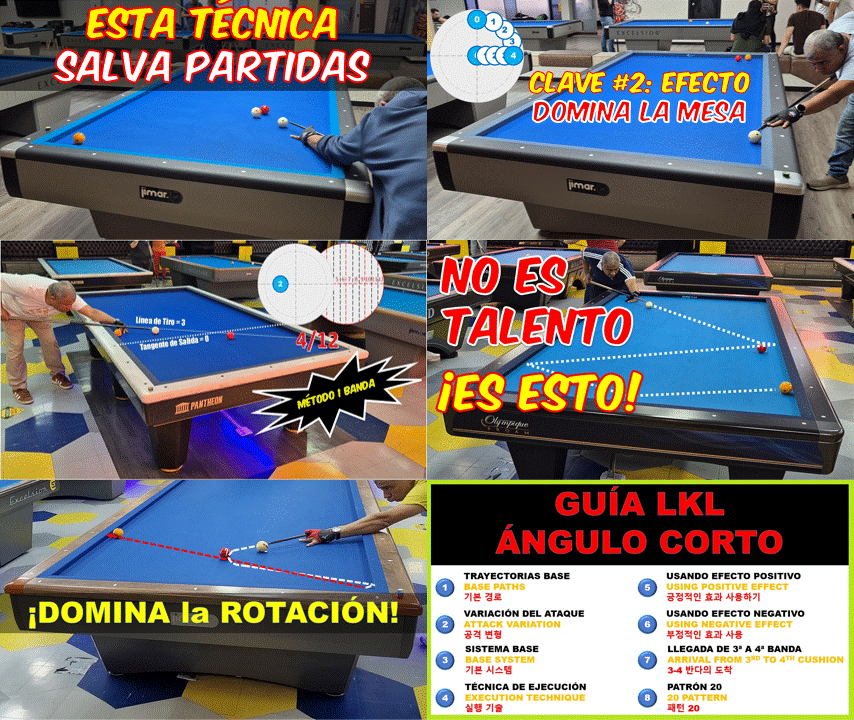
✅Key #6: Exit Tangent
✅Key #5: Shot Line
✅Banana Shot: Complete System
✅Key #4: Parallels
✅Chat with Billiards Psychologist
✅Hair Ball Hit Technique
✅Key #3: Mirror Technique
✅Key #2: English
✅Key #1: Halves System
✅Ball Hit for Pass Ball
✅1 Cushion Method
✅Vertical Pass Ball System
✅Cross Table System
✅Master Halves System
✅Vertical Counter Effect System
✅Master Rotation: Systems & Technique
✅X-Ray Plus System
✅LKL Short Angle Guide
Long Rail and Ball System

The rail and ball system gives us a trajectory reference for ball 1 when ball 2 is close or very close to the long rail, and we play rail and ball.
Ball 1 heads toward the corner and from there to the fourth rail.
The arrival value on the fourth rail is determined by adding the value of ball 2 and the opening value.
Note that the values for the position of ball 2 are separated by 5 points, which makes them easier to remember.
Note that the opening values are separated by 2 points, which makes them easier to remember.
Korean Systems for Three Cushion Billiards

Fernando Díaz presents a selection of Korean systems applied to 3-cushion billiards, the result of years of research, training and direct validation on the table.
Fernando Díaz is a multiple champion, coach of the main leagues in Colombia and recognized as one of the greatest billiards experts in Latin America.
Where to aim?
The aiming point is at the intersection of the rail and ball 2.
Which spin to use?
This system is played with spin 2.
And what about the departure values?
Each departure point for ball 1 corresponds to a position of ball 2, as shown in the image.
Parallel trajectory
What do we do when ball 2 is in a location that does not correspond to the departure point?
When ball 2 is not in the corresponding position, it is suggested to use the parallel trajectory technique. The dotted lines show the trajectory of ball 1 if ball 2 were in base position 32. The solid lines show the parallel trajectory, according to the position of ball 2 shown in the next graph.

UNIBILLAR: The Billiards University
Access a wide variety of digital billiards content.
Study at UNIBILLAR, the Billiards University, with the best instructors in Latin America.
José “Pepe” Hernandez, Pedro Gonzalez, Marco Vallejo, Fernando Diaz, Mauricio Gutierrez, Carlos Vallejo, Fernando Castillo “El Flaco Billarista”, Rafael Galeano.
