

Maestro del Billar presents: how to determine the ball hit and spin to use for playing KLK caroms (classic system backwards) in three-cushion billiards.
The perfect complement to the very well-known classic system!
Classic System Backwards – Video
The classic system backwards is very flexible and POWERFUL, although somewhat difficult, as it allows us to solve a wide variety of very common positions in three-cushion billiards.
At the end, we will see a preview of our next system: “Plus Extended No Spin”.
Don’t miss it!
In the following video, we present the classic system backwards.
Join The Billiards Master
Access the PREMIUM content of Billiards Master, exclusive for MEMBERS:
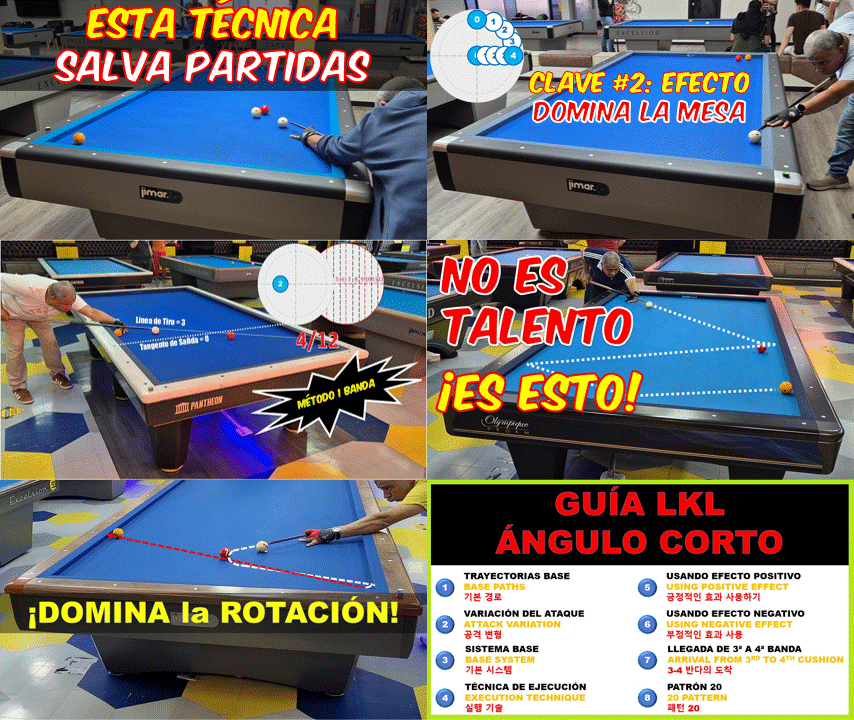
✅Key #6: Exit Tangent
✅Key #5: Shot Line
✅Banana Shot: Complete System
✅Key #4: Parallels
✅Chat with Billiards Psychologist
✅Hair Ball Hit Technique
✅Key #3: Mirror Technique
✅Key #2: English
✅Key #1: Halves System
✅Ball Hit for Pass Ball
✅1 Cushion Method
✅Vertical Pass Ball System
✅Cross Table System
✅Master Halves System
✅Vertical Counter Effect System
✅Master Rotation: Systems & Technique
✅X-Ray Plus System
✅LKL Short Angle Guide
Ball Hit and Spin
This system uses the 12-part technique for the ball hit.
- A quarter ball has a value of 3.
- Half ball has a value of 6.
- Three quarters of a ball has a value of 9.
5 spins are used.
The image on the right shows how to mark each of them.

Formula for the Classic System Backwards
The classic system backwards is a second rail system, as it allows us to determine the ball hit and spin to use to reach a certain point on the second rail.
The basis of the classic system backwards is the diamond angle between balls one and two.
In the image, we have a 4-diamond angle, as shown by the black lines.
Later, we will see how to calculate the value of the different angles.
If we use a ball hit and spin that sum to a total equal to the angle value plus the arrival value, in this case 4 plus 2, that is, 6, we will make ball one head to the corner and complete the carom.

In this example, we have decided to use a ball hit of value 4 and a spin of value 2, but it is valid to use any combination that sums to a total of 6.
When using spins one, two, or three, use a dry stroke or one with little penetration.
When using spins 4 or 5, use a penetrating and advanced stroke.
Korean Systems for Three Cushion Billiards

Fernando Díaz presents a selection of Korean systems applied to 3-cushion billiards, the result of years of research, training and direct validation on the table.
Fernando Díaz is a multiple champion, coach of the main leagues in Colombia and recognized as one of the greatest billiards experts in Latin America.
Angles of value 4
Angles of value 4 are special, as they are 45-degree angles, which occur more frequently and are easier to calculate.
Whenever the sides of the triangle that run parallel to the rails are equal, see the double-arrows in the diagram, we will have a 45-degree angle and its value will be 4.

Let’s look at more examples:
In the following example, the double-arrow are equal, as they measure 3 diamonds, and therefore we have an angle of 45 degrees and its value is 4.

In the next example, the double-arrow are equal, as they measure 2 diamonds, and therefore we have an angle of 45 degrees and its value is 4.

And finally, let’s look at the 1×1 angle, which is also 45 degrees and its value is 4.

How to calculate the value of any angle?
Since we will not always encounter 45-degree angles, let’s look at a formula that allows us to calculate the value of any angle.
The value of the angle is obtained by multiplying the values of the short rail and the long rail, as shown below:

In the previous graph, we show an angle of value 6, which is obtained by multiplying the value 3 of the short rail by the value 4/2 of the long rail.
The ghost table allows us to verify the accuracy of the formula.
How to calculate the value of the arrival on the long rail?
When the arrival is in the corner, it is easy to determine the value of the arrival. But when the arrival, on the second rail, is on the long rail, it is another story.
A formula similar to the one for the angle is used to calculate the value of the arrival on the second rail on the long rail.
The value of the arrival on the second rail, on the long rail, is obtained by multiplying the values of the short rail and the long rail, according to the following image:

In the previous diagram, we show an arrival value of 4, which is obtained by multiplying the value 3 of the short rail by the value 8/6 of the long rail.
The ghost table allows us to verify the accuracy of the formula.
UNIBILLAR: The Billiards University
Access a wide variety of digital billiards content.
Study at UNIBILLAR, the Billiards University, with the best instructors in Latin America.
José “Pepe” Hernandez, Pedro Gonzalez, Marco Vallejo, Fernando Diaz, Mauricio Gutierrez, Carlos Vallejo, Fernando Castillo “El Flaco Billarista”, Rafael Galeano.
